By Mike Hudgins
Most Montanans know Marcus Daly as a copper king who helped shape the state’s early mining economy. Fewer realize he also played a significant role in building a horse racing operation that, for a brief stretch in the late 1800s, put Montana in the thick of American thoroughbred racing.
That story is at the heart of “When Montana Outraced the East,” a new book by historian Catharine Melin-Moser, who recently shared her research during a presentation at the Marcus Daly Mansion. The event drew a crowd of local history enthusiasts eager to hear about a chapter of Montana sports history that has largely faded from public memory.
“They were really interested and asked a lot of questions,” Melin-Moser said. “It was a good turnout and a good presentation.”
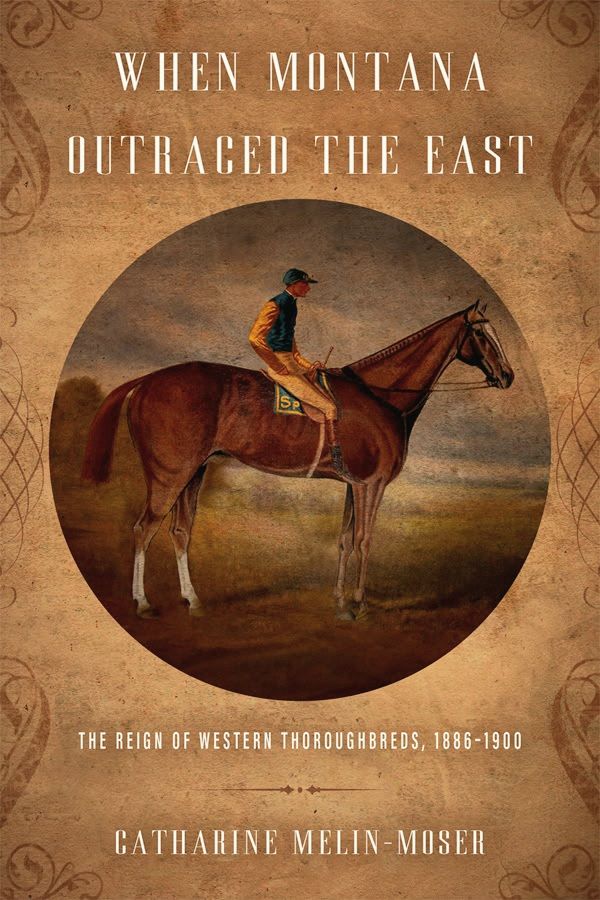
Her work reveals a little-known era when Montana-bred thoroughbreds were not just competitive on the national stage, but dominant in some of the country’s most prestigious races.
The idea for the book began more than a decade ago while she was combing through Montana newspapers from the 1880s and 1890s. She kept stumbling across brief, almost unbelievable references to Montana horses winning major eastern races.
“I’d read snippets of information that told of thoroughbred horses from Montana winning important eastern races,” she said. “Montana was still very much a frontier at that time, and I wondered how all that came to be.”
The answer led her into a story built around three self-made Montana millionaires: Marcus Daly, Samuel Larabie and Noah Armstrong. At a time when Kentucky and Tennessee largely controlled thoroughbred breeding, the men became convinced that Montana offered something different, and potentially better.
They believed Montana’s bunchgrass, wide-open land and high-altitude climate could produce stronger, faster horses capable of competing with the most established bloodlines in the country.
Not everyone was convinced.
“When eastern traditionalists heard about this, they thought they were absolutely nuts,” Melin-Moser said.
Many in the racing world expected Montana horses to be undersized, undertrained and outmatched by animals bred in the long-established racing regions of the East. Instead, Montana began to win.
Between roughly 1886 and 1900, Montana horses emerged as a legitimate force in American racing. One of the most famous victories came when Noah Armstrong’s horse, Spokane, won the 1889 Kentucky Derby. Other Montana-connected horses went on to capture major wins in races such as the Belmont Stakes, the American Derby and the Metropolitan Handicap.
As victories piled up, skepticism among eastern sportswriters and racing officials began to give way to reluctant respect.
“They earned eastern traditionalists’ respect,” Melin-Moser said.
But that kind of success came at a price.
The scale of the operation was enormous for the time. Horses were shipped thousands of miles by rail. Breeding stock was imported from Kentucky, Tennessee, England and South America. Specialized barns, training facilities and rail cars were built to support the growing enterprise.
Marcus Daly alone reportedly invested more than $1 million into horse racing, a staggering sum in the late nineteenth century.
Despite the financial strain, the men continued to invest heavily in the sport, driven by ambition, pride and a desire to prove that Montana could compete on equal footing with the established centers of American racing.
Melin-Moser’s research also uncovered layers of the story that go beyond the owners and the races themselves. One of the most telling shifts she noted was the changing landscape of jockeys during this period.
In the early years of American horse racing, African American jockeys were dominant figures in the sport. As the industry professionalized and prize money increased, white jockeys increasingly displaced them, reshaping the sport by the early twentieth century.
She also found herself drawn to the personalities of both the horses and the people who built their reputations.
“You spend so much time researching these men and their horses, and eventually their personalities come through,” she said.
Some horses were known for late surges from behind. Others preferred to set the pace from the front. One horse, Tammany, developed a reputation for being unusually gentle and affectionate, even around children and dogs.
Though Montana’s dominance in the sport faded after 1900, its influence did not disappear entirely. Several bloodlines developed during this period continued to shape American thoroughbred racing for decades. Horses such as Ben Holladay, Hamburg and Ogden became influential sires whose descendants carried Montana’s legacy forward well into the twentieth century.
For Melin-Moser, that legacy is precisely why the story matters. “It’s such an underrepresented piece of Montana sports history,” she said.
More than a century later, her work aims to restore attention to a brief but extraordinary moment when a handful of Montanans challenged the established racing world and, for a time, beat it at its own game. For fourteen remarkable years, they did exactly that.
Information about Melin-Moser, her book and her history research journey can be viewed at cathymoser.com.