by Mike Hudgins
Just as the morning sun fully settled into the valley, trucks with horse trailers gathered at Larry Creek near Florence, where volunteers were met with shovels, Pulaskis and chainsaws. After a quick exchange of pleasantries and a safety briefing, they split into teams and spent the day doing the kind of work most hikers and riders never see but that almost always benefits them.
This is National Trails Day in earnest.
Held every first Saturday in June and established by the American Hiking Society, National Trails Day highlights the country’s trail systems and the volunteer labor that keeps them functioning. On June 6 at Larry Creek, the event looked less like a celebration and more like a typical maintenance day. For Brad Pollman, a longtime member of the Bitter Root Back Country Horsemen (BR BCH), that was exactly the point.
“It’s pretty much a typical trail maintenance day,” Pollman said. “We’ve maintained Larry Creek for many years.”
Pollman has worked on the project for more than two decades. Larry Creek is one of several low-elevation routes the group relies on each spring. It opens earlier than higher mountain trails, giving riders a place to condition horses after winter while also offering a chance to assess and repair damage before heavier summer use begins. “We use that area in the spring to tune our horses up after they’ve been at winter pasture,” Pollman said. “It lets us ride without damaging the resource.”
Volunteers broke into teams and moved along the trail, clearing brush, cutting back overgrowth and removing downed trees. They also maintained drainage systems designed to move water off the trail before it causes erosion. “We cut back brush that could be a hazard,” Pollman said. “We clear down trees. If they’re too big or too challenging, we work with Forest Service saw crews.”
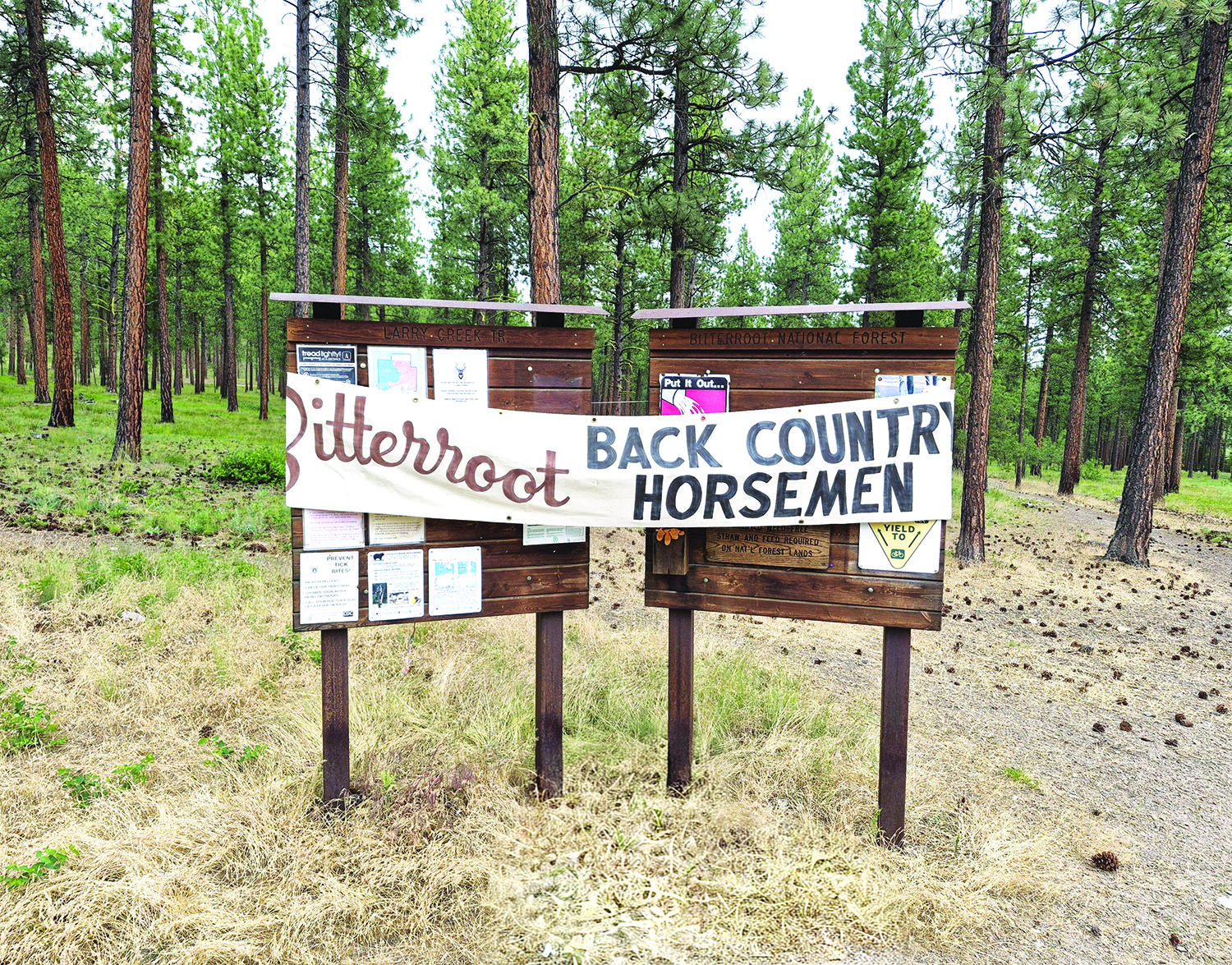
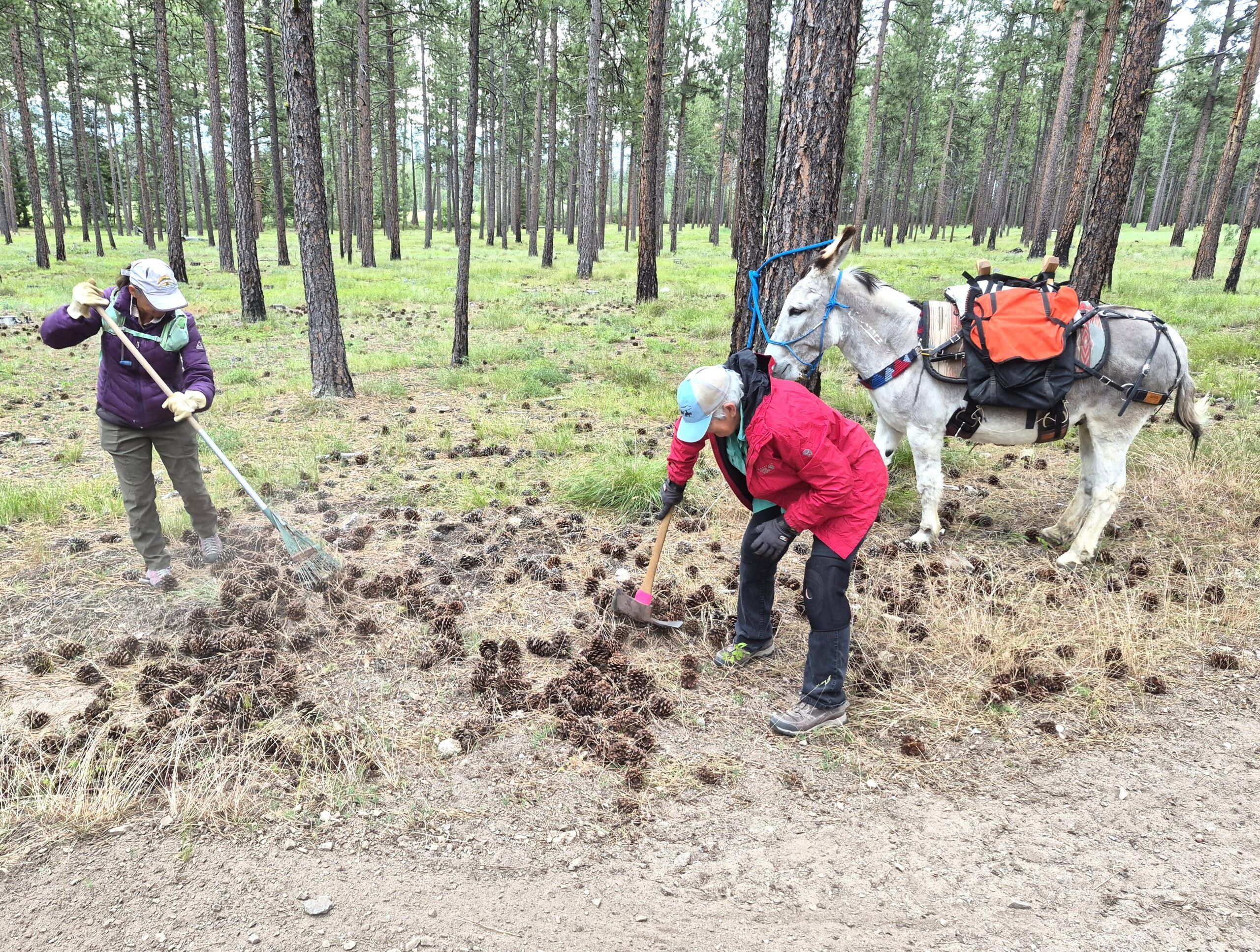
Bitter Root Back County Horsemen members meet at Larry Creek near Florence on June 6 – National Trails Day – to highlight the local trail systems and the volunteer labor that keeps them functioning. Photos by Mike Hudgins.
Water management is a major part of the job. Water bars fill with dirt and debris, forcing water to stay on the trail instead of draining off it. “We clean those out so spring and summer rains can shed off the trail,” he said. “Otherwise, it just erodes it out.”
The BR BCH operates as part of a statewide and national organization that partners with agencies, including the Forest Service and Bureau of Land Management.
“Years ago, we would find out after decisions were made that a trail was going to be closed or changed,” Pollman said. “We thought it was smarter to build a working relationship and be part of the decision-making process.”
That involvement helps quantify volunteer labor, which represents millions of dollars in trail maintenance nationwide. But for volunteers, the impact is more immediate: keeping trails open at all.
“If they get too far gone to where there’s a hazard, the federal government has to shut the trail down,” Pollman said. “Once they’re closed, they’re awful hard to bring back.” Population growth has also shifted use patterns, with more people traveling into the Bitterroot from Missoula and surrounding areas. “That pressure is starting to show up down here,” he said. “Larry Creek is getting hit with it too.”
Addressing that level of trail damage often exceeds what volunteers can handle alone. Larger projects require grants, contracted crews, or agency support. “It depends on the chapter’s abilities,” he said. “Some of it is too physical for our membership now, so we bring in crews to help.”
That aging membership is one of the organization’s biggest challenges. “We’re an aging membership, and it’s hard to get young people involved,” Pollman said. He believes part of the issue is a shift in how people relate to public lands. Earlier generations often came from ranching or farming backgrounds. Today, more users are recreational and less familiar with how trails are maintained. “A lot of people don’t realize how these trails got there or what it takes to keep them there,” he said. “They think they just happen.”
That disconnect is part of why National Trails Day matters. It briefly makes visible the work that is usually invisible. Despite the workload, Pollman said the motivation is simple. “It’s fun,” he said. “You get to see the results and you’re with a good group of people.” That sense of community carries through the workday and into the project’s end, when crews gather for food and conversation at the trailhead.
“You can’t take people out for six or seven hours of work and not feed them,” he said. “When you feed them, they come back.”
As pressure on trails continues to grow, volunteers expect the workload to rise with it. For now, the routine remains the same. Brush gets cleared. Water gets redirected, and trails stay open because people show up to maintain them.
More information about BR BCH and their work is available at bchmt.org/wp/bitterroot/.