by John Dowd
On May 5, candidates for the 2026 election from both sides of the aisle gathered at the Ravalli County Fairgrounds to speak on their distrust of the Sheep Creek Mine project, and to talk about the options the community may have to fight it.
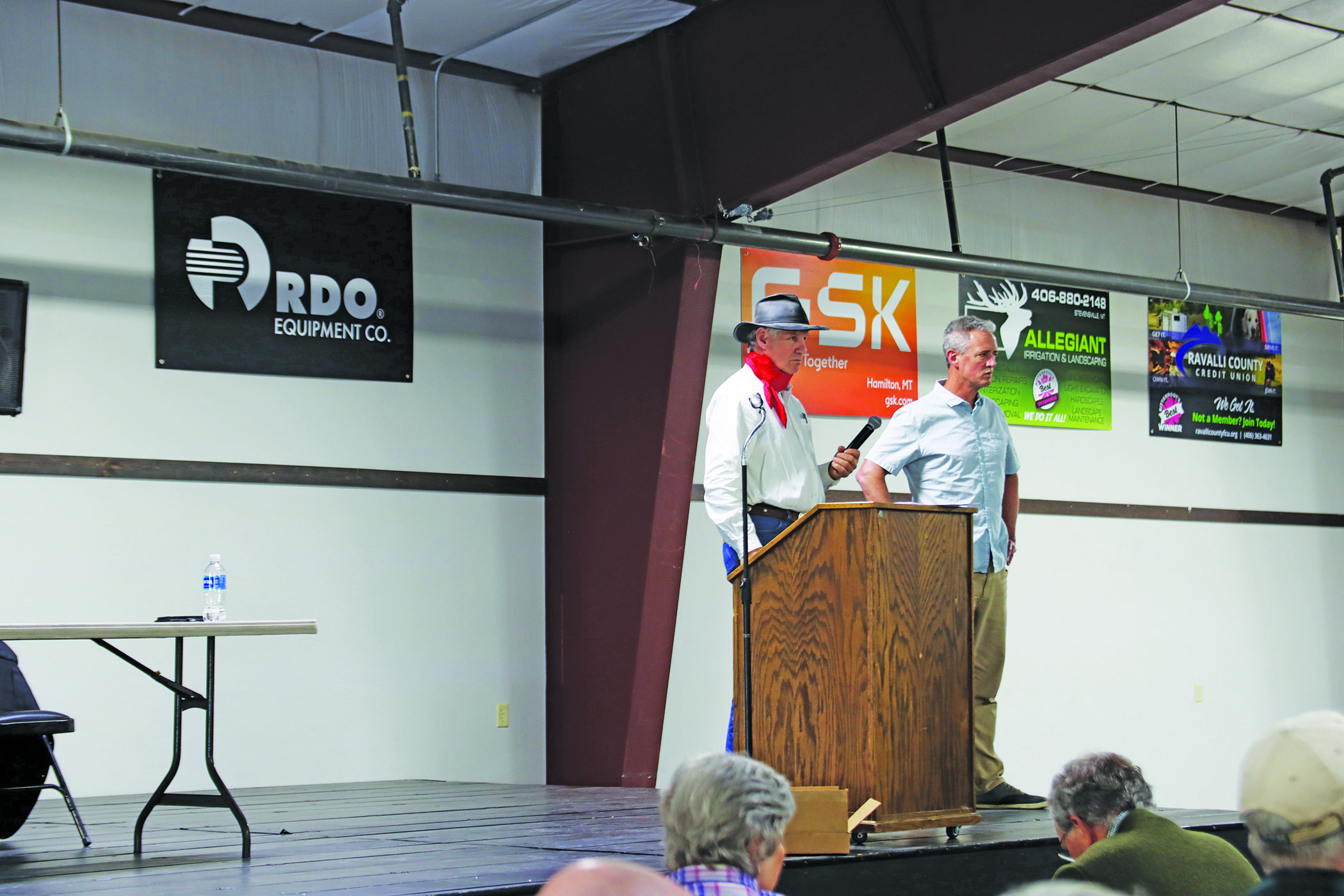
Tony Hudson, a local rancher and active member of the Republican party, organized the event. He gave an introduction, prefacing the event with, “Everything we touch has come out of the ground,” and, “I’m 100 percent for responsible use of natural resources, but I’m 100 percent against the Sheep Creek Mine.”
The meeting was attended by over 100 people, and a majority of the candidates running for Ravalli County seats. Many of the candidates stood to speak on the issue.
The first to speak was Democratic candidate for Montana House of Representatives District (HD) 88, Evan Schroedel who said, “I am vehemently against this sheep creek mine.”
Schroedel said his grandfather was a chief engineer at Berkeley Pit, the infamous superfund site in Butte. Schroedel’s grandfather told them not to turn off pumps but they did it anyway, and Schroedel added that corruption has been constant from the mining companies, as has “rampant misuse of property for mining.”
“I don’t think anybody is advocating that we don’t get the minerals, but we can all agree that this area is too high a risk,” finished Schroedel.
The next to speak was Archie Thomas, a Democratic candidate for HD 86. Thomas described the position he is coming from, as a “rino-crat.” To him, part of the issue with Sheep Creek will be that there is not enough federal man-power to stop it. He stated, “How’s that gonna work with a forest service that’s gutted out? How’s that gonna work with an EPA that’s gutted out?”
He believes we should restore staffing to those groups and ask, “what are they going to do for us, as a community?” He also spoke on how important these local elections are in fighting things like the Sheep Creek Mine. “Everything that’s happening, of any importance, is happening at the community level,” said Thomas. “We have a king that’s having a negative impact on our local community.”Thomas finished, saying, “Talk like a rino-crat, and maybe we can get something done.”
Bill Jones spoke third, as another Democrat. Jones is running for HD 87. He started with some good news, mentioning a potential new Japanese mining venture. Near Minamitorishima Island, the Japanese are conducting deep-sea mining trials to extract critical and rare earth minerals. To Jones, that may hopefully make the prospect of Sheep Creek less appealing to the company, and it may drive the price of these minerals down. “This mine (Sheep Creek) will not be big enough to compete with it,” hoped Jones.
According to Jones, just bringing power up there would be a “multimillion dollar project.” He segued into why this could help the community, as the best solution might be to make things as difficult for the mining companies as possible. One way to do this would be the bonds, which are the money a company puts forward to ensure site clean up.
According to Jones, mining law has not changed since 1880, and this site is on federal land, so there is potentially not much the state can do. It is up to Montana DEQ to issue permits, so, “All the little hurdles we have, we have to use them.”
Kathy Love spoke next, and echoed some of Jones’s thoughts on creating friction in the process. Love is a Republican representative for HD 85, and is running for the Montana State Senate District (SD) 43.
“We’re all against this mine,” said love. “This is not a political issue, this is a Ravalli County issue.”
She agreed with Jones, saying we should “Make the bonding so prohibitive,” that it dissuades the mining companies. Love added that water is a good way to go after them, with water rights and use already big issues in the area. Addressing how the pollutants could flow downstream into the valley may be an avenue to push back with.
Another point raised by Love was that the Montana Constitution guarantees the “right to a clean and healthy environment.” However, she added, “Montana doesn’t exactly have a stellar record with mining.” She also addressed Jones’s point that the site is federal property, saying, “It’s on federal land, but it does affect state and county issues.”
Kim Dailey spoke next. Dailey is a Republican Candidate for HD 85. She did not speak long, but pointed out that the mining company will use roads the county pays for. She attended various meetings where the county has met with US Critical Minerals Corp., the company behind the Sheep Creek Mine proposals, and said it has been confusing, at best. According to Dailey, it started as three acres, then 100 acres. However, the claim area is several square miles. To her, “There are just too many issues with the Sheep Creek Mine and I do not support it.”
Hudson then called Ravalli County Sheriff Steve Holton up to speak. Holton is running for re-election as the sheriff. His comments were also short winded, mainly expressing, “There hasn’t been a single proposal about how we’re gonna support public safety,” from the company. “Everybody here is gonna have to foot that bill,” said Holton.
Matthew Roth, a Ravalli County Commissioner candidate, spoke next. He said the current commissioners have done what they can, but he has another idea. For him, it makes a lot of sense to clean and harvest other mines already created, including superfund sites. He explained that with modern technology, we are finding ways to simultaneously clean sites, as well as collect these critical minerals.
Roth added that these projects will also drive Montanans to those jobs, instead of bringing out-of-state people in to do the research and work. “I have those connections to start that conversation.” Roth finished, saying, “There’s opportunities greater than the Sheep Creek Mine that can help the state of Montana.”
David Bedey stood to speak. Bedey is the HD 86 representative, and is running as a Republican for SD 43. Bedey started with explaining how he approaches this type of issue, being a legislator. To him, that process starts with gathering a lot of information. In his research and inquiries, Bedey said he has discovered that the company has already submitted another proposal, which has not yet become public.
The next step for Bedey is to establish possible legislative actions, which for him would start with enhancing bonding requirements. Specifically, he said they should include language that takes the surrounding area further into consideration. He considers these “off-site risks.” He also said they should work to clarify reasons to deny a permit. Language Bedey described as “unclear” at best.
Bedey also believes those fighting the mine should bring in local stakeholders to the table, including mining organizations like the Montana Mining Association. According to Bedey, mining done irresponsibly will destroy that industry, “which they don’t want.” Bedey closed, saying, “I’m not against mining, but I am pro environmental. I do not believe those two things are mutually exclusive.” And to him, the way the Sheep Creek project has been moving, its interests are not the best for Ravalli County.
After Bedey, an ecologist with MPG Ranch, Dr. Phillip Ramsey, spoke. Ramsey has been a long-time opponent to the Sheep Creek Mine. He started by saying how this series of proposals has been an attempt to “cloak a mining plan as an exploration attempt.” To him, it is all a constant effort that will end up abusing the natural resource and polluting the area. “Do we want to play a game of never-ending wack-a-mole?” said Ramsey. “Montana’s mistrust of mining has been well earned.” For him, this needs to be stopped before other companies come along.
He brought up the idea of prohibitive bonds, and how they are supposed to support site clean up. He said they often do not, an issue known as a “bond Gap.”
“The bonds don’t cover the clean up, we do,” said Ramsey.
Ramsey explained that the area for the Sheep Creek Mine is also difficult to work, steep and dangerous, meaning it would be difficult for there not to be issues, accidents and clean up troubles. “Without bond reform, the company isn’t going to cover it, we will,” and “Mining creates waste by design,” with crushed rock and dust. Ramsey believes it is an inevitable process that all that waste will end up going down stream and polluting the area.
Ramsey believes there are plenty of other old mines, and many new ways to recover critical minerals there. “The right mines of the future will process the waste (from mines) of the past,” said Ramsey.
He finished, talking about how things are backwards. Instead, we should first process minerals that can come from old mines, then reopen old mines and then open new mines “dead last.”
He added, “Don’t pollute the root, let’s go for it in Butte.”
Michael Howell stood to speak, someone who has been covering the Sheep Creek Mines for years with the Bitterroot Star. He commented that there could be something under the “Cultural Heritage Act,” which would preserve hunting and other recreational uses, while outlawing large scale mining operations, such as Sheep Creek Mines. That avenue would need more exploration, but Howell is hopeful because he has seen it work before.
Another candidate then spoke. Michele Binkley was a former representative for HD 85, and is running again for the same seat. Her only comment was, “Without you, we have nothing. We cannot become complacent.” She encouraged everyone in attendance to go out and participate in more of these events, and keep showing up, pressuring the government and local representatives to do something about the Sheep Creek Mine.
The last candidate to speak was Seth Bodner, an independent running for the U.S. Senate for Montana. He said he is concerned about the mine proposal, and its far reaching effects on the state. “This isn’t a Republican issue, this isn’t a Democrat issue, this is a Montana issue.” His last comment was “Thank you for showing up and making your voices heard.”
Tony Hudson closed the forum, warning against Americans for Prosperity, which he believes has interests in the mine. He said to avoid voting for candidates supported by the group, adding, “They have their hooks in them a bit.”
Hudson then spoke about the future of Montana, saying, “Montana’s largest export is its children,” and much of that is due to job insecurity, low wages for comparable work and a lack of housing.
Hudson echoed Ramsey’s words, among others, saying it is imperative to chase this venture of cleaning old superfund sites. “This is a value-creating national enterprise.” He asked that everyone support Montana colleges and institutions that are researching these techniques to process water from legacy mines. For him, it would both solve an ecological problem as well as economic problems. Otherwise, “These mines are going to keep popping up in American rivers.” He does not care if it is in Montana, or somewhere else, “We can stop this.”
Hudson then thanked everyone for attending and said, “We were Americans long before we were Republicans and Democrats,” and that such an issue should not be partisan.