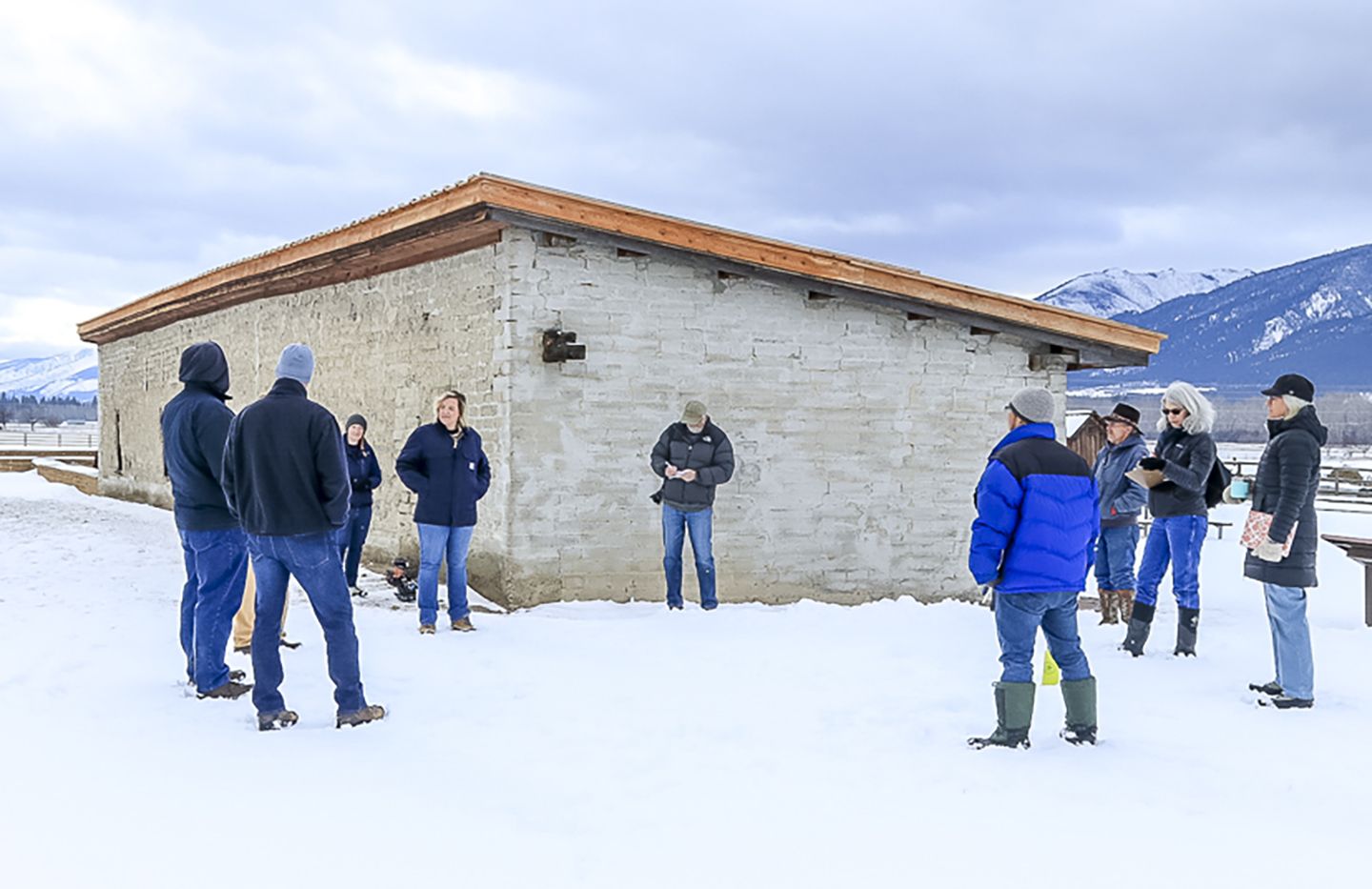
Adobe, a common form of earthen architecture throughout much of the Southwest, is rare in Montana. So rare that the folks working on stabilizing and repairing the East Barracks at Fort Owen State Park in Stevensville, called in an adobe expert to provide them with some insight into the nature and composition of this ancient method of building. It remains unclear as to why adobe was not more commonly used in Montana.
Friends of Fort Owen, a non-profit group whose mission is to preserve and protect Fort Owen State Park, and to help Montana State Parks make the park more accessible, sponsored a talk last week by Alex Lim, an earthen architecture specialist from Nogales, Arizona. The talk was entitled “When Local Soil is Your History – Caring for Earthen Architecture.” Lim’s presentation was a slide show of a variety of adobe applications throughout the world.
“Soil is the most fundamental part,” said Lim. “Soil is everywhere and it’s versatile and forgiving.” He said soil is an insulating material and since it’s everywhere, it’s cheap and plentiful as a building material. He said that soil consists of clay, silt, sand and gravel, and organic matter. And that is what adobe is made of as well, with the addition of water to make it cohesive.
In 1850, John Owen bought the land where Fort Owen sits, and built the fort, which was a major trading post in the region for the next 10 years. The barracks were made of adobe. Today only the East Barracks remain, and with funding from a $500,000 grant to the Montana Parks Foundation, a major historic preservation effort is underway to prevent further deterioration of the building.
Margaret Gorski, president of Friends of Fort Owen, said, “We’ve come a long way in the last two years. We’ve helped get visibility for the state park and helped line up resources to help with access to the park.”
The major grant helped Fish, Wildlife and Parks, which manages Fort Owen State Park, to purchase an acre of land from Myla Yahraus, owner of the ranch that surrounds the park, for a parking lot. The parking lot sits just to the south of the park, and allows room for school buses, which was a problem in the past.
Friends of Fort Owen also received a $9500 grant last year. With part of the money, they held a “mud party” to explore the making of adobe locally, as the exact mixture that was used for the original Fort Owen bricks, and where exactly it came from, remains a mystery.
Maci MacPherson, park manager for Fort Owen, Travelers Rest and Painted Rocks State Parks, said that the plan for Fort Owen this year is to complete the historic preservation work on the East Barracks and then prepare an interpretive plan, something which hasn’t been done since the 1980s. Lesley Gilmore, Historic Architecture Specialist with the Montana Historic Preservation Office, is the consultant for the project. Development of the plan will include meeting with all ages to determine the ways in which people utilize the park, and what their needs and desires are regarding the park.
Lim, a native of Korea, said his father is from a region famous for porcelain and rice, two products that rely on rich soil. His wife is from Mexico, where adobe is still used widely for building. He showed the audience many styles of adobe structures, including some made with bricks, wattle & daub, soil washed over walls, multiple-story buildings such as the Mesa Verde cliff dwellings, and many more.
“There are things that buildings want to tell you,” said Lim. “It’s us that refuse to see it.”