by Michael Howell
The Gold Butterfly Project, a landscape-scale forest management project stretching over 55,000 acres across the Sapphire Front on the eastside of the Bitterroot, has been put on hold by U.S. Magistrate Judge Kathleen DeSoto pending an analysis of the potential adverse impacts on grizzly bears, an endangered species.
The stated purposes of the project were improving landscape resilience to insect and disease, improving landscape resilience to wildfire, providing timber products and related jobs, reducing chronic sediment sources in the Willow Creek watershed, and restoring or improving key habitats.
The project authorizes vegetation treatments throughout the area including 5,281 acres of commercial harvest treatments, which may involve clearcutting lodgepole, commercial thinning, improvement cutting, sanitation harvest and other treatments. Authorized treatments also include 2,084 acres of non-commercial treatments, which may involve maintenance burning, meadow restoration, mechanical fuels treatment, stand-improvement thinning and whitebark pine restoration.
It also authorizes road construction and decommissioning involving approximately 6.4 miles of permanent road and 17.3 miles of temporary road. Decommissioning will encompass approximately 22.3 miles of roads that are no longer needed for future management, and 21.3 miles of Intermittent Stored Service (storage) roads and 16.5 miles of non-system (undetermined) roads.
Bitterroot National Forest officials initiated scoping on the project in June 2017 and issued a Draft Environmental Impact Statement (EIS) in 2018. A Final EIS was issued and the Record of Decision was signed in November 2019. But in August of 2020 the Forest Supervisor withdrew the project and instructed USFS staff to conduct additional review and analysis. It was not until February 2023 that a Final Supplemental EIS was adopted and a Final Record of Decision was signed in August 2023.
In light of new information regarding wolverine and grizzly bears that emerged after the Record of Decision was signed, USFS prepared a Supplemental Information Report (“SIR”) in December 2024 and two Montana grassroots conservation groups, Alliance for the Wild Rockies and Native Ecosystems Council, subsequently filed their complaint in federal court in September 2024.
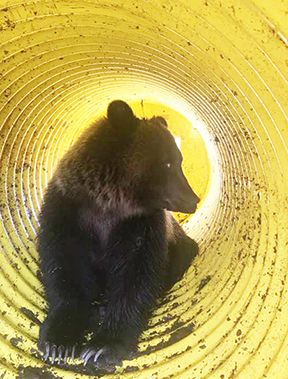
This 249-lb. male grizzly bear was captured at Whitetail Golf Course near Stevensville in 2018 and relocated to the Blackfoot area. Star file photo.
The organizations raised many procedural issues in their complaint concerning alleged violations of the National Environmental Policy Act (NEPA), the National Forest Management Act (NFMA), the Healthy Forest Restoration Act.
Many of the group’s allegations concerning violations of the NEPA process were found in favor of the Forest Service based on another recent ruling, Seven County Infrastructure Coalition v. Eagle County, that was decided while their case was ongoing in 2025. Judge DeSoto notes, “Announcing a ‘course correction of sorts’ for NEPA litigation, the Seven County decision describes a limited judicial role in ‘policing NEPA compliance.’”
“Accordingly, when reviewing an agency’s NEPA analysis ‘[c]ourts should afford substantial deference and should not micromanage those agency choices so long as they fall within a broad zone of reasonableness.’
“That substantial deference extends even to instances where a court may disagree with the agency’s determination of how to limit its NEPA analysis… [E]ven if the reviewing court . . . might think that NEPA would support drawing a different line, a court should defer to an agency so long as the agency drew ‘a reasonable and manageable line.’ The issue of remedy is also encompassed by the Court’s realignment regarding NEPA adjudication. ‘[E]ven if the [agency’s NEPA analysis] drew the line on the effects of separate upstream or downstream projects too narrowly, that mistake would not necessarily require a court to vacate the agency’s approval of the . . . project.’ This new and binding precedent weighs heavily on the adjudication of Plaintiffs’ NEPA claims,” wrote DeSoto.
In a detailed analysis of all the plaintiffs’ claims about violations of the process and issues about project-specific amendments to the Forest Plan concerning elk and old growth management, and deficient EIS analysis in terms of considering alternatives, road densities, etc., Judge DeSoto found in favor of the Forest Service.
One critical issue that DeSoto found, however, that would get the decision remanded and call for a supplemental EIS, was the determination that there would be no adverse impact on grizzly bears. Solito notes a discrepancy between information contained in the Supplemental Information Report (SIR) and the Record of Decision, remarking firstly that the Plaintiffs’ cited a local newspaper report indicating three grizzly bears were present in the Sapphire Mountains in August, 2023. Secondly, that U.S. Fish and Wildlife Service’s updated determination regarding grizzly bears’ presence in the project area. And thirdly, that the March 2024 Supplemental Biological Assessment for Grizzly Bear identified the potential for direct, indirect, and cumulative effects on grizzly bears.
“In effect,” writes DeSoto, “the SIR states that the Record of Decision relied on the conclusion that transient grizzly bears may be present in the Project area. However, the Record of Decision indicates otherwise…on its face, the SIR misrepresents the conclusions and analysis underlying the Record of Decision. The SIR arrives at the conclusion that further NEPA analysis is not necessary. However, that conclusion is based, at least in part, on inaccurate or contradictory recitation of the contents of the record. Accordingly, the SIR, as currently drafted, cannot sustain Defendant’s arguments that no further NEPA analysis is required.” She finds the decision not to engage in additional NEPA analysis to be arbitrary and capricious.
DeSoto declines to vacate the decision entirely, however, she does enjoin the Forest Service from implementing the project and remands it back to the Forest Service for further review, stating, “It is possible that the agency may be able to resolve the errors that the Court has noted with minimal delay and disruption to the Project.”
“The court ruled that the Forest Service violated federal law when it told the public that there weren’t grizzlies in the Sapphire mountains,” said Sara Johnson, director of Native Ecosystems Council, a co-Plaintiff. “Keeping grizzlies safe in the Bitterroot region is the lynchpin to recovery of grizzlies in the lower 48 states,” said Johnson, who has a Ph.D. in wildlife biology and was a wildlife biologist for the Forest Service for 14 years. “This critical area connects the grizzly population in the Greater Yellowstone region with the grizzly bear populations in the Northern Continental Divide, Cabinet-Yaak, and Selkirk regions, thus providing genetic diversity to preclude irreversible inbreeding.”
Mike Garrity, Executive Director of Alliance for the Wild Rockies, also harkened back to a preceding legal victory three years ago when a federal court in Montana ordered the Forest Service to reanalyze the recovery of grizzlies in the region. “On one side, we fought for and won a new analysis that will look at the big picture of Bitterroot grizzly recovery over the whole region; on the other side, we fought and prevailed against a specific project that is trying to move forward as if Bitterroot grizzly bears don’t exist.”
“Most grizzlies are killed within 1/3 mile of a road,” Garrity said. “So, this is great news for Bitterroot grizzly bears since they would be at incredible risk if the Forest Service was allowed to bulldoze even more roads into the project area. This is a win for Bitterroot grizzlies. Without Bitterroot bears, we can never fully recover endangered grizzly bears in the U.S.”