by John Dowd
Something that has been a hot topic for the Town of Stevensville for a long time is water, whether it involves water rights or water use. Because of this concern, the Town of Stevensville Public Works department has been on a mission not only to improve the town water system, but to get to the bottom of leaks and rein in water use.
According to Stephen Lassiter, Public Works Director, water meters are the main interface they have to see how water is being used in and around town. Because of this, looking toward the future, his department is trying an experiment with some new meters.
Lassiter said that in the past, town water meters have always been a big concern. When he first got into the position of director, he made a huge effort to update and change out most of the bad meters.
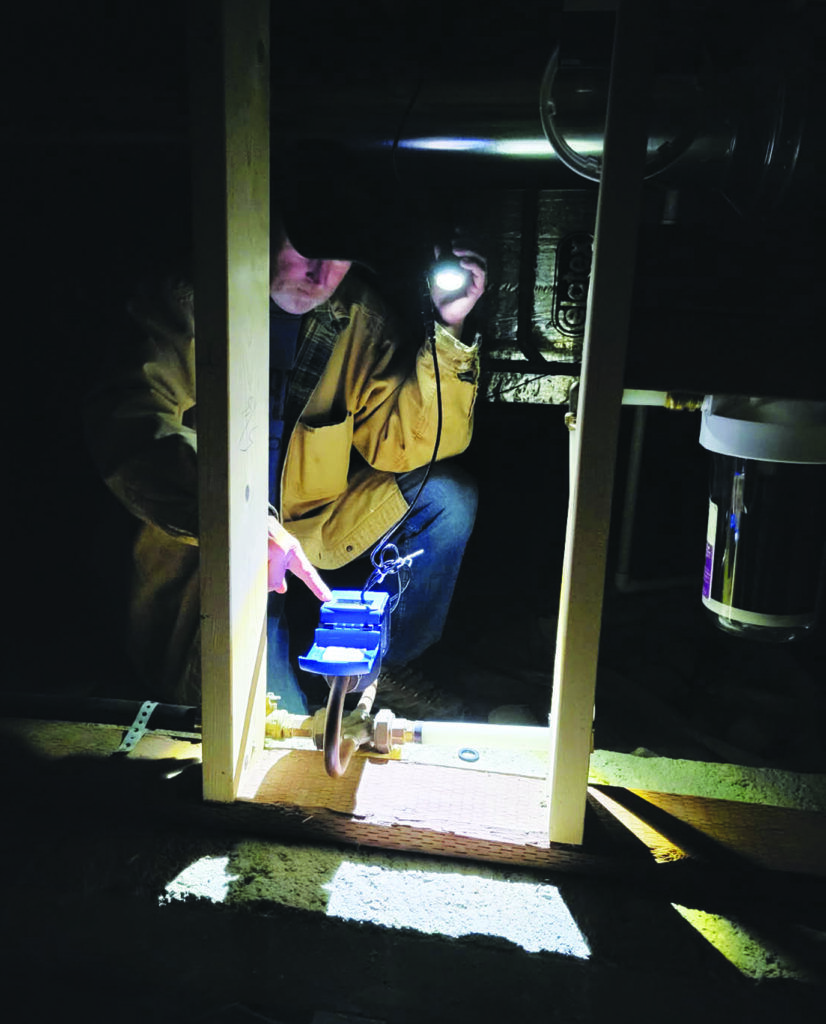
Stevensville Public Works Director Stephen Lassiter checks one of the town’s new meters. Photo courtesy Stephen Lassiter.
Many of those meters were not reading properly, and according to Andrena Case, Stevensville Town Deputy Clerk, there are still about 25 of these problem meters that will not read. Case said without being able to read how much water is being used, the town has only been able to charge these users the base rate. Unfortunately, this is likely for less than they are using, especially during the summer months when yards need watering.
Before the effort over the last few years to replace these meters, there were over 200 meters that would not read properly. Now, most of the meters work as intended. However, Lassiter and Case say there is more they can do. Over the last couple of months, Stevensville Public Works has been trying something new.
The town received five new cellular meters to try out. According to Lassiter, these new “cell meters” are approximately the same cost as their old meters, but come with a few pros and cons.
The first pro is that the new meters cost only about $8 more than the old ones, with the new cellular meters costing $330.15 each, while the old ones cost $321.85. With all the capability these things come with, Lassiter is impressed. “I think they are a good idea, moving forward,” said the public works director.
Lassiter described these meters as “more reliable” than the radio meters which the town currently utilizes. When they say the meters do not read properly, the primary issue they are referring to is that some of the current meters don’t transmit the water use they have seen. This can be either due to the location of the meters, the meter needing to transmit through thick concrete walls, or other inherent flaws in the design.
The cell meters utilize a different cellular signal, which is significantly more reliable. The town currently has about eight of these problem areas where the meters will not transmit properly. Most of these have been replaced at least once. In order to test these new meters, Lassiter took four of the new meters and placed them in four of the eight problem areas. Leaving one in an “easy-to-read-area” as a control, Lassiter is pleased to say all these cellular meters are reading properly, even in the same difficult locations. In one of the worst spots, in a customer’s basement, when Lassiter replaced the old radio meter with a new cellular one, he said, “This cell meter started working as soon as I put it in there.” He further stated that it was in a place where the old one “hasn’t worked in years.”
The first con was described by Case, who explained that in order to enter the readings of these new meters into their billing with their current software, the town would need to pay $710 per year to continue doing both the new and the old meters. The town would need to pay that every year while doing both simultaneously.
To save that money, currently Case manually enters these new meters into the system once a month during the billing cycle to avoid needing to pay that $710. Case added, “We want to avoid paying that as long as we can.”
Case said they are “jumping through hoops right now to make these work.” Once a month, a public works employee drives around town, picking up both the cell and radio meter reading signals. Those readings are returned to Town Hall where Case takes the figures from the cellular meters to enter them. With only five meters, that is not a problem. However, she added that when they start having to manually enter 50 to 100 meter readings, that could become difficult. However, Case said she will “continue doing that until there are too many for it to be feasible.”
Another con is that every cellular meter the town reads costs 95 cents per month. Stevensville has nearly 930 meters scattered around town, including town property, businesses and residential. With just about 900 of them being regular customers, that monthly service fee would be expensive and may need to be passed on to the customer down the road.
One of the most innovative pros is the customer portal capability. This is a program attached to these cellular meters that would allow customers to download an application onto their devices to monitor water use day to day. Though it is not quite instant, Lassiter said it can “allow someone to know how many gallons they are using when they run their sprinklers and maybe turn them down, or tell their kids to stop taking such long showers. This is going to allow the customer more control over their water usage,” meaning superior transparency and complete access to their usage figures. For Lassiter, that would be a powerful tool he would love the community to take advantage of.
The con attached to that would involve the town needing to pay a one-time start-up fee of $10,890 for the system and program setup. And according to Lassiter, that is no matter how many people get the application and take advantage of the customer portal program.
Another pro for the new meters is how they can notify the town of potential leaks immediately. This is especially important, as the town has struggled over the years to rein in the numerous leaks. The current radio meters only read and notify for leaks once a month, which Case said can be too late. The new ones would notify about a leak immediately, the day of, which could save both the town, and customers, a lot of money.
The final pro Lassiter wanted to highlight is the warranty. He said these devices have a 20-year pro-rated replacement warranty and a 10-year full replacement warranty.
As part of a promotional program, the Town of Stevensville received all five of these meters for free for a trial period. Stevensville had 90 days to install them after receiving them, which was around October 14. The town installed them in early January, and had 30 days to order more if interested. If the town decides to order more, it will be able to keep the original five, which Lassiter equated to nearly $1,500 of equipment.
“I don’t see any reason not to add more,” said Lassiter. Case added, “even if it’s just to fix the problem meters.” Also, fortunately, there seems to be no minimum order volume, so Lassiter plans to get these new meters as various ones in town go out, and replace them with the cellular meters.
This all depends on the end of the month, when they will get the actual figures. As part of this promotional program, the town also received a two-hour training on the meters a couple weeks ago, including how to enter them into their billing system. This will be the first time they enter the numbers. However, Lassiter foresees no issue, and they are curious to see what the water usage will be for those various problem areas. This is all part of a long term plan, and Lassiter hopes as they slowly change over to these new meters, it will help remedy some of the confusion and unknowns behind town water use.
Speaking on the biggest upside, Lassiter said it would end up being “transparency and customer accessibility in the long run.” As for Case, she believes it will be the town “being able to charge people for the water they actually use, rather than just the base rate.”
Helen Sabin says
Stevensville is putting in water meters, and yet there is a 29 lot subdivision being planned near 3 mile Creek that would put 29 Wells and 29 septic in a very small area. The developers claim to have enough water for 29 homes and I say baloney. If Stevensville thinks they have a problem with Water now at 29 more homes to the mix. I know people who live near three mile creek and they are all suffering, dry wells, dry, streams, etc. people of Stevensville need to rise up and say no more subdivisions. We do not have the water nor land for 29 septic systems … wake up and speak out. .
Dave Haire says
Finally! Something you and I can agree on, Helen!
Even if these subdivisions have a community well, common sense says 1 acre for a septic system – AND its replacement (as required!) – is totally inadequate to protect surface water and basic environmental and human health. Perhaps 40+ years ago common sense zoning regulations with minimum lot sizes of 2.5 acres would have helped … but it seems greed and lack of science drives the development show.
And where are these land application sites for septage going to be located? Talk about shitty neighbors!
14- lot major subdivision on 8.11 acres
SRK says
Everyone wants affordable housing. One way to solve this problem is to have more housing. Stevensville has had water meters for some time. This is an upgrade. Not something new. Living in a municipality is different than outside of one. Can’t compare the two.
And I cannot stop myself from pointing out that the water that will service the subdivision in the Three Mile area isn’t coming from the same aquifer as the water used in Stevensville town. Unless, of course, defying the law of physics, water has started to flow upstream instead of down.
Dave Haire says
As a matter of fact, and physics, groundwater can flow “uphill”, even vertically, as in the case of wells drilled into confined aquifers with sufficient pressure. They are called Artesian wells when they flow to the land surface. But yeah, it may be a different aquifer at 3 mile versus Stevensville, but it’s all part of the same Bitterroot Valley water system and the state needs to take some measures to – at least! – get a hold on “exempt” wells. As it is under current state law, the individual wells on these 1 acre lots will EACH have a valid STATE right to 10 ACRE-FEET of water … 10 feet of water on each lot. Tell me THAT doesn’t defy logic.
SRK says
I agree that water can flow in pretty much any direction. Water takes the path of least resistance. Exempt wells are the mechanism used for residential wells in Montana. A maximum use had to be established and the legislature chose 10 back in 1973. Simple as that. Most homes average 3 gallons per minute. This is the minimum FHA requirement for lending. 3 gallons per minute at a sustained rate. Let’s put that into perspective. 1 gallon per minute is equal to approximately 0.00442 acre feet per day. This is 0.0133 acre feet per day based on the 3 gallon requirement . This is 0.014% of the total 10 acre feet allowed. Water is a huge topic currently. I hope everyone can be reasonable regarding the issue.