by Michael Howell
At a meeting on January 7, the Ravalli County Planning Board made a recommendation of approval of the Preliminary Plat for the Sunnyside Orchards Subdivision, a 29-lot Major Subdivision on a 31-acre parcel along Three Mile Creek Road northeast of Stevensville.
The proposed lots average one acre in size with individual wells and septics. The wells will be limited to domestic use and irrigation water will be provided by shares in the Bitter Root Irrigation District gravity feed pipeline. One well will be used for continual monitoring of groundwater in the area and provide water to fill a 20,000 gallon cistern for use in fire emergencies. Access is provided by a single entrance/exit off of Three Mile Creek Road and extends to cul de sacs at both ends of the subdivision. A storm water conveyance system with a single culvert will also be installed.
A pending boundary line relocation will serve to straighten out the eastern property boundary. The subdivision is expected to generate 264 new vehicle trips per day and the developer agrees to pay a $41,800 pro-rata share into the County Grader District as mitigation. The subdivision is located in the Lone Rock Elementary School District and the Stevensville High School District and is expected to generate 10 new students. A $500 per lot fee to the school district is proposed to mitigate those impacts. A $750 per lot to the Sheriff’s Department is proposed for mitigating impacts on public health and safety. County regulations require a donation of 1.89 acres of land or its cash equivalent for park land and the developer, Terry Nelson, proposes a combination of those creating a small parkland in the subdivision.
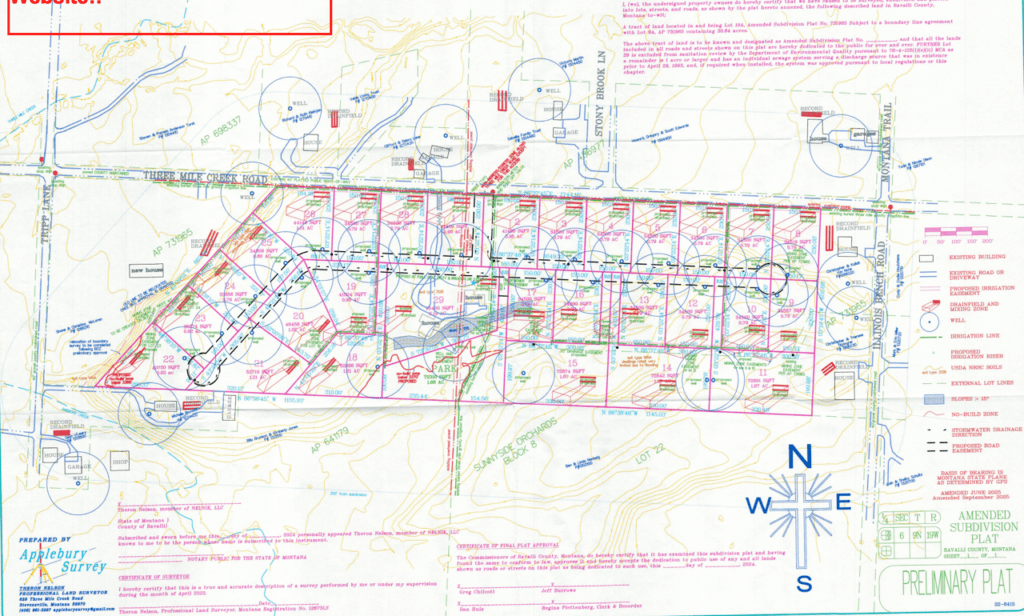
Map of proposed 29-lot subdivision along Three Mile Creek Road northeast of Stevensville. Each lot would have its own well and septic system.
Seven people made public comments and several written comments were received expressing concerns about the subdivision proposal, including concerns about impacts on the groundwater table and neighboring wells and potential contamination from so many septics in such a small area, impacts of the increased traffic, light and noise pollution, and impacts of public health and safety. Many complained about the extreme density of the housing on very small lots.
Neighboring property owner Rick Kleinjan, who has lived in the area for 24 years, said that he had seen the traffic on the road increase from 20 to 30 cars a day to over 3000 and that the new subdivision was going to virtually double that. One neighbor said one of two wells on her property had already run dry from all the previous development in the area.
The Nentwigs, in their comments, pointed to previously approved subdivisions in the area including Ambrose Estates where 32.16 acres was divided into 26 lots from 1.14 to 1.64 acres in size; Valhalla Ranch Estates where 40.48 acres was divided into 26 lots from 1.42 to 1.8 acres in size. Broken Spoke Road is 29.62 acres divided into 16 lots from 1.54 to 2.41 in size. “These are subdivisions in this area that once was farm land. This subdivision proposal is for lots that are mostly .79 acre and has one as small as .50 acre. This is something you would expect to see near or connected to a city,” they wrote.
The Utzingers commented, “On average, a 3-bedroom house uses 240 to 270 gallons of water per day. In one year, that amounts to 2,540,400 to 2,857,950 gallons, or 7.78 to 8.77 acre-feet for the proposed 29 lots. Can the local groundwater table support that amount and for how long?”
“Approving a high-density rural subdivision in a location with inadequate roads and unverified water capacity externalizes risk, leaving existing residents to absorb the consequences of congestion, emergency access limitations, and declining water availability. That outcome is neither lawful nor acceptable,” wrote Jesse Riddle, another neighboring landowner.
Russ Giese spoke in favor of the subdivision. “We all think we can stop growth but we can’t,” he said. “Look at Legacy Ranch [a large subdivision containing many parcels that was denied but subsequently developed ]. This is what happens when we don’t do well-thought-out subdivisions. I want to commend the developer.”
Brad Jones, a well driller, said he had a lot of experience with wells in the area and that the ones having problems were really old and/or poorly constructed wells and he didn’t believe these new wells would be a problem.
Local hydrologist Howard Newman agreed, saying, “I think Brad hit the nail on the head.” He said in his experience, and based on studies of groundwater flows done by the state Bureau of Mines and Geology, the proposed wells would have no negative impact on any existing wells in the area due to the good flowing aquifer and the direction of its flow.
“These new wells won’t affect other wells or each other,” said Newman. “The rate of flow and amount of water is good. There will be no adverse impact on the groundwater.”
Planning Board members discussed the concerns in relation to the state’s seven criteria for approving subdivisions and felt that they would all be successfully mitigated by proposed measures, many to be included in covenants restricting and controlling lighting, water use, fencing, etc. However, Dennis Lane did ask during public comment how the mitigation proposals were going to be monitored and maintained after build out. “HOAs don’t always fill the bill,” he said. “Usually it’s a big fight and nothing gets done. It takes it out of the community’s involvement with no teeth in it. These things need some sort of enforcement. I question the developer’s credibility and truthfulness.”
Although installation of water flow meters on the wells was recommended by the county’s planning staff, it was deleted from the requirements by the Planning Board. Planning Board members felt that it was not something they would recommend because the legislature has been struggling with the issue in the last few sessions and still had not resolved it on the state level so the county should not be sticking its neck out and inviting litigation. It was noted, however, that the county commissioners were requiring water meters on wells in some subdivisions. County Planner Rob Livesay said that the county commissioners had the right to make such mitigation requirements.
There was also some disagreement over limiting fence heights to accommodate wildlife migration conflicting with concerns about keeping large dogs who could harass wildlife from jumping the same fences.
Following all the discussion, a recommendation to approve the Preliminary Plat with mitigating conditions was approved unanimously.
The County Commissioners have scheduled a meeting to consider the subdivision proposal on January 20 at 1 p.m.
Montana speaks out says
The planning board members needs to be replaced with individuals if they work for the developers – Penny Howe who is allegedly on this board works for Terry Nelson the developer. Did she recuse herself in this decision?
As Ginger says above, we do NOT need more subdivisions in the valley. We should instead redevelope, refurbish the properties we have now…there are abandoned homes or homes that could be redeveloped, rebuilt and thus no more impact on additional people, traffic, etc.
Ginger says
In a small rural town in Wa, it started the same way. More and more subdivisions were put in, taxes spiked for neighboring parcels. Traffic got terrible, subdivision folks started complaining about this and that. Fast forward a few years, it’s ALL subdivisions due to neighboring farms not able to afford taxes, deal with the complaints. Now, the city has pushed its way into the last of the rural areas. Then came the city wanting everyone on city water, forcing permits on everything, including the ability to cut down a tree on your own property, or live in an RV which is now illegal! Now, the county is patrolling parcels with the use of drones. Although I agree that growth has to come, It also comes with a price. Not to mention you can’t even get into a local doctor there anymore without waiting a month and a half. I feel there should be areas that are left rural. At least make the parcels larger for the area. When they approve these subdivisions, I wish they could look at other states that have done the same thing. A lot of the people that are for these subdivisions are contractors/builders, and I get it. That small rural town in Wa, is now ruined. If we don’t start looking ahead at the impact of these in rural areas, we will be in the same boat.
Michele says
Both local emergency crews are volunteers, 17 minutes to respond to my husband’s heartattack, how will this be addressed with that many new residents, and can LoneRock School handle an increase in students ? Three Mile has had at least 2 fatalities due to road conditions and traffic will it be sufficient? Accidents on the turn out to Eastside Hwy from Three mile . Illinois Bench and Ambrose crk rd will also an increase in traffice Has that been considered
Kenneth Pignone says
Cluster developments, such as these will ruin a small town and adversely impact a rural area. There should at least be a mandatory 2 acre minimum to build a home anywhere in a county that is not connected to city water or sewage. This allows proper septic and well placement which has less impact on the environment. I personally moved here so that I would be away from cluster developments where I couldn’t hand my neighbor a cup of coffee out the window. Unfortunately it’s not about what’s best for an area but more about politics and how much money somebody can make.
Rick Kleinjan says
The comment of the traffic numbers was misquoted, The daily number of cars would increase from 23-30 to 300 cars per day. Some of the lots are only .6 acres which is smaller than most of the surrounding subdivisions and seems to invite low-income housing or small multi-family units or mobile homes as no guidelines on what will be allowed were offered at the meeting.
Chris Utzinger says
The statement that the lots average one acre in size is misleading as 21 of the 29 lots are merely 0.79 acres.
The pending boundary line relocation will serve to straighten out the western, not the eastern property boundary.