by Michael Howell
The Bitterroot National Forest has received a draft initial Plan of Operations for the Sheep Creek project on the West Fork Ranger District. The Forest will assess the Plan for completeness and will then work with the proponent, U.S. Critical Materials, to develop a final proposal and determine the appropriate level of analysis under the National Environmental Protection Act (NEPA).
The level of analysis can range from a Categorical Exemption (CE) in which it is summarily determined that there will be no significant impacts, or it could require an Environmental Assessment (EA) which is a preliminary analysis to see if a federal project significantly impacts the environment; if impacts are minor, it leads to a FONSI (Finding of No Significant Impact), but if impacts are significant, it triggers a much more detailed, comprehensive EIS (Environmental Impact Statement), which involves extensive public review, detailed alternatives, and a “hard look” at cumulative effects. The EIS is for major actions with significant environmental consequences, while the EA is a stepping stone to decide if an EIS is needed or if the project can proceed with minimal impact.
The Ravalli County Commissioners recently submitted a letter to the Governor and Montana’s congressional delegation requesting that an EIS be conducted. They also asked for help in taking the Sheep Creek project off the federal FAST-41 list. The congressional delegation sent a joint letter to the Forest Service to U.S. Forest Service Chief Tom Schultz and Emily Domenech, director of the Federal Permitting Improvement Steering Council, which oversees FAST-41 projects. The delegation did not ask the Forest Service or permitting council to remove the project from the FAST-41 list, or “fast track,” but it called for the chief and director to ensure transparency from U.S. Critical Materials or any successor companies.
“Unfortunately, it has become clear to us that the developers of the proposed Sheep Creek deposit have not engaged with community leaders and gained their trust to proceed with the development of this deposit,” the letter said. “As such, we cannot support the project and urge the Forest Service and the Permitting Council to ensure full transparency and increased local engagement in the permitting process.”
The Permitting Council has kept the Sheep Creek project on the FAST-41 Transparency Project list and the project timeline can be viewed here: https://www.permits.performance.gov/permitting-project/fast-41-transparency-projects/sheep-creek-project. FAST-41 Sheep Creek Project.
The initial draft of the company’s plans calls for some road rehabilitation in the area and some new road construction. It describes a 2-acre site for locating a portable site office, maintenance area/shop, a change house or “dry,” a fueling station, as well as a laydown and load out area designated to support project activities, a 2,000 gallon fuel storage container inside a berm and a spill response trailer.
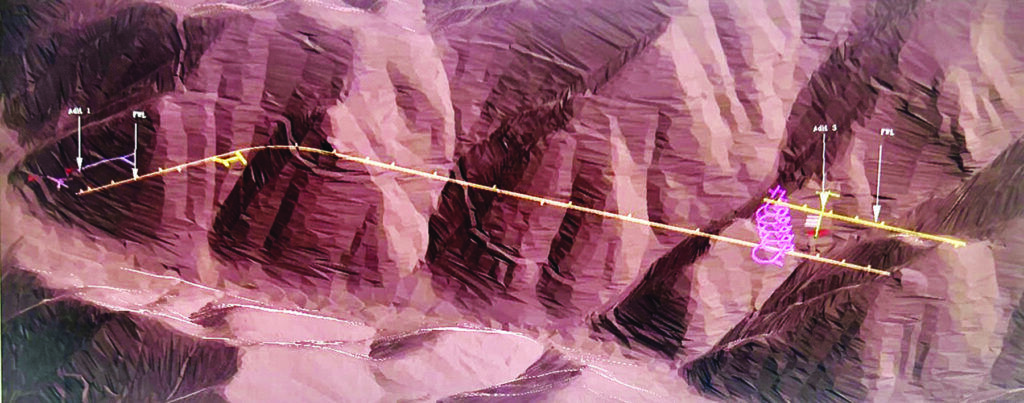
Sheep Creek Preliminary Underground Design – The portals are located on the left and right extents of the image with a connection drift (tunnel) created between the proposed Adit 4 and Adit 3. Along this “drift” there are strategically placed drill vaults that are aligned to drill perpendicular to the suggested vein. This allows drilling to intersect the vein to gather needed information from the drilling program for deposit planning. Diagram from Bitterroot National Forest website.
Three historic adits (mine entrances or portals) will be enlarged and reinforced and a fourth new adit will be installed with tunnels connecting them for machinery access and power and ventilation infrastructure.
The company proposes a scheduling and resource planning Phase 1 for the first three months of operation including road building and refurbishing, adit rehabilitation and construction, equipment staging and installation of water sumps and storage facilities, and some mining activities in Adits 2 & 3.
The project mining schedule for Phase 2 is scheduled to begin the fourth month and last nine more months. It projects four months of diamond drilling extending 19,900 feet and over the course of the whole nine months producing 5,793 tons of waste rock and 10,473 tons of ore.
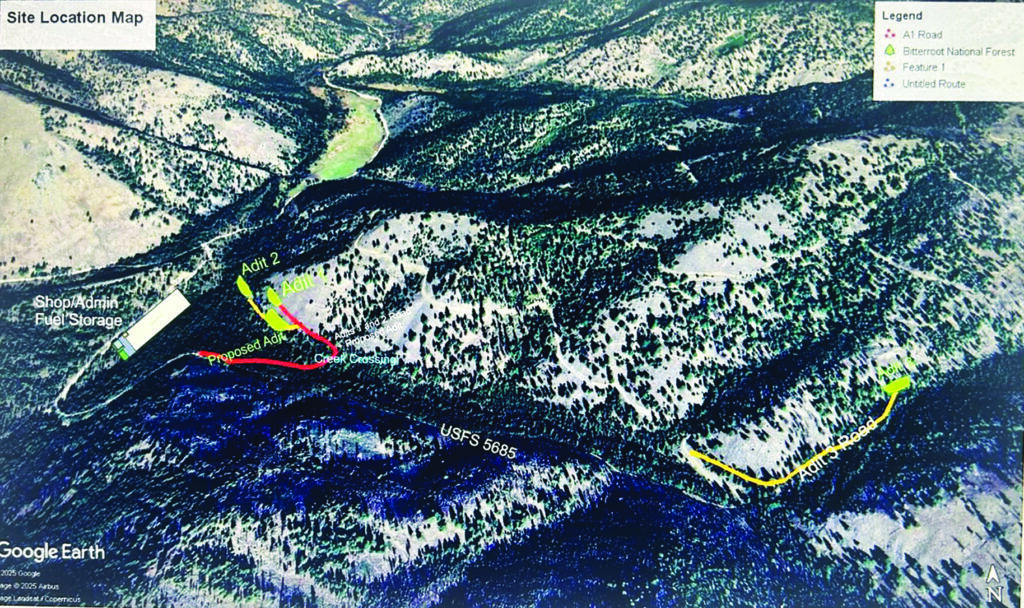
Site Map with Project detail. From Bitterroot National Forest website.
The project is scheduled as a day shift, 7-day-a-week operation employing approximately 30 people including mining engineers, nippers (laborers) and professional positions such as geologists, operations professionals, surveyors, mining professionals and administrative staff.
Ore produced at the site is to be removed to an off-site location for processing. Waste rock or blasted rock that does not contain recoverable minerals will be utilized as internal fill within the adit to fill voids and further production. Any waste material that is produced that cannot be utilized as internal fill will be used to build up the portal pads. Once those pads are established, excess waste will be transferred to a containment pad and then offsite via truck to be utilized in gravel production or backfill unrelated to the proposed site activities.
This will require trucking materials on Montana Highway 473 from the Sheep Creek drainage to its intersection with Highway 93 and on to an undisclosed destination. These loads are currently planned on a 5-day-a-week schedule, with between 8 and 10 loads a day of a 23-25 yard side dump at peak extraction in later years under the current plan.
The plan describes using groundwater that is captured underground for process water with a sump system installed underground designed to capture the water where it can be processed to a level that allows its reuse underground with the plan to have a zero-discharge operation. An underground water reservoir will be constructed with a capacity of approximately 15,000 gallons. Water that is cleaned through the sump and clarifier system will be temporarily stored in this reservoir until it is required for underground purposes. But the plan also states “If additional process water is required, a source such as Sheep Creek, or the West Fork of the Bitterroot River to supplement activities underground would be needed.”
The plan contains illustrations and photos of all the large machinery to be used in the underground mining operation and on the surface for loading and hauling. It also contains several options for extracting ore in the mine such as an overhand ramp and fill method, production long hole extraction and others. The current bulk sampling plan consists of several different narrow veins and multiple specific methods in consideration.
The draft initial Plan of Operations can be accessed on the Bitterroot National Forest Sheep Creek project webpage.
Questions about the Plan of Operations can be directed to info@uscriticalmaterials.com
William (Bill) Campbell says
The entire scenario is designed to go through the motions, offering public viewing and appeasement, all while moving forward with the plan. Their programming utilizes the time periods involved to promote their cause.
The history of such activity and the resulting environmental damage are omitted while offering only untested experimental processes as a solution to any negative impacts that might be created. Half-truths, omissions in every area of consideration, and fanciful statements are the norm. The mode and manner of their proposal are reliable indicators of future events.
The Bitterroot Valley and its residents would be subjected to high risk, destructive processes and left with both enviornmental and social wreckage of unimaginable magnitude. The great profits offered the proponents are made possible only through the sacrifice of the community and the area in which they reside.
Research the facts conveniently omitted, consider the costs created by their experiment and who would bear that burden. There can be only one conclusion. That is that the public demand full transparency of any assessment process and be provided a means and opportunity for a meaningful response.
We are the subjects of a monumental experiment yielding monumental profits at a monumental cost. The profit is theirs. The cost is ours.
Please investigate, ask questions and demand answers that are factual in place of fanciful. Be aware that what is proposed can be successful only if those affected allow it to happen.
HSabin says
Dave, you are absolutely correct. And if the congressional delegation does not come out in full throated voice and say no, then we need to throw them out of office and that is where the convention of states comes in. Let’s get Montana to vote and we will put stern limited on them .
Dave says
It’s completely insulting that they have a community meeting, to get public input on this, as well as to answer questions regarding this project, but then they ignore the public and just do whatever they want. In the meeting that was held in hamilton, it was overwhelmingly clear the residents of the Bitterroot Valley did not want this mine and their reasons were well laid out by the folks who spoke about the risks, etc. The only people who will benefit from this project are the mining company and their investors…. it’s of zero value to the people who live here and who are taking on all the risk.