by John Dowd
The City of Hamilton has officially proclaimed August 2026 as “Dogust Shelter Dog Month,” continuing a tradition that celebrates shelter animals and raises awareness about the importance of adoption.
Hamilton Mayor Dominic Farrenkopf made the proclamation during the Hamilton City Council’s Aug. 4 meeting, where representatives of the Bitter Root Humane Association (BRHA) attended, including board president Lisa Allison, Shelter Director Tucker Chase, BRHA volunteer coordinator Lisa Pintok, staff and volunteers.
It is the third consecutive year the city has recognized Dogust. Allison approached the city three years ago about making the proclamation, and the mayor readily agreed.
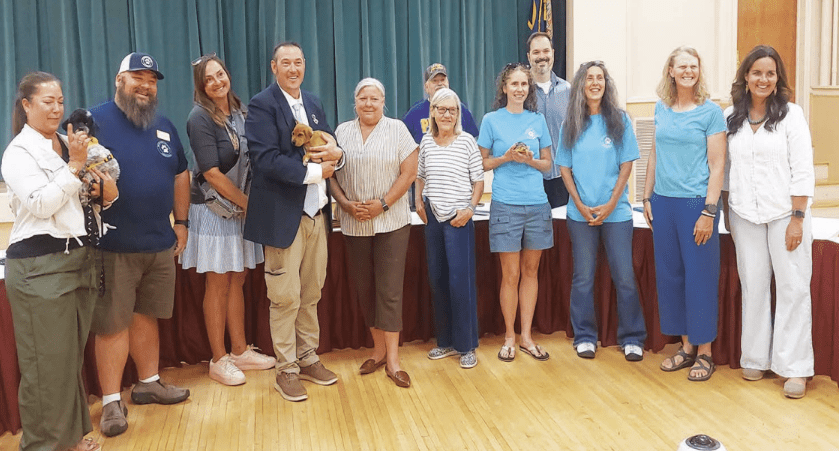
Hamilton City Council, mayor, Bitter Root Humane Association staff and volunteers pose for a picture with animals, proclaiming August of 2026 “Dogust.” Photo by John Dowd.
Dogust is considered the unofficial birthday celebration for shelter dogs and other shelter animals whose actual birth dates are unknown. The national observance began in 2008 and is intended to raise awareness about shelter animals and encourage adoptions.
“It’s to celebrate all the shelter dogs that don’t know their birthday,” said Pintok.
The proclamation recognized BRHA’s service to Ravalli County since 1972 and wished shelter dogs a happy birthday.
“Now, therefore, I, Dominic Farrenkopf, Mayor of Hamilton, Montana, do hereby proclaim August 2026 as Dogust Shelter Dog Month,” the proclamation states.
In a following interview, Farrenkopf noted his own birthday falls in August and that he has a particular fondness for dogs. “I love dogs, I love people, and dogs are people too,” Farrenkopf said.
The proclamation ceremony included a group photo and a rendition of “Happy Birthday” for shelter dogs and animals. The celebration also offered BRHA an opportunity to update the council on its work over the past year.
One of the shelter’s most significant recent cases involved more than 100 animals surrendered to the organization following a neglect case on a property in Corvallis at the end of May. The animals included dogs, cats, rats, chickens, a tortoise and a donkey.
The BRHA partnered with the Humane Society of Western Montana, near Lolo, to care for the animals. Most of the animals were adopted within 10 days, which Chase and Pintok attributed in large part to the community’s response and support.
The case is also expected to lead to a criminal investigation and possible charges related to animal neglect.
During the council meeting, the rescued tortoise even wandered around the council chamber. “How many city council meetings have tortoises?” Farrenkopf joked.
The relationship between Hamilton, Ravalli County and the BRHA is an important part of the community’s animal welfare system. The BRHA is a private nonprofit organization and serves as the primary shelter for animals impounded by the city and county, as the valley does not have a separate animal control facility.
Hamilton budgets a $10,000 donation annually to help support the humane association’s operations. The city also does not have facilities to house impounded animals itself.
The shelter takes in domestic animals, with the exception of roosters, and relies heavily on volunteers. Chase said the organization has 12 staff members and more than 300 volunteers. “That’s a big reason” things go so well, Pintok said.
The organization handles about 1,200 animals each year and has significantly reduced the amount of time animals spend at the shelter. When Chase began working there, the average stay was about 60 days. Through changes in operations and increased community support, that figure has fallen to less than 10 days.
The shelter has been able to become so efficient locally that it also helps animals elsewhere in Montana and outside the state.
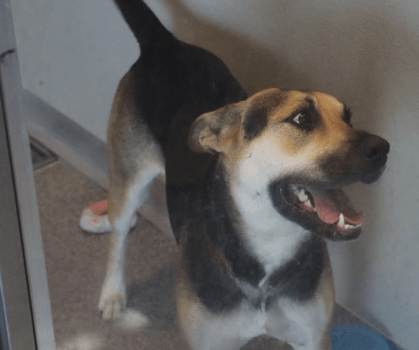
Marley, a lab and German shepherd mix, waits patiently for adoption. She is one of the Bitter Root Humane Association’s current longest waiting residents, having been in the shelter now since May. She is one-and-a-half years old. Photo by John Dowd.
The humane association is nationally recognized for its “return to home” rate. Chase said the national average is about 30%, while the BRHA’s rate is more than 90%. “Which is awesome,” Chase said.
In addition to sheltering animals, the organization provides several free or low-cost community services. The shelter offers free microchips, vaccinations and identification tags, as well as a community pantry stocked with items such as food, leashes, blankets and bedding. “Whatever is donated to us that we can’t use, we put out there,” Pintok said.
The humane association also holds monthly low-cost spay and neuter clinics. Those interested can schedule an appointment by calling the shelter’s hotline, which is listed on the organization’s website.
The BRHA also provides disaster-relief services, including sheltering animals during wildfires. That work can include livestock, with the humane association partnering with numerous properties throughout the Bitterroot Valley to accommodate animals during emergencies.
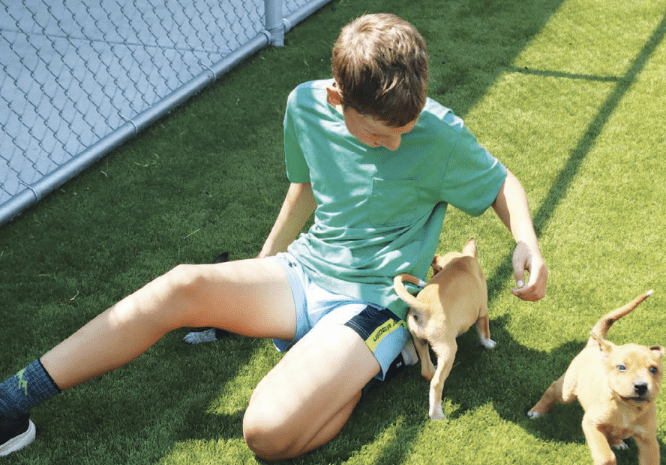
Alaric Reneau hangs out with the puppies of the Bitter Root Humane Association. Photo by John Dowd.
Another recent initiative is the organization’s community cat program. Stray cats brought to the shelter are spayed or neutered, microchipped and given a collar.
Chase said the program addresses a common problem: people sometimes assume a wandering cat is a stray when it actually belongs to a nearby household.
“Cats are smart; they go right back home,” Chase said.
Once an owner is located, the shelter registers the cat so its home can be identified if the animal is lost again. Pintok said community members have generally been receptive to having their cats spayed or neutered.
The BRHA has also provided the Ravalli County Sheriff’s Department with several microchip scanners, allowing deputies to identify pets and return them directly to their owners, without the need for the BRHA to play middleman.
Community support remains a major part of the organization’s operations. The shelter’s annual “The Howling” event is scheduled for Oct. 24. The Halloween-themed dinner gala includes costumes, auctions, games and other activities. Tickets are currently available through the organization’s website.
The event has become a major fundraiser for the organization and helped the BRHA pay off its building last year.
Other community events include Donuts for Dogs, where children can meet shelter puppies while enjoying doughnuts. The shelter is currently fortunate to be short on puppies, staff said.
The humane association is also collecting photographs for its Dogust celebration. Community members can email pictures of their dogs to opmanager@bitterroothumane.org. At the end of August, the shelter plans to feature the submitted photos in a social media post.
The BRHA continues to accept donations and encourages community members to support its work throughout the year.
Farrenkopf said the city intends to continue the Dogust proclamation as an annual tradition.
For the BRHA, the celebration is about more than giving shelter animals a symbolic birthday. “It’s about increasing awareness for shelter animals,” Pintok said.