by Michael Howell
The old S&W Sawmill facility in Darby became a State Superfund Site in July 1991 under the Montana Comprehensive Environmental Cleanup and Responsibility Act (CECRA), but investigations and treatability studies at the facility have actually been ongoing since 1987. Although International Paper (IPC) was not involved in the creation of the contamination problem, as the current owner of the property, it has been designated as the lead liable party responsible for the investigation and cleanup efforts. As part of a lawsuit settlement agreement in 2001, IPC agreed to bear the cost of completing remediation at the facility.
The company has been working under the supervision of Montana Department of Environmental Quality (DEQ) since the early 2000s, doing “interim” remediation work on the facility grounds and doing investigative monitoring to determine the extent and severity of the contamination to soils, groundwater and surface water in the area. The company is required to perform annual groundwater sampling activities to monitor concentrations of contaminants of concern (COCs) in groundwater underlying and surrounding the S&W facility. The primary COCs at the S&W facility are pentachlorophenol (PCP) and dioxins/furans.
In 2021-22, the company excavated about 15,000 tons of soil from a portion of the mill property and then another 1,000 or so tons from the nearby Waddell Ditch. The contaminated soil was hauled to the certified and licensed land fill in Missoula.
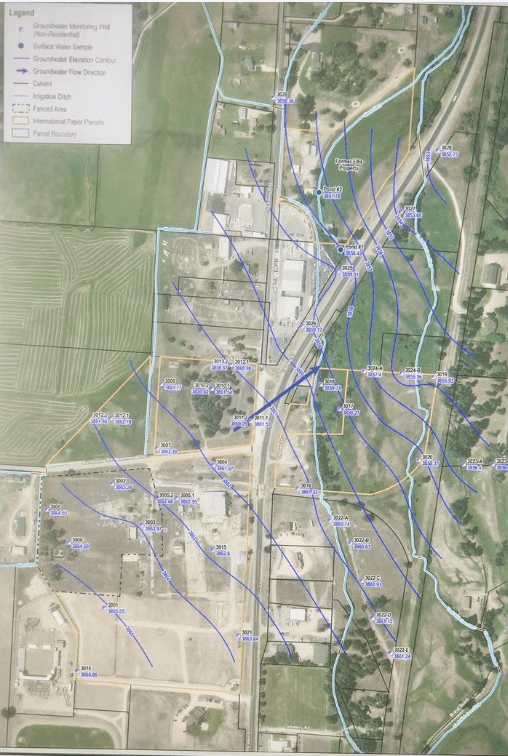
In 2010, on the Chaney property immediately across the street, it saw exceedances of DEQ standards for ground water and EPA limits for drinking water. The company immediately provided the property owner with bottled water. DEQ also required IPC to provide Chaney a source of uncontaminated water by digging a deeper well.
In 2011, more test wells were installed on the Chaney property and a neighboring property, and the company ended up purchasing both properties to facilitate remediation work in the area. Since then, the efforts to delineate the extent of the underground plume have gradually expanded to include the Tiedt-Nicholson Ditch and the Overturf Ditch in 2015; the Waddell Ditch in 2018-19 and other surrounding properties. The company purchased another adjoining property in 2023-24.
Concurrent with the groundwater sampling activities in 2025, DEQ required IPC to collect surface water samples as part of investigating groundwater and surface water interactions around the S&W facility. This investigation was primarily focused on the Hatch Waste Ditch and ponds associated with or adjacent to the ditch. A total of 39 monitoring wells were gauged and sampled. Of these monitoring wells, thirty-four monitor the shallow groundwater at the facility and five monitor deeper groundwater concentrations. Additionally, four domestic water wells for nearby residences or businesses were sampled.
All surface water results from the two ponds (Pond #1 and Pond #2) were below the Montana DEQ-7 Surface Water Standard for PCP (0.3 µg/L) and all surface water results exceeded the Montana DEQ-7 Surface Water Standard for dioxins/furans (0.05 pg/L). Surface water results were lower at the two pond locations in November 2025 at low groundwater levels, particularly when compared to July 2025 results at high groundwater levels. The concentration of dioxins/furans at the Pond #1 location was 5.29 pg/l, compared to 57 pg/l observed in July 2025. The Pond #1 location was 5.29 pg/l, compared to 57 pg/l observed in July 2025. The concentration of dioxins/furans at the Pond #2 location was 2.5 pg/l, compared to 14.4 pg/l observed in July 2025.
Based on the new information, as well as additional investigations of the Hatch Waste Ditch, DEQ has required IPC to perform additional sampling activities of the Hatch Waste Ditch and other ditches and surface water bodies connected to the Hatch Waste Ditch. These other ditches and surface water bodies are located east and north of the Hatch Waste Ditch, between US Highway 93 and the Bitterroot River. DEQ will provide results to the public once it has received and reviewed the data.