by Chuck Stranahan
In some parts of the country flyfishers still talk about the willow fly hatch.
Depending on where you are and who’s doing the talking, they could be referring to the early brown or gray stoneflies that come off when snow might still be crusted along the streambanks, or their larger cousins that start a little bit later, the ones we refer to as the skwala.
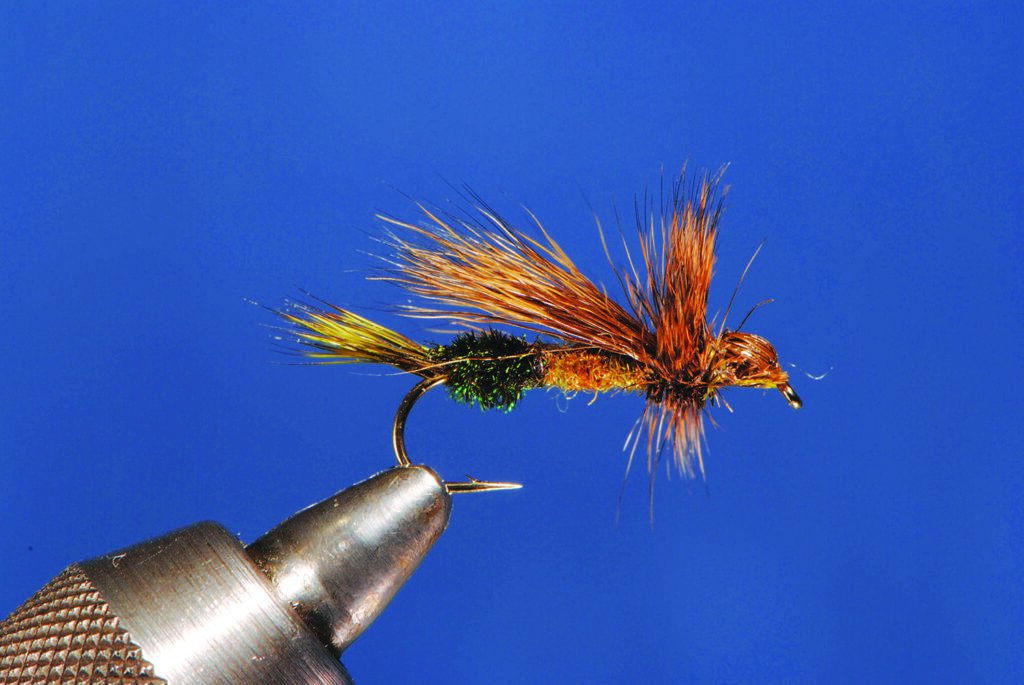
Chuck’s Skwala – not the perfect skwala pattern, but it works. Photo by Chuck Stranahan.
The hatches overlap – and both might last until full-blown runoff shuts them down. There’s a third bug that gets thrown into the same seasonal mix, an early gray stonefly we call the nemoura.
For practical purposes we can say that out flies for the early grays and browns are all about a #12, and the skwalas are usually a #8 or #10.
In our end of Montana we don’t pay much attention to the smaller flies (even though we should) and instead concentrate on the skwalas,
Fishing the skwala is not the kind of fishing where you strap one on, let out a whoop and slap the water with it. True, big trout can get careless when they’re on, but that’s no reason we should.
We’re better to fish carefully, get the cast in, our fly not making more than a natural’s disturbance when it hits the water. We’ll do better to comb the quieter shaded water under overhanging willows than to fish the main currents. Why? Skwalas have the habit of crawling up into streamside willows, mating, and from there the females will make a short fluttering drop into the slow moving current below. This kind of water is usually dug in against a willow bank, just deep enough to hold a decent – and sometimes big – trout.
Skwala adults are a drab olive-brown color on top. Even at their size, they’re not real conspicuous. They don’t form mating hatches as their later season counterparts do and they don’t fly very far to lay their eggs. Some will get washed into the edge of the main current. It’s easy to see the rises there, and miss the less conspicuous rises closer to shore where the bigger fish might be laying.
To do well during the skwala hatch, don’t fish where you think the fish are. Fish where the bugs are, and fish how the bugs behave.
And it helps, in the slow-moving water where you’ll find the best fish, to have a fly on that mimics what the trout are seeing. Our artificials tend to be overdressed.
The bugs themselves are skinny. They’ll show some, but usually not a flurry of wing activity. They’re drab, not flashy. Our artificials should look the same.
Underneath, the bodies of egg-laying females range from a pale willow green early in the hatch cycle to a darker brown-olive later on. The robust early bugs are lighter in color bigger and more active than the ones that hatch later.
A n egg-laying adult can live for a couple of weeks, so a range of colors in their spectrum can be on the water at once in individuals that hatched at different times. All of them will show an amber shade of yellow in their abdominal gills. That makes matching the perfect skwala body color in an artificial difficult.
Noted flyfishing writer Dave Hughes points out that trout want to see the right body color in the flies they take. Doesn’t matter if other colors are present, just so long as they see the right one.
Many years ago when I first arrived in the Bitterroot I did my own research with skwalas. I went to the rive without a fly rod, many times, watched carefully and remembered what I was seeing. I caught a few bugs each time. I turned over rocks along the margins of the water. I traced the paths of migrating stonefly nymphs, under the streamside gravel or up the stalks of willows growing close or into the water where they would hatch and mate.
Some of the female skwalas I caught had bodies showing shades of dark brown, golden olive, light willow green, and amber. I made a dubbing blend that contained all of these colors, in natural, synthetic, and UV dyed colors.
The rest of the fly shows the right colors in a sparse, skinny silhouette. It worked. The others I’ve tried since didn’t do as well.
It may not be the perfect skwala pattern, but it worked.
Still does.
John Paniszczyn says
Chuck has a wealth of fishing knowledge that equals the richness of the Bitterroot. His column always presents a fresh insight and unique perspective.