by Michael Howell
Dr. Byron Winslow Caughey passed away at his home on February 15 at the age of 68. He was a devoted husband and father, a real family man. He was, by all accounts, a humble, kind, and understanding man. He was a well-rounded individual, an accomplished artist and enjoyed making furniture, sculpting, and writing poetry. He was also a world-renowned scientist at the National Institute of Allergies and Infectious Diseases (NIAID) at Rocky Mountain Laboratory (RML) in Hamilton. After coming to work at RML in 1986 he shot up the ranks, becoming a tenured Senior Investigator in 1994 and Chief of the TSE/Prion Biochemistry Section in 2006.
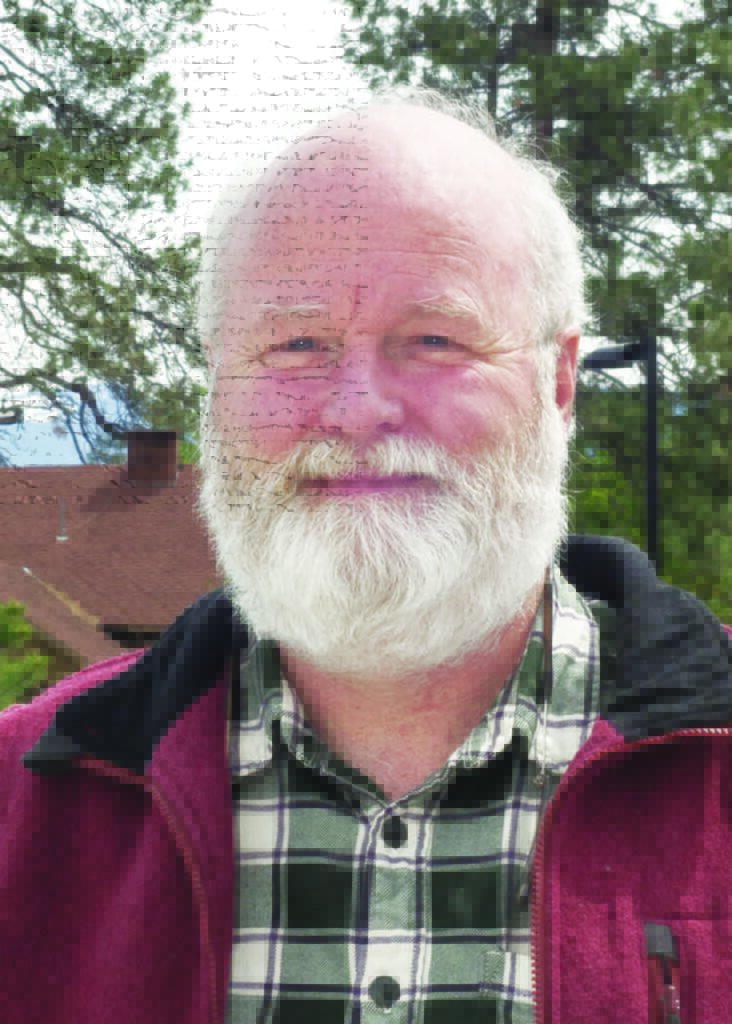
Dr. Bryon Winslow Caughey. Photo courtesy of NIAID.
Prions are infectious, misfolded proteins (PrPSc) that lack nucleic acids and trigger normal brain proteins to misfold, causing fatal, rapidly progressive neurodegenerative diseases known as Transmissible Spongiform Encephalopathies (TSEs).
When he arrived at RML, Caughey began working under the direction of Dr. Bruce Chesebro who was involved in intensive research into the fatal prion diseases among animals including Mad Cow Disease among cattle, Scrapies among sheep, and Chronic Wasting Disease among deer and other wild mammals.
Caughey soon turned his attention to Creutzfeldt-Jakob Disease (CJD), a rare, rapidly progressive, and fatal neurodegenerative disorder caused by infectious misfolded proteins in humans. CJD was first described in the 1920s. But the disease was only diagnosable for certain by examining the brain tissue of deceased patients. Caughey put together a team to study the fatal and incurable disease and around 2010 developed a technique called “real time quaking induced conversion (RT-QuIC)” that could be used to reliably identify CJD in living patients by extracting brain tissue from living patients and eventually by examining spinal fluid obtained by a spinal tap. Both were very serious and invasive procedures.
In 2015, however, scientists at the University of California at San Diego and UC-San Francisco were able to collect eyes from eleven deceased CJD patients who had donated them to science, dissect them and send the samples to Caughey for testing by his team at RML.
They discovered evidence for prions in the eyes of all eleven CJD patients and in multiple parts of each eye. Caughey recognized that the results revealed that CJD patients accumulate prion seeds throughout the eye, indicating the potential diagnostic utility as well as a possible biohazard for patients undergoing cornea transplants.
While they still didn’t know how early in live patients the prion activity shows up in the eye, experiments in mice showed that it could show up quite a bit earlier than the other clinical signs of the disease. This raised the possibility that eye fluids or any other easily accessible component of the eye might be useful as a diagnostic specimen in order to better diagnose CJD in people.
Caughey and his team at RML worked hard on improving the sensitivity and accuracy of the RT-QuIC method and protocols involved in testing for CJD and in 2018, RT-QuIC was added to the Centers for Disease Control and Prevention’s diagnostic criteria for prion disease.

Dr. Byron Caughey, second from left, and his team of scientists at Rocky Mountain Laboratory, Andy Hughson, Christina Orru and Bradley Groveman in 2019. Photo by Michael Howell.
When this reporter first interviewed Caughey at that time, he was excited and said some diseases like Alzheimers, Parkinsons, dementia with Lewy bodies and other neuro-degenerative diseases also involve the accumulation of certain misfolded proteins that can propagate within people much like prions. He said they would like to develop a real-time quaking-induced conversion test for these types of diseases and see if the problematic proteins related to those diseases also accumulate in the eyes.
The following year I had the pleasure of interviewing him once again when he and three other scientists at RML and several of their colleagues in Italy were all recipients of the 2019 Aspen Institute Italia Award for scientific research and collaboration between Italy and the United States in recognition for their work in developing the improved test.
Caughey said, “It’s really nice to have back-ups, when you do a test and you are about to tell a person that they have a horrible, fatal, untreatable and rapidly progressing neurological disease, it’s nice to have further confirmation.” The lab was then able to issue a certified diagnosis of CJD to a patient whose samples test positive and be close to 100% certain. Although it was not a cure it was a major step forward.
I noticed a few things about Caughey at the time. He not only possessed a keen mind, he also had a very big heart. He was not in it to make a name for himself or for purely research purposes. He wanted to help people. And having a test capable of making a definite and timely diagnosis of prion disease while a patient is still alive was an extremely important step forward. By informing family members, it allows them to avoid further tests, reduces costs and could allow for timely treatment, and at this time prepare for the inevitable, he said. Studying the disease in its early stages of development, before any symptoms present, could also present a better opportunity for successful therapeutics.
What I remember most from my interview with Caughey about the Aspen Institute Italia Award was his genuine humility. He did not want to talk about his own accomplishments or his team’s accomplishments at first. He wanted to talk, and did at great length, about one of his colleagues at RML, Dr. Bruce Chesebro, and the work that this man did in his investigations of Mad Cow Disease, Scrapies and Chronic Wasting Disease, all fatal prion diseases among mammals, and how it set the stage for his own research into CJD. It reminded me of the phrase Isaac Newton made famous concerning his own insights into gravity, “If I have seen further, it is by standing on the shoulders of Giants.”
He was also quick to give credit for breakthroughs to his team, in this case particularly to Christina Orru (now Christina Orru-Groveman), lead author of the published reports. At that time, she had already trained people at 30 different laboratories around the world on how to perform the tests. She and Dr. Andy Hughson had also just finished a blind examination of 200 samples testing for Parkinsons disease and performed well. They also performed well on a large set from Sweden.
What Orru-Groveman recalls about Caughey is not just his humility, but his genuine interest in other people and what they think, and his inspiring manner. She was born in Sardinia and got her education in Italy before coming to the U.S. for postdoctoral work at RML. She said the academic environment in Italy was very formal and the prestige attached to scientific accomplishments created a highly competitive atmosphere fraught with arrogance, competition and ownership of ideas. She was nervous about working for someone who was so renowned in his field.
“I was shocked at how personable he was and the first thing he said was to ask me what I thought about prions,” said Orru-Groveman. She was also shocked by how willing he was to share the fruits of his research with others. “I had an incredible amount of independence in my work,” she said. Upon returning to Italy she opened up her own laboratory but found the formalities, the bureaucracy, and the reticence to share research discoveries there stultifying and jumped at the chance to return to RML when Caughey offered her a job. She spent the last 19 years on his team at RML. “He was and always will be my mentor,” she said.
Orru-Groveman was not the only one to benefit from Caughey’s easy manner and openness. He trained dozens of PhD students and post-docs, many of whom now run their own labs.
Sue Priola, a senior investigator and currently Chief of the TSE/Prion Molecular Biology Section, came to RML in 1991 to do her post-doctoral work under Dr. Chesebro. Due to lack of space she shared an office with Caughey for 10 years and worked with him for the next 35 years.
She said she remembered when she first arrived as a naïve little post-doc and came up with an idea but was not sure if it was a good idea or a bad idea. She said she turned to Caughey in the office and said, “Byron, what do you think of this?” He listened and said, “Yes. I think that’s a good idea. I think you should try that.” She said it was the first time that anybody had said to her she had a good idea and the first time anybody had really encouraged her.
“He was a fantastic mentor in that way and just a great person to talk science with and always open to new ideas,” said Priola. “A fierce proponent of his lab and people. He was marvelous that way and from the day I met him till now he never changed. He was able to tackle the big questions and just stick with it and find an answer to the problem. The RT-QuIC assay is a good example. As well as the first picture of an infectious protein that he published a few years ago. That was an impossible project that he struggled with for years and years. He was really good at steering very difficult projects to completion and not a lot of scientists can do that.”
Dr. Caughey’s colleague at RML and a good friend of his, Dr. Kim Hasenkrug, also noted in recent remarks how Byron (and many others) spent decades working on the intractable problem of solving the crystal structure of a misbehaving protein that would not form crystals and in 2021, used cryo-EM to finally elucidate the first high resolution structure of a prion. According to Haskenkrug, it was a structure very similar to one Byron had conceptualized years earlier, by bending foam covered metal wires into spaghetti-like shapes covered in post-it note labels.
Hasenkrug noted in Caughey’s obituary that he received numerous national and international recognition honors, was awarded five U.S. patents, brought over $1.3 million in outside research money into the lab, organized a dozen international meetings, worked tirelessly as an editor and editorial board member for numerous scientific journals, reviewed way too many grant applications, and served on a multitude of committees.
“Scientists came from all over the world to learn how to perform the RT-QuIC assay in Byron’s lab. He was a highly sought-after speaker at conferences around the world, and when Byron got up to speak, a hush fell over the audience. They knew something interesting and exciting was about to unfold. Most people will never realize how much his work touches our lives, but those who were fortunate to work with him will never forget,” wrote Haskenkrug
Leave a Reply