by John Dowd
4-H (which stands for Head, Heart, Hands and Health) is an integral part of Bitterroot Valley life for thousands of people in the county. However, just how intertwined it is can be hard to grasp for someone on the outside. The Bitterroot Star met with members of the Ravalli County 4-H Teen Council who provided a snapshot of what 4-H is all about and what it’s impact is on the community. Teen Council representatives Vivian Svee, Elliana Walz, Cheyanne Knutson, Kealie Hixson and Neil Gertner, were joined by Sophie Kolb, the MSU Extension Agent and 4-H youth development director.
All 4-H programs in the county fall under Kolb’s jurisdiction, even though she is technically a Montana State University employee. She is contracted with the county to organize and run 4-H events and to “speak on behalf of 4-H for the county,” as she explained. This gives her a unique view of the programs and the bigger picture.
According to Kolb, there are fourteen 4-H clubs in the valley, and well over 300 youth members. All are between 8 and 19 years old, and there are around 100 certified volunteers to help with the structure. Her oversight also covers the “Clover Bud” program, which is for five- to seven-year-olds. Kolb said 4-H is the largest out-of-school youth program in Montana and in the country. She added that it goes far beyond learning to raise animals, and there are almost endless ways to get involved, and for the program to help young people learn life skills.

Ravalli County 4-H Teen Council members, l to r: Sophie Kolb (advisor), Cheyanne Knutson, Elliana Walz, Vivian Svee, Kealie Hixson, Neil Gertner. Photo by John Dowd.
One such opportunity is the Teen Council, which develops leadership skills, said Kolb. These individuals take a more active role, not just in the local club, but in county-wide 4-H affairs.
The Ravalli County 4-H Teen Council meets once a month. Generally, teen councils have several offices, including president, secretary, etc. However, the Ravalli County 4-H Teen Council does not have any of these positions filled at the moment. Some of them are also ambassadors, such as Gertner. He explained that this is when 4-H members start to get more involved at the state 4-H level.
When asked why they are in 4-H, Knutson said for her the number one thing is leadership. It was the first thing that jumped out at her when she attended a 4-H junior leadership camp, which is open to all youth, not just 4-H. This gave her a taste of the leadership and other 4-H programs and she loved it.
“The leadership is a big thing to me because you can apply it anywhere,” said Knutson. She added that, “you don’t have to be miserable,” because there are a lot of ways to be involved in 4-H. She is not into the animal part of 4-H, but finds plenty of other avenues to enjoy the program, saying there really is “something for everyone.”
Hixson added to this, saying “4-H really caters to who you are and what you want to do.” She is in it because her mom was involved in it and her life has always revolved around animals. They live on a 40-acre ranch that provides a lot of the show lambs for 4-H and FFA. Hixson loves mentoring new members and said the program has “created a ton of experiences for me that are going to help me the rest of my life.”
Svee said she started in 4-H in fourth grade. She loves it because those who are in it often “experience things you could use later in life, even if they are disguised as something else.”
For example, “4-H-ers” as they call themselves, need to keep pretty diligent records during many of their projects. To Svee, that translates into other responsibilities seen in adult life. She also enjoys learning about things and then presenting on what she learned.
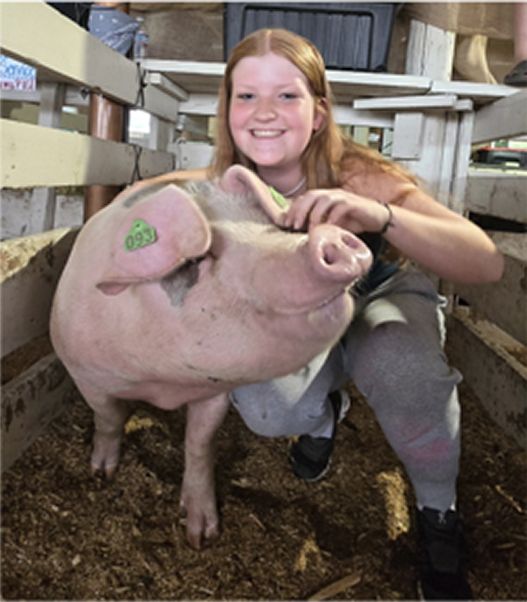
Vivian Svee, a member of the 4-H Teen Council, with one of her swine projects. Photo courtesy of Ravalli County 4-H.
“You learn about yourself and you really get to put yourself out there,” said Svee.
For Walz, a big part is also getting to try new things. She has family that have been in 4-H for a long time, and felt a responsibility to continue in the program. She has learned about keeping track of things, time management and much more. This is her first year in 4-H leadership. “I have been learning as I’ve been going,” said Walz.
Gertner has been in 4-H since he was eight years old and spoke to the hosts of things required for raising and showing animals. He enjoys it all and working with a lot of different people, building those friendships and relationships. He added that there are scholarships available and he has learned a lot of self-confidence through 4-H. He spoke to the life skills and job opportunities, as well.
“Everyone can really tell, those people that care about the program and stick with it, usually have really good character,” said Gertner. He said that for him, 4-H boils down to “an opportunity to grow.”
Many teen council members also do various community projects as part of their time on the council. For example, Svee does a “project fair” presentation every year. This is where she talks to 4-H youth, and interested youth not already in 4-H, about potential projects they can do. She said animals are a lot of work, but members do not have to do animals, and there are a lot of other options. She does this in November, and allows youth to look through 4-H books for ideas. The event is open to all youth and she has done this for two years. There were 20 participants last year, and she said she wouldn’t be surprised if there are more in 2026.
Another form of participation is the 4th Grade Farm Fair, held at the county fairgrounds in May. Hixson participates in this and said even though it is an FFA event, a lot of the volunteer staff are 4-H-ers.
“4-H is big on experiential learning,” said Kolb. Members must fill out a project book where they need to complete at least seven activities other than their main projects and entries. These can be a visit to a breeding facility, learning current market prices, taking a portrait photo, etc. In fact, Svee referenced the portrait photo, saying, “You’re learning based off the activity, but you are also getting outside experience,” talking about how she learned doing the extra research and everything else that revolved around the project of taking a portrait photo.
A really big thing in 4-H is undoubtedly the animal projects, and the county fair is like their Super Bowl; something they have been preparing for all season. Depending on the animal, youth can start as early as October the year prior. However, the council said most animal projects begin in spring.
In fact, many youth start various new projects shortly after the fair is over. Hixson has a breeding program she has been working on that she said she does year after year. “I love it, it has taught me a lot,” she said.
Another to work year after year on a consistent program is Walz, who breeds market sheep. Her family has raised goats for years, and so it was an easy thing for her to pick up. However, she added that youth get a chance to work with other animals, like in the Round Robin showing.
At the end of the season, many 4-H members sell their animals at the fair and that money will go back into their operation costs like feed, medication and general care costs. According to Gertner, marketing beforehand is actually a big part of it. The council spoke on this, saying they sometimes start as much as two months prior to the fair. Members go out and talk with local business owners and build those relationships. Hixson said many of the business owners know how it works and they will ask specific technical questions, such as daily gain, how often they work with the animals and other things.
According to Kolb, many buyers pay far over market value, and they believe in this because it supports 4-H and all the benefits it gives these youth. Many of them were even in 4-H themselves and they know the skills these youth will develop and how that helps the community at large. Kolb said that goes into what 4-H is about, “being beyond ready.” Additionally, their goal is to “prepare yourself and other 4-H-ers,” so it perpetuates the benefit to the community.
At the fair, 4-H-ers often literally live there, camping out and working all day. 4-H programming runs most of the day, and there are constant showings and other programs. Members get there early to set up their space for their animals, then they bring their animals the next day. According to Gertner, if they live more than 20 minutes away, many often just sleep there. He added that most also do multiple types of entries in the fair, and they help and volunteer around other parts of the fair. The council even judges for Clover Bud exhibits.
All 4-H members are required to put in time at the 4-H Corner Cafe food booth. The council said that it brings in the most money out of all the fundraisers they hold, year round, for 4-H. Kolb added that it also has arguably the best food prices.
“It’s an opportunity for them to showcase what they have been doing all year, but its not the end-all-be-all,” said Kolb. After fair, the cycle begins again. According to her, they are often looking at the bigger picture, and growing their skills year after year.
Anyone is welcome to attend 4-H meetings and can reach out for more info on how to get involved. Within 4-H, they have several club events like competition days, which includes mock presentations and project submittals.
There is also a 4-H spring carnival, dances, fundraisers and more, like the Boots and Buckles Ball, a new event that will include food, drinks, a silent auction and more. The event is meant to benefit 4-H and FFA in the valley and will take place Saturday, February 28 at The Flying Horse MT in Corvallis.
4-H also has a general calendar with club events that is available to those interested. For more information contact the Ravalli County Extension Office at (406) 375-6611.
Leave a Reply