by Michael Howell
Many people think of Trout Unlimited simply as a fish and fisheries conservation organization engaged in many environmental restoration projects. However, Trout Unlimited also sponsors some vital and extremely successful educational programs in the schools.
Already this year students all over the Bitterroot valley are learning about the life cycle of trout by raising trout from eggs that will be released into local fishing ponds, thanks to the work of Trout Unlimited’s Trout in the Classroom program. The program was started by Trout Unlimited and is offered in many states that have cold water fisheries. Locally, the Bitterroot Chapter of Trout Unlimited (BRTU) hosts the program.
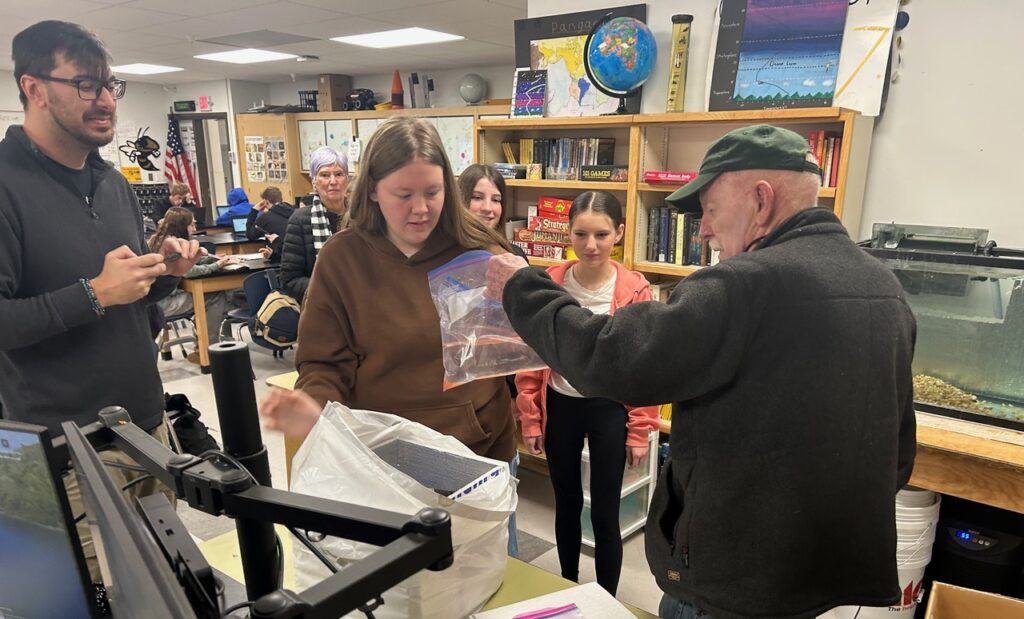
BRTU President Dave Ward hands off a bag containing 80 trout eggs to Emma Neel, Michelle Roebke and Elise Jessop, students in Tyler Joyner’s Stevensville High School biology class where the trout will be raised and released into a local pond. Photo by Michael Howell.
The program was started locally in 2020 at Corvallis and Hamilton High Schools. Since then, over the last six years, the program has expanded to include Florence, Stevensville, and Darby High Schools, Corvallis Middle School, Trapper Creek Job Corps and, this year, Sunni Stuber’s fourth grade class at Daly Elementary School was added to the list.
BRTU provides each classroom with a 55-gallon aquarium and a chiller to keep the water at a constant 53 degrees, pumps, initial chemicals and a detailed handbook. The students, under guidance from their teacher, monitor the water conditions on a daily basis to ensure that conditions are optimum for the health of the trout. As the eggs develop, the students get the opportunity to see how the eggs change from the fertilized eggs to a releasable fingerling. Along the way students also engage in stream habitat studies, learn to appreciate water resources, foster a conservation ethic and grow to understand ecosystems. Towards the end of the school year, the students release the fingerlings into an approved local pond such as the pond at Hieronymus Park in Hamilton. According to state law, the fish may not be released into a river or a stream. All the fish in the river must be from natural reproduction.
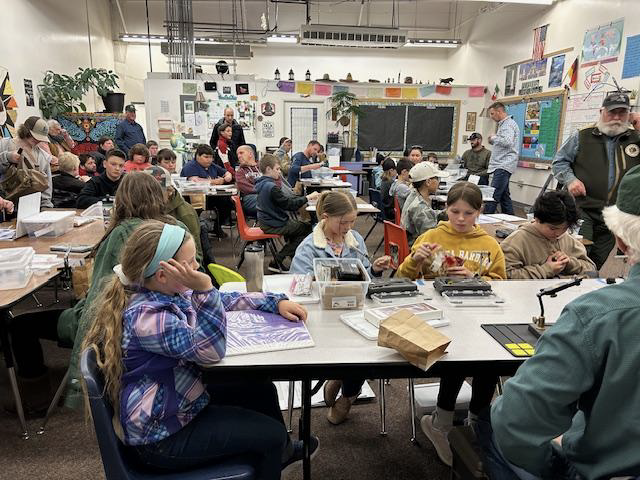
Bitterroot Buggers Class of 2025. Photo courtesy of BRTU.
According to BRTU President Dave Ward, program coordinator, the program has proven to be an excellent way to develop a conservation ethic among the students. Many of the students in this program develop a lasting interest in the biology of fish development. A few have chosen to pursue a career in fisheries or wildlife biology. For more information about the program contact Dave Ward at dward0451@gmail.com.
Another youth educational program that is just getting underway for the current season is the Bitterroot Buggers program. This is a class for boys and girls ages 9-14 years that introduces them to fly tying, fly fishing basics and conservation. The class has been offered continually since 1998 to Bitterroot youth and has graduated more than 1000 students. It is limited to 30 beginners and 10 advanced students to ensure quality instruction by Bitterroot volunteers. Curriculum covers fly tying, casting, entomology, safety, knots and ethics
The program works in tandem with the Hamilton Middle School and course masters this year are BRTU Past-President Greg Chester and Hamilton Middle School teacher Joe Byrne. Longtime BRTU member and certified instructor Steve Davis and Jim Mitchell from the Bitterroot Fly Company handle the casting.
It does not cost the kids anything to attend and BRTU has rods and tying kits available for purchase at a greatly reduced price, although loaner equipment is also available for any participant thanks to the generous contributions by TFO Rods and Dr. Slick tools.
Eight classes are scheduled from the middle of February to the middle of April and are held at the Hamilton Middle School from 6:30 to 8:00 p.m. The first orientation class is scheduled for February 19. According to Chester, the classes are already filling up. You don’t need to register in advance, but he says it helps. Chester can be contacted at gchester55@aol.com; Byrne can be contacted at byrnej@hsd3.org.
The course tops off with a picnic and fishing day at a local private pond.