by Michael Howell
Montana Department of Fish, Wildlife and Parks fisheries biologist Jason Lindstrom recently gave Bitterroot Trout Unlimited members an update on the status of the fisheries in the Bitterroot River drainage. Lindstrom gave an account of the fish populations by species found in various reaches of the river from Stevensville on up into the East and West Forks. On the whole, in terms of density and numbers, it appears that things are running a little below and a little above average for different species in different reaches “but not out of the range of variability” and for the most part “nothing alarming” in terms of levels, except perhaps the steady decline in the Bull Trout populations.
In the Stevensville section, both Rainbow and Brown Trout populations are holding steady, though at a little below average levels, perhaps due to drought and warmer temperatures. Mostly they are large adult trout and not a lot of juveniles in this part of the river.
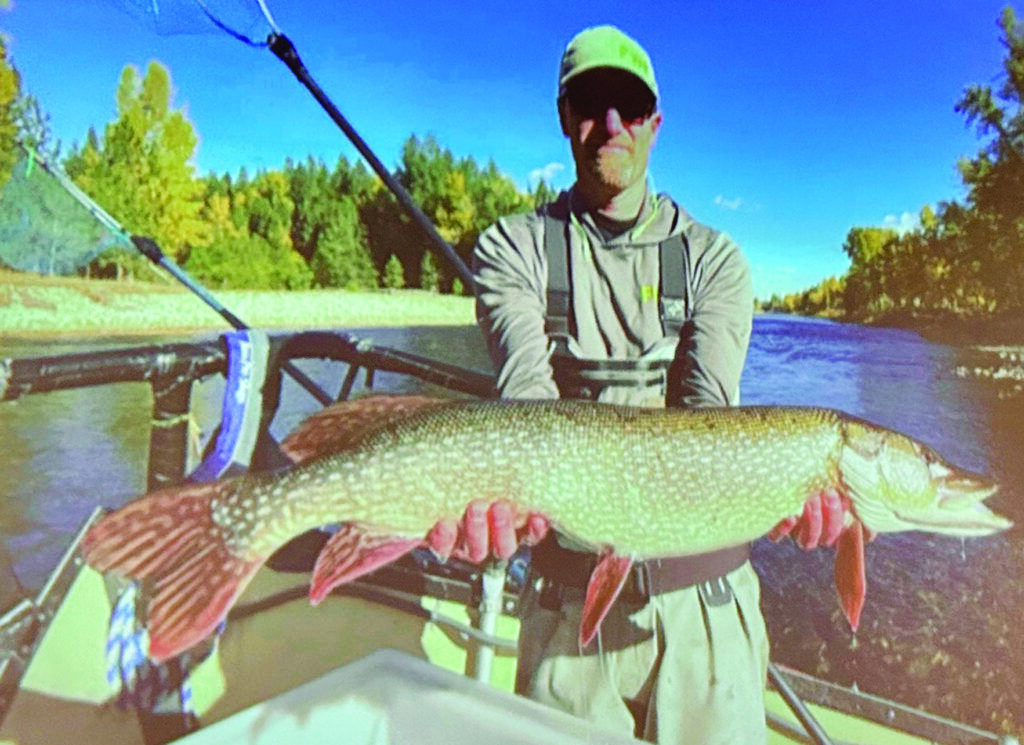
Northern Pike is an invasive species known to be present in the lower Bitterroot River from Stevensville downstream. As the waters warm in the Bitterroot, species that prefer warmer water are gradually moving upstream. This pike was taken in the Hamilton section of the river this year just below the Corvallis Canal. It’s the first time FWP has documented a pike this far upstream in the Bitterroot River. Photo courtesy of FWP.
In the Hamilton section, Rainbows were also showing a little lower population levels but within the range of variability compared to past years. Browns were also showing a little lower levels similar to the Stevensville section. Phenotypically pure Westslope Cutthroat Trout by count (not enough to average) are showing up at about 25 fish per mile which is about average.
Just above Darby in the Hannon section, the Rainbows are estimated at just below average but in the range of variability compared to previous years. The Westslope Cutthroat Trout are right around the long-term average. Browns which have been showing an increasing trend in the area are dropping back down as they are in the Beaverhead and Ruby. But the Bitterroot population is not showing the signs of disease symptoms that are showing up in the other rivers. Lindstrom suggested that the drop in population here may be related more to drought and carrying capacity rather than any disease.
In the lower West Fork, Rainbow populations are down to half the average compared to long term data, perhaps due to drought and possibly some Whirling Disease. The Westslope Cutthroat Trout populations are holding steady, and this year are a bit above the average. Browns are also holding steady in terms of long-term trends, but up a little bit above average this year. A total of ten Bull Trout were counted in this section of the river, which Lindstrom called a “small bright spot” in the species status.
In the upper West Fork, at the Bonnie Blue section just below the dam, no Bull Trout were counted. “It was a little bit weird that we got 10 down below and none up here, but it’s not too odd, they are just getting harder and harder to find,” said Lindstrom. A stable trend is holding for both Rainbow and Brown Trout. Brown Trout numbers are higher here than in the lower part of the river with a lot of spawning activity. Westslope Cutthroat do not dominate here as they do in the lower section. It’s mostly a Rainbow/Brown fishery.

Jason Lindstrom, Montana Department of Fish, Wildlife and Parks fisheries biologist for the Bitterroot, gave a presentation on the state of the fisheries at a recent Trout Unlimited meeting. Photo by Michael Howell.
In the Maynard section on the East Fork, one mile below Sula, Rainbows and Browns dominate. The river is much warmer here than in the upper section. The Rainbows showed a lower than average population level, perhaps due to Whirling Disease, which has been documented in the past and/or to habitat disturbances. Brown trout are showing a very stable population, a little lower than the average.
Further up the East Fork, only 12 Cutthroat and three Bull Trout were counted.
There were several significant rain events that caused a great deal of erosion on the East Fork this past year, which left the river “running like chocolate.” One, about seven miles upstream from Sula, caused a lot of erosion delivering a lot of sediment. A few weeks later one hit the Johnson Fire burn area and blew out an entire drainage, sending big debris and sediment wedges into the channel, according to Lindstrom.
“It will take some big flushing flows to clear out this sediment,” said Lindstrom. “It will take some time to clear this out. It has had some significant impact on pool filling and aquatic insects.” Including the Tolan landslide a few years ago, the East Fork is under incredible sediment assault, he said.
In terms of tributary sampling, Lindstrom discussed annual data from Sleeping Child Creek, Skalkaho Creek and Daly Creek.
About 10.2 miles up Sleeping Child Creek near the hot springs, he said the Westslope Cutthroat took a big hit after the 2000 fires but have since recovered. In 2020, they took another hit but the reasons remain sketchy and the population has mostly recovered from it. The Brown Trout (estimates) and Bull Trout (counts) are moving in opposite directions. More and more Browns are showing up with the second highest estimate in history this year. But the Bull Trout populations have been in decline for several years and this year the count was zero.
”That’s a little scary,” said Lindstrom.
Skalkaho Creek is still a pretty cold creek compared to Sleeping Child and the Cutthroat densities have been fairly stable since 1989. For many years there were no Browns to estimate in Skalkaho but now they are showing up, this year the most ever. The Bull Trout are showing a long term decline. Lindstrom said there isn’t anywhere in Region 1 or Region 2 showing increasing trends in Bull Trout populations.
“It’s scary to see this kind of decline in such a cold reach and see the Browns coming on so strong at the same time,” said Lindstrom.
“Daly Creek is arguably our best Bull Trout stream in the Bitterroot in terms of densities and temperature,” said Lindstrom. This creek also suffered a big debris flow from the Daly Fire a year or so ago. But the long term average for Cutthroat and Bull Trout remain strong and “even a lot of Brown trout knocking on the door,” he said.
In terms of fishing pressure the Bitterroot rates near the top in the state. Mail surveys show an increasing trend with a “ridiculous high” during the Covid years. The pressure shows a little bit of decline in the upper and lower Bitterroot since then but the West Fork is climbing.
In terms of hook scars, catch rates have risen to a high not seen in years. Cutthroats show up with higher rates than Browns and Rainbows in the Stevensville and Hamilton sections despite their lower densities because they are simply “more catchable.” Browns are probably the hardest fish to catch, said Lindstrom.
In the Hannon section, all the species show an increasing trend in catch rates. This year Cutthroats showed over 60% catch rates. Last year was even higher. Rainbows and Browns are above the long term average.
At Conner it was a very similar pattern.
According to Lindstrom, the Bitterroot River is showing quite a bit more pressure than other rivers in the region, with pretty high catch rates.
But is there any real biological impact on the fishery related to the catch rates? Length/weight ratios are generally used to determine such impacts. A classification of scars was created ranging from no scars, to temporary scars (quickly healing scars to perforated membrane), permanent hook scars (with missing pieces), eye damage (blind in one eye). When length/weight ratios of the various categories in the Cutthroat population were compared, it was determined that there was a little bit of difference between each class. But the overall difference was not enough to say there is any measurable biological impact on the fish. Results from the Brown and Rainbows have not been analyzed yet.
Lindstrom said that the potential listing of Westslope Cutthroat Trout as endangered led the state to consider establishing a Conservation Plan for the species. The Bitterroot and Flathead have been a little slow in developing plans compared to the eastern regions of the state where Cutthroat populations are in dire straits, but they are now underway but still in the draft stage.
Lindstrom didn’t discuss the plans but did offer an account of the current status of Cutthroat in the Bitterroot. He said Cutthroat historically were probably found in every drainage and still show up in most drainages. He said one interesting thing about the Bitterroot is that it has both Resident and Migratory Cutthroat populations. He said most places in the state don’t have any migratory populations. There is also an extensive stocking history in the Bitterroot in which Rainbows, which interbreed with Cutthroats, were introduced. Some of it took and some did not. He said we were lucky that it did not take hold in a lot of places and displayed a map showing streams that still contain genetically pure Cutthroat populations.
He noted that the upper West Fork had an incredibly extensive network of streams with unaltered populations of genetically pure Cutthroats. He said the mainstem West Fork and most of the tributaries were still genetically pure.
“This is the best thing we have going in the Region by far,” said Lindstrom. “We have 180 miles of genetically pure Cutthroat habitat with a very high degree of genetic diversity amongst them. This is a really, really important Cutthroat population. We are calling this a Mega Meta population, which means it’s just a giant connected population. This is something that we really want to take care of the best we can.”
He said isolated populations are very important to try and maintain, but so is the migratory population and this will all be part of the Conservation Plan they are working on. He said there is a lot to find out yet about both the genetically pure groups and the migratory populations. They are just now beginning to discuss priorities and targets in relation to the plan and have a lot of information to gather yet.