by John Dowd
In the coming weeks, the City of Hamilton will propose updates to the zoning code and zoning map which will alter the way Hamilton treats properties and structures within the city limits. The city will also propose resolutions for changes to be made to the Future Land Use Map, part of Hamilton’s growth policy update, also referred to as the comprehensive plan. Both will be used to inform how Hamilton will develop in the future. Matthew Rohrbach, the Hamilton city planner, spoke on the process, what the people of Hamilton should expect and how their voices on these issues can be heard.
According to Rohrbach, in early December the city held a public hearing recommending the adoption of the updates to the future land use map, as well as zoning ordinances, to get the ball rolling. These proposals have since been on the table, and open to public comment. Comments have already had an impact, however, important meetings are on the horizon.
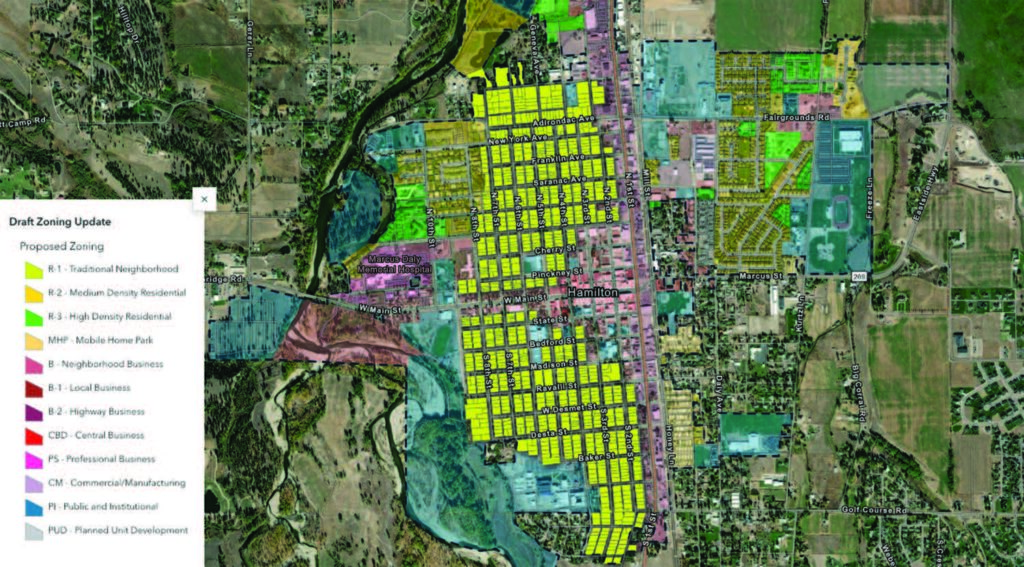
Image of the interactive map from the hamiltonzoningupdate.com site.
According to Rohrbach, the January 6 Hamilton City Council meeting is the big one, where he will update the council on all changes and give a presentation on the entire series of updates. Between then and the end of the month, the public will have more time to comment and will have all the information. On Jan. 6, the Hamilton City Council will cast the first vote for or against an intent to adopt the changes, and on Jan. 20, the Council will finalize its decision. Both meetings will occur in City Hall at 7 p.m.
These proposals have already seen some confusion as well as opposition. However, as Rohrbach explained, the important and more informative meetings are to come. When asked what opposition the proposals are seeing, Rohrbach said some of the biggest concerns have been about single family residential areas and how some proposed changes may affect structures and development there.
These changes would alter these areas, primarily on the west side of town, to allow up to a four-plex to be constructed in westside neighborhoods.
“People really care about the westside neighborhoods and the look and feel,” said Rohrbach. “Some are concerned, asking how this is going to fit in with those older existing neighborhoods.”
To address this, the zoning ordinance updates make several concessions. One Rohrbach cited was the plan to lower the maximum heights and require further setbacks, all in an effort to maintain the traditional look of the area, and to not take away from what people all over Hamilton love about the west side.
“We put in restrictions that match that atmosphere,” said Rohrbach, “more congruent with what we see on Hamilton’s west side today.”
According to Rohrbach, “form and scale matters” in maintaining the spirit of the area. Moving forward, “development that comes in is going to need to match that form and scale,” said Rohrbach. He stated how they are trying to allow incremental growth, but not drastic growth. A big part of the reasoning is because many in the lower and middle classes are struggling to find appropriate housing.
“Having a greater diversity of housing options that meet the needs of our population,” said Rohrbach, is a key part of development. However, they do not want to do this at the cost of losing the area’s historic character, or its clean, quaint and safe atmosphere.
Rohrbach pointed out that there are already multi-plexes in the area, many of which are scattered around. This was done before zoning was even adopted in that part of Hamilton, and many of those are grandfathered in. However, those areas face difficulties as well.
Currently, the proposals are in the public comment phase, and comments can be made at any time, in person or on the website. Something that came from the public comment so far was to address the issues that have been pointed out by the owners of these grandfathered-in properties. These commenters have asked that allowances for exceptions and flexibility be incorporated into the zoning updates.
To explain this, Rohrbach said these pre-existing properties are considered “non-comforming.” These structures are currently all subject to some pretty substantial limitations, including that if any damage occurs, owners are limited on what they can repair, and expansion is completely out. With the new proposal, these places would be treated more leniently if something were to happen. Damage, expansion, repairing and rebuilding are all current concerns for these property owners, and would be remedied with the proposed updates.
The updates would even allow rebuilding on existing footprints, as long as it does not affect health and safety. Limited expansion would also be allowed. According to Rohrbach, the goal is to bring everything more in line with the zoning updates and to allow more flexibility to those existing structures. This is important, because Rohrbach also stated that a lot of Hamilton’s west side is in this category; it affects a lot of people.
For more information, Rohrbach recommends interested parties visit the City of Hamilton website, as well as the interactive story map at hamiltonzoningupdate.com. There, people can submit comments, track changes and much more, really “diving into all the details,” said Rohrbach. He added that there are a lot of updates being proposed, so the community should be informed on what will be changing.
For the city, Rohrbach said it is important for them to match these updates to the Future Land Use Map, which will reflect in the changes to the zoning ordinances. All of this will help “produce predictability for properties” for development, and ensure that that development meets the standards set by the people of Hamilton.
Helen says
To drive in Hamilton now is a disaster. Some idiot put in those stupid curvy lanes and when snow is thick – that makes di]riving terrible in the city.
Michele says
The City Council meeting voted and approved the zoning laws for Hamilton on Jan 6. There were clear objections voiced by the residents of Hamilton west side that they do not want to have their property surrounded by fourplexes. The city planners discount this request. The repeated response is that there are very few instances where this would happen or it would be a long time before this happened. Neither of these statements are true. Westside resident’s concerns are being gaslighted or minimized. They are treated with contempt and disdain. I have observed this at the October City Council meeting, the informational meetings in November, the December 1 meeting and the January 6 meeting. Matt Rohrbach said himself that the most common objection was fourplexes. The city council voted “yes” on rezoning changes that are clearly opposed by westside residents.
The title of the rezoning R1 is a misnomer. It should read “Nontraditional residential R1”. This is the second time west side density is being increased. It was doubled by adding ADU’s the first time and now doubled to tripled with triplexes and fourplexes. Density is not good for mice or humans. There is a lot of current discussion about helping young families buy homes. Does Hamilton want to help young families or developers. But clearly, current residents do not want to be be surrounded by large triplexes and fourplexes. Does anyone care about the character and culture of the westside? The westside has largely built and maintained the sewer and the water distributions plants on which city intends to build further infrastructure. Their voices deserve to be heard with some modicum of respect and attention.
Patty Hascall says
Historically city expansions totally ignore how traffic will be handled as well as other infrastructures. We only have to look at Missoula to see this. There is one way in and one way out of this valley and virtually no way to alleviate the traffic problems we already have. No way to widen the road or divert traffic through Hamilton. It’s a serious problem that should be addressed BEFORE large developments are approved. AND the expense of improvements should be borne by the developers not the citizens already here by increasing taxes.
Jeanine New says
I have concerns with building new multi-family structures adjacent to a flood plain. How is Hamilton City administration planning to address added lives that may need evacuation and flood management during a disaster?
What are future plans proposed to support updated water and sewer systems necessary to support added families? Is there a future plan to address water needs to support aging water pumps and wells before moving ahead with expansion? Please share that with us.
Michele says
Changing dimensions of the buildings does not make up for the fact that instead pf 4 neighbors you now have 8-16 new neighbors. Do not need new zoning to accommodate a few multi family units in existence today because they have already been grandfathered in. The priorities in rezoning and future use are inappropriate. The westside will never be the same and will look even more chaotic than the east side.
This is a huge power grab by the city of Hamilton. I hope residents will look at these proposals thoroughly and protest loudly. Rohrbach and the city of Hamilton will have too much control over your projects and your land. Plus they was to use a leaky water system and a strained sewer system for future development