Baseline water quality established near potential rare earth mine site
by Michael Howell
The Bitterroot River Protection Association (BRPA) has released the results of a base-line study of the water quality in the upper West Fork of the Bitterroot River, documenting the status of the watershed in the area of a proposed rare earth element (REE) mine.
According to Dr. David Chambers, founder and President of the Center for Science in Public Participation (csp2@csp2.org), who examined the monitoring results, “It looks like very good water. The very low sulfate values suggest no natural or mining acid drainage…right now I would call the water pristine.”
“We are not surprised by these results,” said Andy Roubik, BRPA president. “It’s what you would expect to find over 700 miles inland at the very tip top of the Columbia River watershed.”
“We believe the old adage, ‘you don’t know what you’ve got till it’s gone,’ doesn’t really hold water here in the Bitterroot,” said Roubik. “We believe that most people in the Bitterroot Valley know very well what they’ve got here, and we are not at all ready or willing to lose it.”
According to Roubik, the lower portion of the Bitterroot River currently tests positive for lead contamination. A thorough investigation by Montana Department of Environmental Quality as part of its 2014 TMDL assessment on the mainstem of the Bitterroot River from Missoula to Stevensville, which included examination of abandoned mines in the Eightmile and Three Mile Creek drainages, failed to determine the source.
However, the search did not include examination of the Victor area around the site of the Curlew Mine because that mine had already undergone a Superfund cleanup and was presumed to be clean. The Bitterroot Star discovered subsequently that old tailings from the Curlew Mine were being used extensively by the Ravalli County Road Department and other private contractors for graveling roads in the north valley area and even being used as fill in the installation of stream culverts.
A study conducted by Bitterroot College UM hydrology professor George Furniss and graduate students confirmed lead contamination that could be traced back to the Curlew Mine tailings. A video of the study and results can be accessed on the BRPA website www.bitterrootriver.org (click on Bitterroot River Health Check and click on projects).
“We don’t want the upper Bitterroot River to suffer the same fate and have an out-of-state company come in and contaminate a pristine watershed and potentially the entire Bitterroot River and leave the public to clean it up,” said Roubik. He said contamination from REE mining is documented to be worse than conventional mining, involving potential radioactive contamination and, in this case, potential asbestos contamination as well.
“The Bitterroot River is the lifeblood of our valley,” said Roubik. “It is the foundation of the valley’s economy which is primarily based on agricultural and recreational enterprises, both of which require lots of clean water.” He said the Bitterroot River Basin is closed to any new water right appropriations due to the over-allocation of the resource already. “Mining operations, especially REE mining, require a huge amount of water and, unfortunately, they carry an extremely high potential for contaminating water in the process. It doesn’t make any sense to risk everything we have going for us here in the Bitterroot to put in a mine with such a high potential for spoiling it all at the tip top of our watershed.”
Dr. Phillip Ramsey, a local scientist with years of experience working on the Superfund clean-up of the Clark Fork River and leader of the Bitterroot Clean Water Alliance which formed in opposition to the mine, is very much in agreement with Roubik.
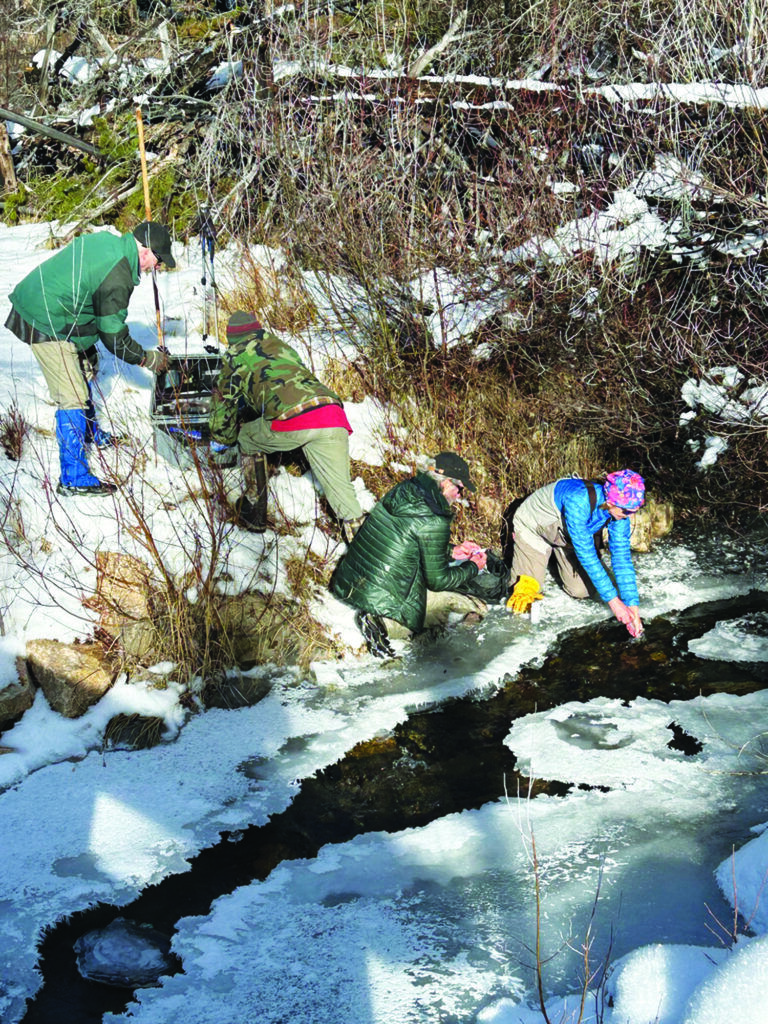
Bitterroot River Protection Association volunteers Mark Van Loon, Doug Soehren, Larry Campbell and Michele Dietrich collecting water samples from Johnson Creek in the area of the proposed Sheep Creek Mine. Photo by Michael Howell.
“Rare earth element mines use far more water and create more toxic and radioactive waste than other types of large surface mines,” said Ramsey. “Since 1980, every new large mine permitted in Montana has caused unanticipated, often severe, impacts to water quality, except for Montana Resources, in Butte.” He said the location for the proposed Sheep Creek Mine is remote, in steep terrain, and snowbound in winter, all factors that make environmental contamination more certain. He said Montana could easily become a world leader in critical mineral production, including rare earth elements, without sacrificing a pristine watershed in the Bitterroot and pointed to potential rare earth element production from existing sites like the Berkeley Pit in Butte, the piles of coal fly ash in Colstrip and the shuttered Columbia Falls Aluminum Smelter Superfund site.
The Department of Defense is currently considering funding a $75 million grant to Montana Resources to build a rare earth element concentrator in Butte. He said supporting this project is a very good alternative to placing a new mine in one of Montana’s most valuable pristine watersheds. He recommends urging public officials to reconsider capping the Aluminum Smelter Superfund Site in Columbia Falls and instituting a gallium recovery operation there instead. He said the Colstrip fly ash contains extractable rare earth elements as well.

The pristine waters of the upper West Fork of the Bitterroot River sparkle in the morning light just below the proposed Sheep Creek Mine. US Critical Materials, owner of the Sheep Creek mining claims, is a private company headquartered in Salt Lake City, Utah with 2 to 10 employees. US Critical Metals Corp. is a publicly traded company that has an agreement with US Critical Materials to earn up to 75% joint venture interest in the property. The partnership allows US Critical Metals Corp to advance the rare earth projects identified by US Critical Materials, with the goal of establishing a domestic supply of critical minerals for national security and technology. US Critical Metals is headquartered in Vancouver, Canada. It is a subsidiary of European Lithium Limited, an active overseas mining exploration company, incorporated in the Virgin Islands, which wholly owns the Wolfsberg Lithium Project located in Austria. European Lithium holds 50.55% of the shares in US Critical Metals. No other shareholder holds more than 2% of the shares each. The partners have announced annually since 2023 that they are going to begin exploratory drilling on their claims in the area but each year have failed to do so. The most recent announcement was to start in September of 2025 but to date no Plan of Operation has been submitted, a requirement for mining on National Forest land. Photo by Michael Howell.
According to Ramsey, the single biggest barrier to all this is retroactive liability under the Superfund law.
“Anyone who handles contaminated material can be held strictly, jointly, and retroactively liable for the entire cleanup—even if they improve the site,” he said. “This deters companies from reprocessing mine waste or coal ash. Repealing or reforming that liability is the key to unlocking Montana’s economic potential and making new headwaters mines unnecessary.”
Roubik said that establishing a baseline for the current water quality in the upper West Fork is a continuation of BRPA’s adopted mission since 2018 to establish a systematic set of permanent water quality monitoring stations across the entire Bitterroot River Watershed. Since 2018 the organization has established 23 monitoring sites on 10 tributaries and seven sites on the mainstem of the Bitterroot River.
According to Roubik, due to limited funding, aside from the nutrient and stream flow parameters collected in the first two rounds of sampling, metal testing was confined to looking for arsenic, lead and selenium, which are the most common form of pollutants produced in any kind of mining operation. No detectable levels of arsenic, lead or selenium were found in any of the samples. In the final round of sampling they also tested for many other metals commonly associated with REE mining, including cadmium, calcium, copper, nickel, silver, zinc and chromium VI. No detectable levels of these metals were found in any of the samples.
Roubik said the Sheep Creek Mine monitoring project totaled about $5,856 in laboratory analysis costs alone.
“We could not have done it without a lot of help from our friends,” said Roubik. “We owe a special thanks to our compatriots in river protection, the Ravalli County Fish and Wildlife Association, the Friends of the Bitterroot and grants from the Cinnabar Foundation, the Rapp Family Foundation, Trout Unlimited, Farmers State Bank and several individual donors. Of course, we also owe a special thanks to the volunteers that did all the work: Mark Van Loon, Larry Campbell, Doug Soehren and Michele Dieterich.”
For more information about the group’s activities visit www.bitterrootriver.org or contact them at bitterrootriverprotection@gmail.com
Clark P Lee says
Although this all seems obvious hopefully this puts an end to the consideration of this totally unnecessary project.
Linda Schmitt says
I am so grateful to Andy Roubik and the bitterrootriver.org for having the foresight to conduct this study. Thank you, than you.