by Michael Howell
The MPG Ranch located along the Sapphire Mountain range at the north end of the Bitterroot valley is not your ordinary Montana ranch. It is actually a state-of-the-art biological research station devoted to ecological restoration, research, and education. It began with the purchase of the Shroeder family ranch and some additional acreage in the area in 2009 covering about 6,500 acres. Since then, in 2016 additional acreage once owned by Champion International and then Plum Creek has been acquired, bringing the current total to about 15,000 acres.
MPG Ranch General Manager Phillip Ramsey was at the North Valley Public Library last week to give the community an update on the operation. He said their aim, from the beginning, was not to mimic the conventional academic-oriented biological stations generally associated with universities, where scientists are cloistered in isolated offices each at work on projects located around the world without much collaborative focus.
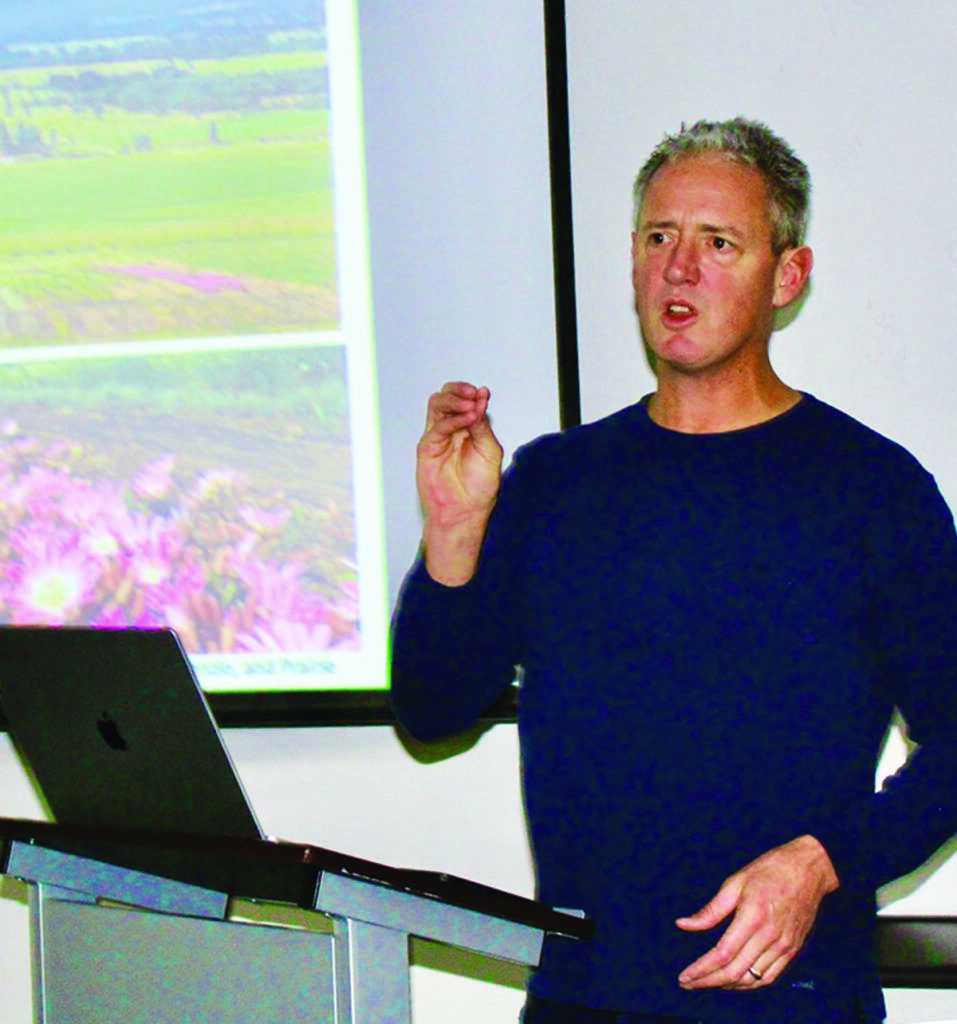
Dr. Phillip Ramsey, General Manager of the MPG Ranch, explains why and how the biological station propagates its own native plant seeds for use in the massive restoration project being conducted on the 15,000-acre ranch located east of Florence. Photo by Michael Howell.
“What we wanted was to have a team of scientists here all working together trying to understand the ecology of this place,” said Ramsey. He said the place was chosen because it was a landscape transformed by over 100 years of intense agricultural activity and decades of intense industrial timber operations on the neighboring forest land. So, a team of scientists was put together including experts in chemistry, molecular biology, microorganisms, soils, non-vascular plants, vascular plants, and all sorts of animals including insects, butterflies, birds, reptiles and mammals, all focusing on projects aimed at restoring the landscape to a more natural condition.
According to Ramsey, the degradation of the natural landscape in the area through over-grazing, for instance, began very early in the Bitterroot, with the introduction of the horse. He said when reading the accounts of the Lewis and Clark expedition as they passed through the Bitterroot, three things especially caught his attention. For one, they were carrying their dogs because of all the prickly pear cactus. He said they also kept talking about the stony badlands they were walking around in. Thirdly, they were astounded by the number of horses, with each man having up to a hundred horses.
“Instead of trails passing through Stevensville in 1805, they were on a wide road,” he said. “So the human history in this place goes really far back.”
According to Ramsey, after World War I, wheat was going for $5 a bushel and the local farming families plowed up everything they could plow “and the native prairie in the area was turned upside down.” He said the whole landscape was transformed in a major way by the wheat farming and the intensive grazing of cattle and sheep. The native vegetation was eliminated and replaced with non-native forage and accompanying invasive weeds. The draws running through the landscape from the Sapphire Mountains were rapidly eroding.

Photos by Gus Seward help document the progress from 2010 (above) to 2019 (below) in the restoration of native vegetation on the MPG Ranch.
Up in the forest land, Champion International did heavy roading and logging and clearing the forest. This was followed by Plum Creek which really hammered the area, hurrying to take all they could as they morphed into a real-estate company.
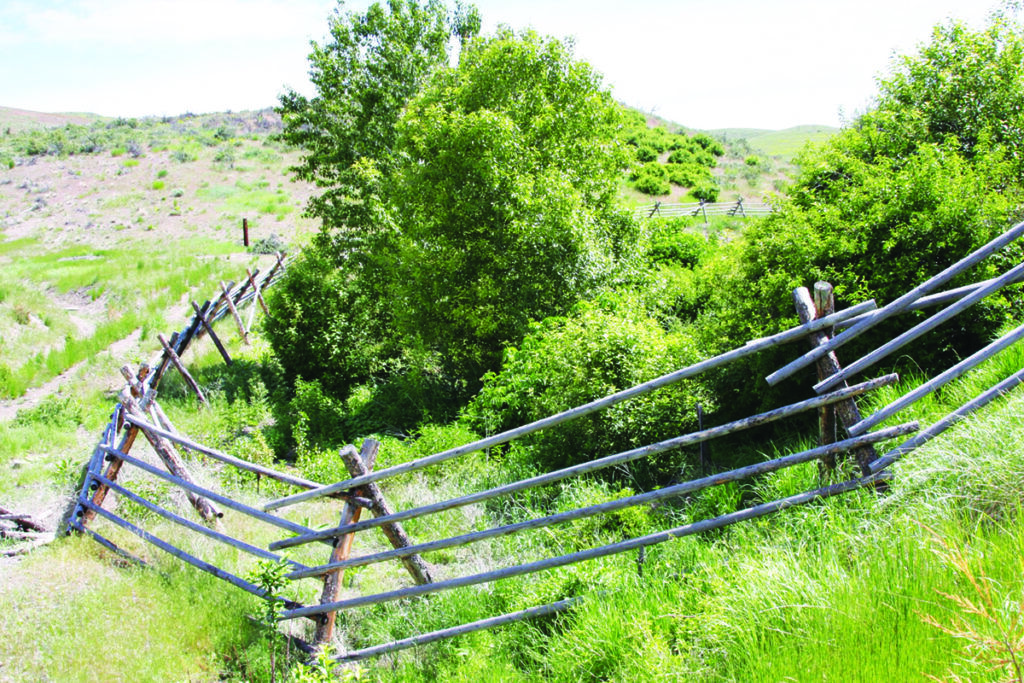
Photos by Gus Seward help document the progress from 2010 (above) to 2019 (below) in the restoration of native vegetation on the MPG Ranch.
So, the MPG Ranch went to work documenting what was there in terms of soil, plants and wildlife and began the long hard work involved in restoration. Bringing in woody debris to hold water on the land, and planting mostly native grasses, trees and shrubs, surveying and documenting everything as they went along.
They established a grid of 570 points across the ranch, each point separated by 250 meters, and began surveying the plant communities and bird communities at each site. They set up a system of 78 trail cameras to document wildlife movement across the ranch. They now have a system of 19 live cameras that can be accessed by the public on the internet for those interested in viewing wildlife activity on the ranch in real time. While these cameras are currently offline during the hunting season, they will be back online after Thanksgiving.
Ramsey said that most news stories about their work on the ranch usually focus on the large animals and their research on bears, mountain lions, golden eagles, elk and other mammals.
“But by far the vast majority of work we do there is focused on restoring native plant communities and documenting and understanding wildlife response to that,” said Ramey. “Birds are good indicators of the condition of the habitat.”
He said Kate Stone, head of the avian research on the ranch, was working with both the University of Montana and the Raptor Institute in monitoring bird activity in the area. He said Stone can identify any bird in Montana by sound and goes out twice a year for 10 minutes to each of the 570 grid points on the ranch and records the bird species, identifying each bird, and estimating its distance from the grid point and the direction as well as the bird’s sex.
Over the last 15 years they have documented a very positive impact along stretches of five draws that cross the ranch from the mountains to the river. At one site, for instance, six birds of five different species were identified in 2011. At the same site in 2019, seventeen birds were identified and eight different species. At another site in 2011, thirty-seven individual birds were identified and seven different species. In 2019, forty-four individual birds and fifteen species were identified at the site.
In response to audience interest, Ramsey discussed the large herd of elk, about 600 of them, that roam the ranchland. The ranch has a hunting program aimed at managing the elk population. The most effective method for controlling big game populations is through the harvest of female ungulates. They are trying to preserve and enhance the population of mature, old bull elk. For this reason, their hunting efforts focus on harvesting antlerless elk and white-tailed deer. Other big game and game bird species on the ranch do not currently require management through hunting.
According to the ranch’s web site, each year, they average approximately 85 hunters who harvest around 50 antlerless elk. Hunter access varies annually based on their management needs and goals. Hunters are selected based on their skills and their history of volunteering with the ranch. Permission is rarely granted to hunters unfamiliar with MPG Ranch.
All big game hunters are required to use non-lead ammunition, and elk hunts are supervised by ranch hunt coordinators. The ranch also hosts an annual Youth Field Day for hunters aged 10–14. Participants learn about wildlife conservation and rifle accuracy. Those who complete the course and demonstrate exceptional shooting skills may earn a chance to hunt antlerless elk on the ranch. For more information on this program you may email: hunting@mpgranch.com.
Ramsey said collaring and tracking studies done in 2014 and 2015 confirmed the presence of the elk and the fact that they are not hanging out on public forest land very much. They are congregating on private ranchland. A controlled comparative study in the area of road closures on the forest revealed that road closures don’t have much effect on the elk’s habits. They are also trying to move the elk back up onto public land but not having much success. When they have moved the elk, they simply move onto other private land.
One thing is certain though; it is not wolves driving the elk out of the forest and onto the ranchlands. He said out of 40 elk collared over a two-year period, not one elk was found to have been killed by a wolf. He said wolves are functionally gone from the area. One elk was found to be killed by a lion, but it had also first been wounded by a hunter. He said hunting was by far the main factor in elk mortality, with a few dying by vehicles.
The amount of study projects and data collection conducted has produced a wealth of information in areas of research ranging from avian ecology to mammals, to plant phenology, to range restoration, to reptiles and amphibians, to soils, plants and invasive species, to vegetation monitoring and more. Over the last 15 years, scientists on the ranch have produced about 180 studies published in accredited and peer-reviewed journals. All the information is available to the public on their website at www.mpgranch.com. Published papers can also be accessed on www.scholar.google.com
MPG Ranch does not offer general open access. Since 2010, thousands of visitors have come to the ranch as part of school groups, volunteer projects, or guided tours. If you’re interested in visiting, it is recommended that you subscribe to the ranch’s newsletter to learn about upcoming opportunities. For other inquiries, you can email: info@mpgranch.com.