by Michael Howell
Lolo Creek has been going dry for years, especially in the lower reaches, but more so in the last few years than in the past. This past year a number of dead fish lining the dry creek bed drew a lot more attention to the issue, spurring the Lolo Watershed Group, a local non-profit formed in 2003, to rev up its efforts at implementing the Lolo Creek Restoration Plan by rallying the entire community to help in developing a more detailed Drought Management Plan.
The Clark Fork Coalition (CFC) has been working on development and implementation of stream restoration plans on impaired tributary streams in the Bitterroot for years and is helping the Lolo Watershed Group in its efforts. According to its Stream Restoration Director Jed Whiteley, Lolo Creek has been going dry on and off for years, but this year it was longer and more sustained than in the past.
“We are in our second year of an historic drought in the Lolo area,” said Whiteley, “and this year the creek has dried up and stayed dry. Really at this point what we are seeing is that it’s a supply issue. There is just not enough water coming out of the mountains.” He said the water comes out of a narrow canyon and opens onto an alluvial plain that works almost like a giant colander which the water pours through.
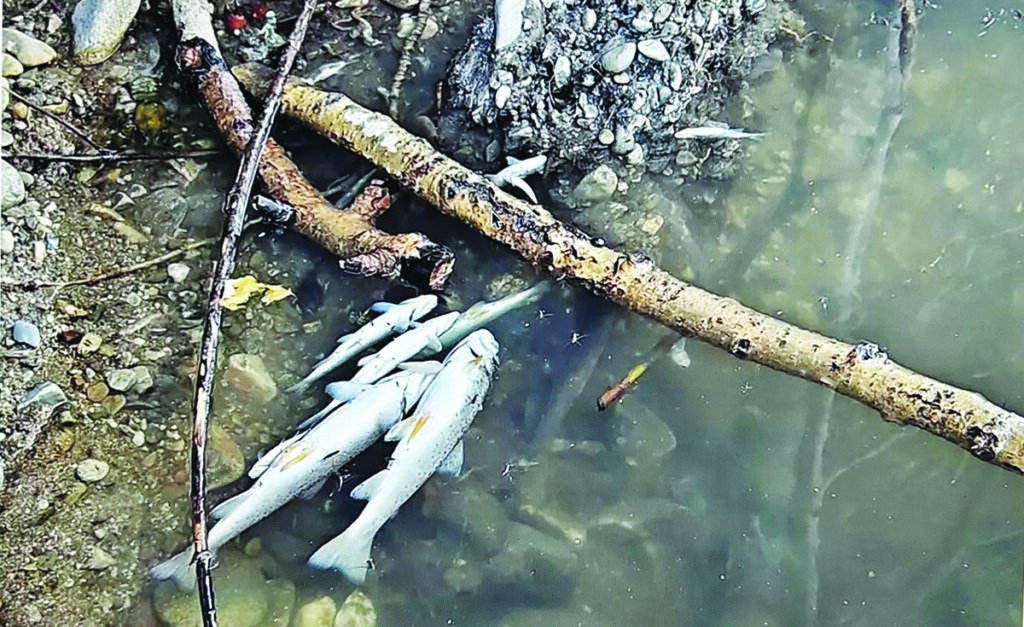
A recent fish kill in Lolo Creek has drawn attention to the drought impacts on the creek and the Lolo Creek Watershed Group’s efforts to address the issue. Photo courtesy of the Lolo Creek Watershed Group.
Although the Bitterroot Fault, which runs through the area, may also be exacerbating the loss, according to Whiteley, studies done by the Department of Natural Resources and Conservation (DNRC) and the Bureau of Mines and Geology have documented losses above the fault at over 11 cubic feet per second (cfs).
Whiteley said a lot of work was already being done in the headwaters to address the problem and that the Lolo Watershed Group was taking the lead in addressing the recent drought conditions.
The group originated in 2003 as an information clearinghouse where a steering committee offered a forum for dialogue. Since then, they have facilitated riparian restoration, debris removal, channel rehabilitation, snowpack analysis, and mitigation of instream and on-the-ground sediment load, along with educational outreach to the community and local schools.
In 2013 the group authored and received approval from the US Environmental Protection Agency and the Montana Department of Environmental Quality for the Lolo Creek Watershed Restoration Plan. Now, facing the most recent extremely dry conditions in the valley, board member Ron Pierce, a retired Montana Fish, Wildlife and Parks fisheries biologist, is drafting a “very preliminary” Drought Management Plan.
“We seem to have some traction, with cooperation of irrigators, and it looks like everyone is ready to dig in and start working on it,” said Pierce.
The Lolo Watershed Group and CFC have been working with the principal irrigators, like those on the McClay Lolo Ditch, to address the problem. The McClay Lolo Ditch system holds about 30 to 35 cfs of water rights. But when the creek went dry this year, they reduced their withdrawals to around 16 to 17 cfs. According to Whiteley, FWP talked with the OZ Ranch, another major upstream irrigator, and they pretty much shut down too.
“We are in the early stages of trying to write a drought management plan working with state and federal agencies, conservation groups and all of the local stakeholders to see if we can begin implementation of something that we can all agree on in terms of solving the problems,” said Pierce. “It’s an attempt by our group to lay the science out there and bring people together to solve some common problems and do it in a way that is good for a small community like Lolo. My sense is people want to help solve some of these problems and we are going to try to put together a plan that helps enable that through a community conservation project.
“I think the community expects their local watershed group to look into this and do what we can to help this stream function a little better. It’s not going to be an easy process, but it can work if people agree that we have a problem and if they care about the stream and I think we are at that point. We are going to give it our best effort.”
For more information about the Lolo Watershed Group and the Lolo Creek Drought Management Plan visit: www.lolowatershed.com.