by Victoria Howell
The Bitterroot Valley Board of Realtors recently held a panel discussion on the ins and outs of selling commercial property in the Bitterroot. The cooling of the real estate market, coupled with high interest rates, is a cause of concern for real estate agents. The forum was designed to help with ideas for how to market and finance properties in this environment. Panelists included commercial bankers from Farmers State Bank, which was a sponsor of the event.
The panel discussion was chaired by Craig Siphers, who is serving his second stint as the president of the Bitterroot Valley Board of Realtors (BVBR). Siphers, 66, has been a real estate agent for 38 years. He started with his own firm, then went to Properties West (which no longer exists). Eighteen years ago he went to work for Exit Realty at the Hamilton office. He currently sells real estate in a partnership with his daughter Erica.

Craig Siphers, president of the Bitterroot Valley Board of Realtors, has been selling real estate in the Bitterroot for 38 years and has seen a lot of ups and downs in the market. Photo by Victoria Howell.
Siphers was born and raised in the Bitterroot. Spending more than half his life in real estate, he has seen a lot of ups and downs.
“My dad was a broker, so I was immersed in the real estate business basically since 1966,” says Siphers.
He recalls that in the early 1980s a recession pretty much shut down the market, “nothing was happening in real estate.” At that time there were 89 members in BVBR, said Siphers. “Currently there are 255 members, with the highest ever in 2006 – well over 300 agents.” He said roughly 1.5 million real estate agents are members of the national association, of which BVBR is a member.
Siphers said that, after the high sales numbers following the pandemic, in 2024 about half of the members in BVBR didn’t sell anything at all. Referring to the high number of agents, Siphers noted, “Very few agents actually do make a living at this.”
Siphers and most other agents don’t really have a specialty, he said. “You have to really be a generalist, which means you have to do commercial. I do more commercial sales than most of the others. Nationwide, that is where the money is. But it’s a very small portion of sales in the Bitterroot. It’s a little better in Missoula.”
“Commercial is tougher than nails,” he added.
When the “Yellowstone” television series was being filmed in the Bitterroot, the capitalization rate (a percentage that equates to the potential return on the investment) was high, because rental properties were in high demand. Interestingly, although the series is finished, rents have remained high, and properties are not selling as quickly as they were.
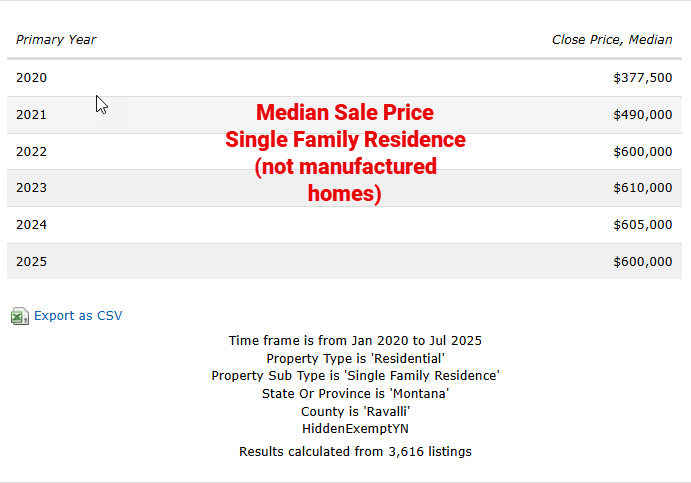
The median sale price for single family homes in Ravalli County has gone from $377,000 in 2020 to $600,000 in 2025. Credit: MLS.
“Rents for 2-bedroom, 2-bath units went from $700 to $1400 in four years,” said Siphers. “That affects employers and workers. It became a problem finding workers because they couldn’t afford to live here… It’s softened a bit now, you can see it softening. Our residential market for single family residences, we now have a 9-month inventory. From a 6-month inventory, it becomes a buyers market, the days on the market are really stretching out.”
Siphers said that it’s a challenging time for the real estate market in general.
“There are so many variables,” said Siphers. “We’ve gone from 40 to over 100 average days on the market. Some are not being realistic in their pricing, still thinking it’s what it was a few years ago. The other part is that you’ve got people who are sitting at a 3% interest rate and don’t want to move to 6+%.”
He said that another element is that prices have escalated to the point that locals can’t afford a home. “The National Association of Realtors has recognized Montana as being one of the least affordable places for real estate in the country,” said Siphers. “Average income versus average and median home prices don’t mesh.”
The National Association of Realtors requires a certain amount of outreach to the community, as well as to the agents themselves. This is part of the core standards for membership. Siphers said that the recent panel was an opportunity to discuss various pricing models for commercial real estate. He said there are three appraisal approaches: market comparison by sales history; cost approach – what would it cost to replace plus depreciation; and an income approach – assigning a cap rate falls within that approach. He said that a price could also be some multiple of gross sales. With commercial properties, the bottom line for buyers is a realistic determination of what will be the return on their investment. Siphers mentioned that determining a realistic price is challenging. One problem is that many small business owners don’t keep good records of income and expenses; he advised that anyone thinking of selling a business should make an effort to have at least three years of detailed records.

Total sales volume of all properties in Ravalli County reached a high of $525,297,154 in 2021. The total is $208,275,128 for the first seven months of this year. Credit: MLS.
The folks from Farmers State Bank said that even though commercial lending rates are currently high, above 7.5%, there are still a lot of commercial deals happening, and owner financing remains a good option.
Storage units are still one of the best commercial investments in the valley, said Siphers, even though with the ubiquitous storage unit businesses it doesn’t seem possible that there could still be a public demand for this service. But, said Siphers, as soon as they are built, they fill up. Another still solid commercial property investment is mobile home parks, according to Siphers.
“There are lots of moving parts to commercial real estate,” said Siphers. “Farmers State Bank, and other smaller local and regional banks, are pretty flexible in how they can provide financing. Farmers, Stockman, Clearwater, they all are willing to look at this. They have local underwriting authority which is particularly helpful for business owners. There are so many ways to structure the financing.”
The lending bankers who attended the panel concurred, all saying basically that, where there’s a will to make a business sale happen, there is usually a way for them to put together a financing option.
However, Siphers emphasized that the real estate agent has a big responsibility in ensuring that the property is valued correctly.
In the end, “the person who buys a working business who is savvy has in their mind what the risk factors are,” said Siphers. “They decide what it’s worth to them. A willing and able seller and a willing and able buyer will eventually come to terms,” with the help of a good realtor.
The BVBR not only serves its members but it also serves the property owners of the valley whether they’re buying or selling, which in turn has an impact on the population in general, said Siphers. “With respect to the property owners, we like to think we advocate for private property rights which is a core mission of ours. And with respect to the general public, we have elements of our organization that are sensitive to the fact that we’ve had a meteoric rise in property value which has put pressure on affordable housing. We monitor the Board of Health, the Planning Board, the Department of Environmental Health.”
“One of the things we did as an organization was we mobilized heavily against Senate Bill 358 in this last session,” said Siphers. “The basic goal of SB358 was to protect the aquifers in certain basins. It came out of a Broadwater County decision. But, the bottom line was that it closed the basin, effectively stopping any new wells. Now, it is stupifying to me that, according to the Bureau of Mines and Geology, who were not even on the task force that made these recommendations with regard to these basins, recent studies say we are sitting on top of 600 billion gallons of water in the Bitterroot valley. We use roughly 4.5 to 6 billion gallons of water per year. There’s plenty of water.
“SB358 would have closed our whole basin which would have skyrocketed bare land prices and stopped construction entirely. It was just absolutely ludicrous.
“We were told by the people in Helena that our organization and our mobilization was instrumental in getting this stopped. It was a big win for our organization.”
Following the panel discussion, the group toured several commercial properties currently for sale. Prices ranged from $175,000 for a stone veneer manufacturing company in the Hamilton area with no land, to $2,975,000 for a grocery store with various living spaces on several acres of land in the Hamilton area.
Betty Landwehr says
Wow! Great job, Craig! Very educational and easy to understand. Thank you.