by John Dowd
It could be argued that blood is the most important fluid in the human body. It carries oxygen and nutrients throughout the body, and assists in every function of the anatomy. It is no wonder that it is always in great medical need. To attempt to fill this need, the American Red Cross has been holding blood drives since 1941, and today, the American Red Cross is responsible for providing over 40% of America’s blood and blood components.
Something a lot of people may not be aware of is that Montana is one of the top contributing states. Montana regularly donates more blood than it needs, and that blood often makes it across the country, to areas of greatest need.
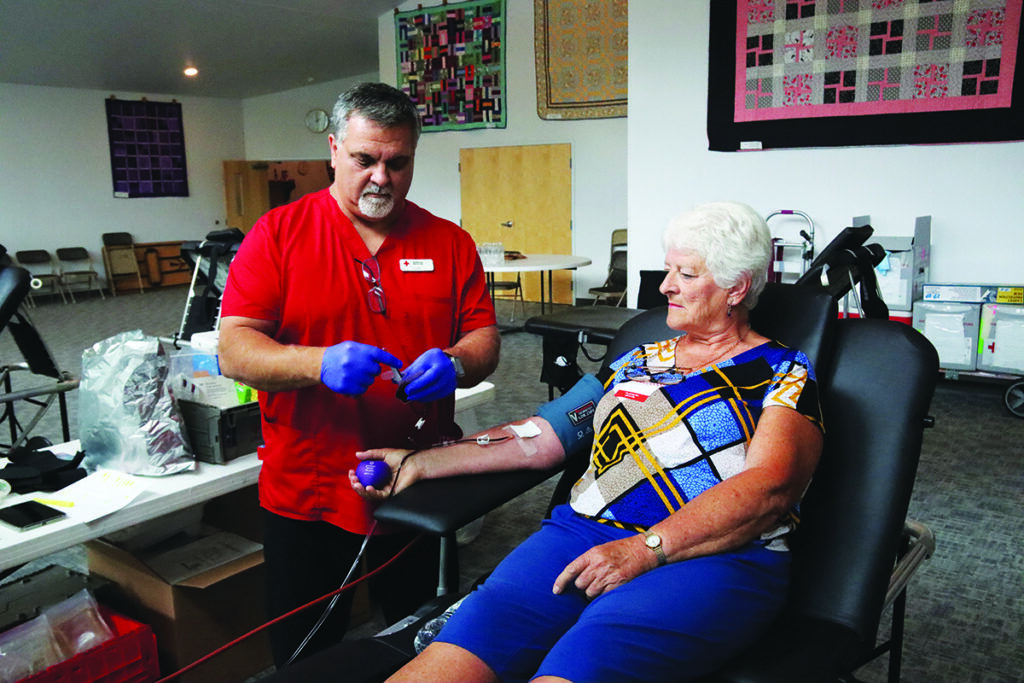
Gail Olbricht prepares to have her blood drawn through the “Power Red” machine by Luis Hall, a local and lead mobile phlebotomist for the American Red Cross blood drive in Stevensville. Photo by John Dowd.
One location, referred to as the “Stevensville Blood Drive Center” by the American Red Cross, has been donating since 2001. The Stevensville United Methodist Church is one of the top drive locations in the valley, and they have so far held 115 drives. Last Friday, they held one of these drives, and as of last Friday, they have seen over 670 first-time donors. The place has collected over 4,014 units of blood since the beginning. Over the last year, as they have seen the need increase, the church has moved to holding drives monthly, instead of every other month.
Beverly Schneider has helped to organize these events for the last 10 years. Schneider is a retired registered nurse, with a career of 54 years behind her. She loved what she did, and loved the interaction with people, and helping to “save lives.”
“I loved every year of it,” said Schneider.
Schneider spent the majority of her career in critical care, and now, she is the ambassador of the Stevensville United Methodist Church blood drive, on behalf of the church. This event has always been organized by a local chapter of United Methodist Women of Faith, the local chapter of which Schneider was president until recently. They help organize all the blood drives hosted by the church, helping schedule people to donate and preparing the space for when the American Red Cross blood collection team arrives.

Beverly Schneider and Carolyn Mickens welcome donors to the blood drive. Photo by John Dowd.
According to Schneider, there is always a “desperate need for blood.” With her background as a critical care nurse, she knows well the need the medical profession has for blood. Schneider always wanted to volunteer with the American Red Cross in a disaster relief capacity, but with MS, she felt she would be a liability. She thinks that is why she loves doing what she does for the drives, and is a way she can help. She encourages everyone who can to donate, and said the process is incredibly pain-free and easy.
Prepare to donate:
Schneider wanted to explain a few steps people should take before coming to donate blood.
The first is to be well fed, and to eat the right things. According to Schneider, eating things like chili, raisins, red meat or liver can help increase the hemoglobin in the blood. This is especially true for foods that contain red beans.
She said donors should also try to be well-hydrated, starting heightened fluid consumption up to a couple days in advance of their donation. They should also plan to drink fluids after a donation and to take it easy, allowing their body to restore itself. She also recommends donors come well-rested.
Schneider said in order to give blood, donors must have appropriate blood pressure, and people cannot be on any blood thinners. They must also be cleared of things like malaria, and must have an appropriate hemoglobin count.
Giving blood:
The process to give blood the standard way can take as few as 10 minutes. People can only give blood every two months or so, and each time can only give a single unit. However, with some newer technology, there is another, more effective way to give.
The “Power Red” is a device that allows a donor to give the equivalent in red blood cells of about two units in a single setting, versus the single unit that can regularly be donated. This new machine separates the red cells from the other elements in the blood, and stores them.
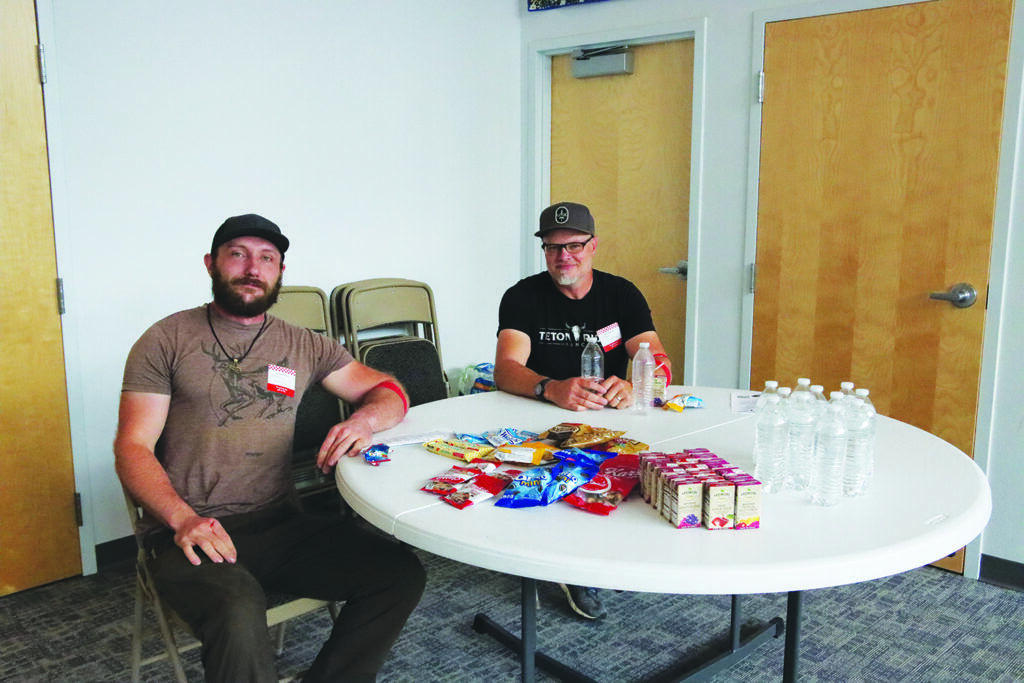
Zack Beresheim and Brent Cotton joke about vampires after giving blood. Photo by John Dowd.
Both kinds of donations are needed, but red blood cells, according to Montana Palen, the Mobile Blood Collection Specialist and drive lead for last week’s drive, red cells are by far the ones most used in blood transfers. The Power Red donations can only be done about every four months, and the process takes longer than a standard donation, about 30 to 40 minutes. To donate this way, a donor must be healthy and for women, must be over 150 pounds and 5-foot-5-inches tall. For men, they must be at least 130 pounds and 5-foot-3-inches or taller.
For all donations Palen said visits start with a physical exam and each donor must complete a “Rapid Pass.” This is a questionnaire that provides background information to vet those who can be allowed to give blood to the American Red Cross.
This all allows for information collection to add information to each sample of blood donated. This allows blood to get to the right place, as the blood can affect the person it is going to.
The checkup sees each donor’s blood pressure, hemoglobin count and pulse rate, among other things. Something Palen wanted to mention was that there is no longer a need for donors to get “pricked” for their hemoglobin count. Now, the American Red Cross uses a machine that fits onto a donor’s thumb, and non-invasively checks their hemoglobin count.
Palen added that they are always in need of donors and there is not currently a way to synthesize blood. According to the American Red Cross Team, the need is often higher in the summer, as there can be fewer donors giving. This is also true for the holidays. They also explained that blood does not last forever, and can have a very short shelf life. In the case of the red blood cells, they can be refrigerated for up to 40 days. However, standard blood, because of the platelets, can only last up to about five days. Blood also must be sent to a location to be processed before it can be given, so that eats into the lifespan in which it can be used, which is already a very tight window.
The state of Montana is also unique in that it produces a lot more blood than it uses, allowing it to send blood to other underserved areas.
For Palen, she said she loves what she does because she often hears the positivity that comes from donating
“People feel good, they say ‘I know that I’m helping people,’” said Palen, and she added she has “always wanted to help others,” and the values of the American Red Cross also align with her values.
For those interested in giving blood, the next few drives at the church will be on September 19, October 10 and November 7. Walk-ins are allowed, but they prefer to have people sign up ahead of time. They can do this on the American Red Cross website, where prospective donors can put in their zip code, and the site will bring up all the local drives. Drives can usually take only 40 people, so it can be a lot of help to register before to make sure a donor can give on the desired date.
These drives will often give out promotional things for donors, like free movie tickets, as was the case in last week’s drive. They also do t-shirts and sometimes enter people into drawings for bigger prizes.
The American Red Cross website is redcross.org, and finding the “Give Blood” landing page will allow a person to find local drives and schedules. Those interested in reaching out to the Stevensville United Methodist Church can call (406) 777-5443.