by John Dowd
Hamilton is the seat of Ravalli County, and home to the largest populated city in the Bitterroot Valley. The original town hall was built in 1906, and was the original location of the public library, fire hall and city governmental offices. More recently, the space was utilized by just the fire department, as the library and other government offices moved to different locations.
Last year, Hamilton opened the new fire hall, and since then the historic building at S. 3rd and State Streets has had an uncertain future. However, with work collectively from the city and the library, the space may be getting new life, and everything may be coming full circle, with city hall and the library ending up back in the building where they started.
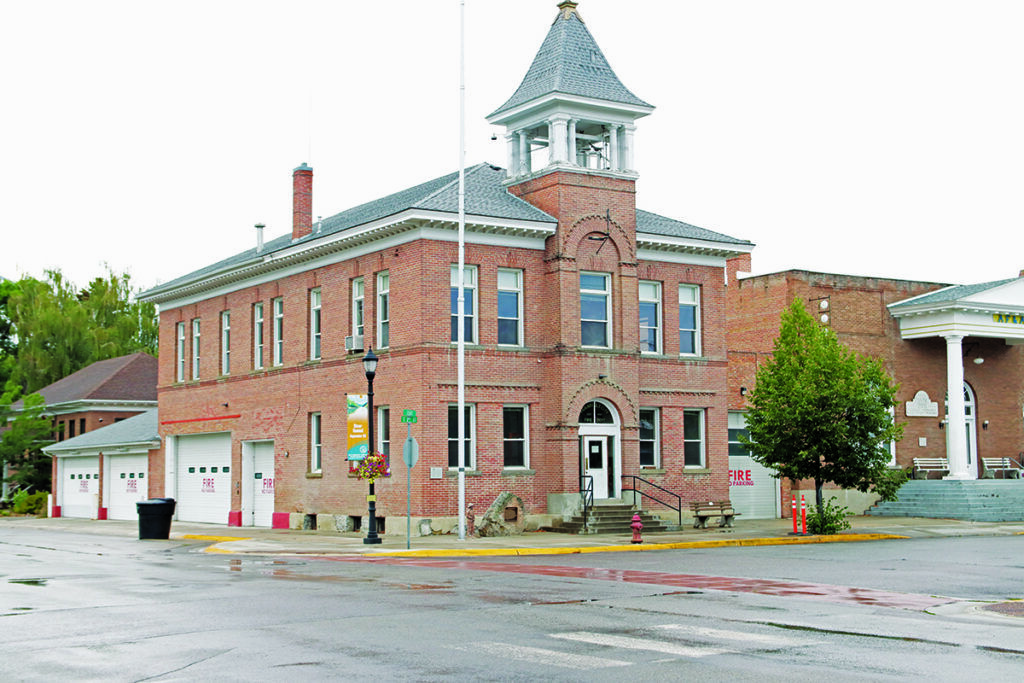
The historic building on the corner of S. 3rd and State Streets in Hamilton, now referred to as the Old Town Hall, was constructed in 1906. An ambitious plan is for Hamilton City Hall to eventually relocate back into the old building, along with an expanded Bitterroot Public Library. Photo by John Dowd.
Hamilton city planner Matthew Rohrbach, Bitterroot Public Library director Mark Wetherington, and Hamilton Mayor Dominic Farrenkopf have all been meeting to discuss the future of the space in a grand partnership project between the city and the library.
According to Farrenkopf, to get to this point there has been a lot of outreach, and good support. He said there has especially been a lot of support regarding including the library in the partnership. He noted that there has been a prolonged public engagement process during the whole ordeal.
According to Rohrbach, the steering committee selected was composed of “a lot of heads in the room,” from all across the community. The input they gathered was instrumental in directing the process.
The plan:
The partnership ultimately decided to do a few things. The first will be to move Hamilton City Hall back into what is referred to as the Old Town Hall building. They also want to construct a space, bridging the gap between the current Bitterroot Public Library and Old Town Hall. This will create more office space, and will allow the library to expand. This will replace the current vehicle bays on State Street that were added on for the Hamilton Fire Department.
“It’s kinda cool to see the buildings coming full circle and in public hands,” said Wetherington. As he explained, the Old Town Hall building was originally home to all three, the library, the fire department and town hall. The space also eventually added the Hamilton Police Department.
Over time, the library moved into its own building, the Hamilton Police Department and legal arms of the city moved into another new building and the city municipal government outgrew the space, and moved into its current building (the former Elks Lodge). The only one of the three original occupants to stay was the fire department until just recently.
The first step:
The first step in determining the future of the space was to determine the nature of the space, and if such a project could even be feasible. Through a Montana Department of Environmental Quality (DEQ) funded grant, the partnership was able to commission a Preliminary Architectural Review (PAR). This review took a lot of the feedback and ideas into consideration and took a deep dive into the property and buildings. The PAR assessed everything from existing conditions and statutory and code requirements to area growth and public needs.
The PAR helped the partnership get a grasp on the process, and they expect this to be a multi-year project.
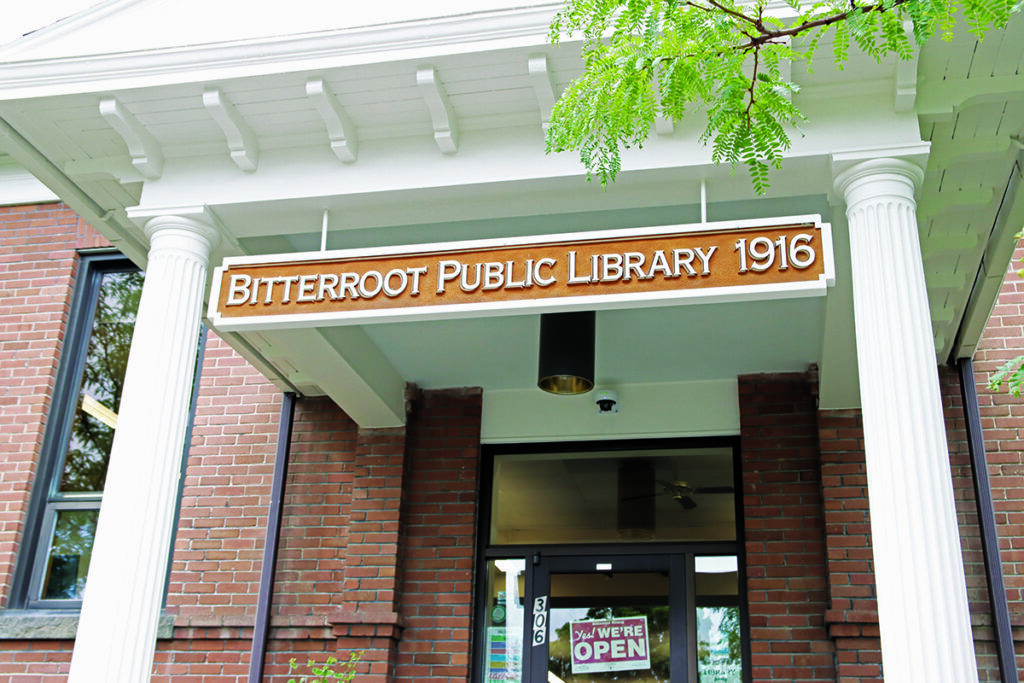
The Bitterroot Public Library may double in size, and the Hamilton CIty Hall may find itself again in its original home. Photo by John Dowd.
“The PAR was the high-level concept,” said Rohrbach. “The next part is where we try to parse out all the individual projects.”
Piecing out the individual projects, and deciding what those are even going to look like, as well as establishing a funding schedule for all those projects is going to be the next and ongoing stage for the partnership. Many of these projects will be stand-alone pieces that will need to have uniquely established funding. The PAR established that the total project will cost an estimated $21.5 million.
One of the leading things will be abatement for potential asbestos and lead paint. This project will be paid for by more Montana DEQ funding. They have also recently finished adding new windows, which were paid for by a Montana Historic Preservation Grant. However, there are some unique concerns facing the process that have made these, and future pieces, more complicated.
Concerns:
Both the Bitterroot Public Library and Old Town Hall buildings are listed on the National Historic Registry. Old Town Hall was built in 1906, and the library soon after, in 1916. “That means that, for the contractors working on these buildings, there are more complications,”said Wetherington. This means that the buildings, namely Old Town Hall, will need to be brought up to code. When these were built, there were not the same building codes there are today.
Additionally, Rohrbach highlighted how the project will also need to include plans to make the buildings more accessible. They will need to build an elevator, which will also need to navigate the fact that both buildings are at slightly different elevations. This means somehow, the elevator will need to land on floors corresponding to each structure. The addition of the elevator should also solve another problem, which is creating other forms of egress through the space.
The partners:
The project will be split between the two parties, with some overlapping projects. Each side will have different goals and complications.
On the library side, according to Wetherington, they are a municipal and county library, serving over 29,000 people. With a building layout spanning only about 12,000 square feet, they are woefully under-built. Wetherington stated that a rule of thumb for libraries is that they should be about one square foot for each capita they serve. “That’s our biggest limiting factor, space,” said Wetherington.
They already lease the space from the city, and this expansion could add about 10,000 square feet to the library’s usable space, almost doubling it. Wetherington hopes this would allow them to add more space for their children’s section and family meeting rooms, as well as more general storage for their collections. They could also add more study rooms and generally plan a better and more effective layout for community visitors.
Wetherington has been director of the Bitterroot Public Library since late 2014, and said this has always been a problem. “We’ve really been undersized for quite a while,” he said, but he said they have done their best to work with what they have had. Serving an estimated 250 people a day, on average, the library is in need of expansion.
Speaking on their funding, Wetherington said their part will come from their Bitterroot Public Library Foundation. The funding arm of the library has been raising money for such a project for the last 40 years, since the last expansion.
On the City of Hamilton side, Farrenkopf said they will need to fundraise, but will also be searching for grants for each part of the project.
“We’ll be chasing that grant money,” said Rohrbach, but he says people should also understand, “we’re in this for the long haul.”
“We’re thinking of it as an asset that we already own,” said Farrenkopf. “It’s needed anyway,” he said, speaking of things like abatement, so it is not a waste of money if any part of the project gets halted. However, they expect it to all be a great benefit to the community. Farrenkopf also wanted to remind people that, “it’s going to take time for this to happen.”
As for the joint projects, one they already know of is the elevator, as well as some of the demolition work. They also want to try to preserve the historic spirit of the space, especially the outside appearance. The partnership is working to retain as much of the original structure as possible. They have historic photos of the outside to help recreate the original landscaping. They are also trying to keep iconic visages, like the old staircase and the wood floor of the upstairs, which will be the council chambers.
“If we weren’t going to keep some historic aspect of the historic building, why keep the building?” added Farrenkopf
According to Rohrbach, after the engineers looked at it, they found that “that building is still in really good shape.” This bodes well for their potential projects. Other than some obvious things, wiring, etc, the structure is doing well.
Final thoughts:
According to Wetheringon, this project will have a lot of “complexity and nuance,” due to the many moving parts, and factors like the buildings being historic. However, he added, “It’s just great that what’s best for the library, will be good for the community as well… it’s cool that it will be a whole block that’s going to be community accessible.”
Rohrbach wanted to reemphasize that there has also been a lot of “future proofing” to address growth and future needs. They are planning for this to meet community needs for the next 50 years, according to Wetherington.
For Farrenkopf, he is excited to have all the city services in one building, and for everything to be more centralized. Currently, several municipal government services are spread across town. He said that is going to make a huge difference for everybody.
Parties looking for more information on the project and the status can look to the Bitterroot Public Library website, bitterrootpubliclibrary.org. A digital copy of the PAR is available on the city website, cityofhamilton.net, under PAR-Hamilton Town Hall Reuse Appendix. Flyers as well as ways to donate are available at both Hamilton City Hall and at the Bitterroot Public Library.