by Michael Howell
An application submitted by Network Connex, a wireless network designing and implementation company owned by ORIX Capital Partners, to install a cell phone tower on the mountainside west of Hamilton on property owned by Matthew and Lindsy Durling along Black Bear Lane has drawn a lot of opposition from neighboring landowners. The County Commissioners held a public hearing on April 11 to consider the proposal. That meeting was continued to a meeting held on June 3 in a room packed full of members of the public, mostly in opposition to the proposal.
The application for a wireless communication facility permit is being handled by Vertical Bridge, a telecommunications service provider located in Boca Raton, Florida, that specializes in site location and T-Mobile. T-Mobile is the brand name used by some of the mobile communications subsidiaries of the German telecommunications company Deutsche Telekom AG in the Czech Republic, Poland and the United States.
The Ravalli County Planning Department recommended granting the permit subject to a spacing exception in Ravalli County’s Wireless Communication Facility Ordinance No. 13. 2002. During the review process, it was identified that the proposed tower does not meet the ordinance’s requirements because the ordinance prohibits the placement of a new tower over 60 feet tall that is within 5,280 feet of the proposed tower. There is an existing tower located within that range further up the mountain at the Grubstake.
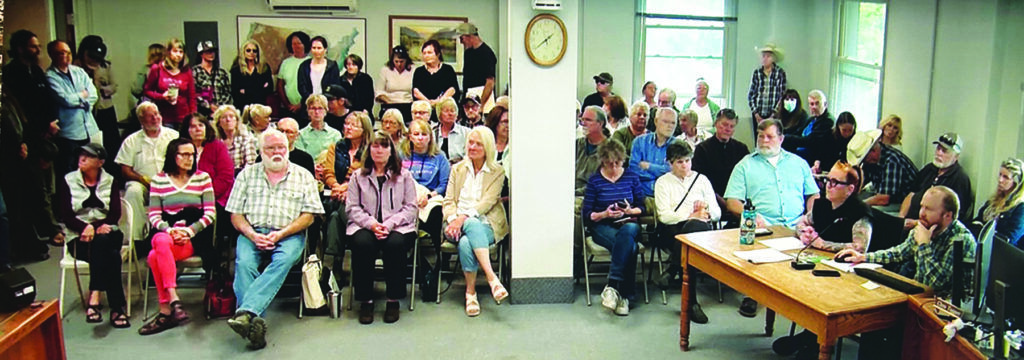
It was standing room only at a meeting of the Board of Ravalli County Commissioners on June 3 with most of the crowd in opposition to a proposed new cell tower to be located on the mountainside west of Hamilton. The Commissioners will make a final decision on July 30 at 1:30 p.m. All public comment for the record must be submitted by June 13 at 5 p.m.
However, the ordinance goes on to state that an exception to the spacing requirement may be allowed “only if co-location is scientifically proven to be unfeasible and where it can be demonstrated that a unique hardship exists to prevent compliance.”
The applicant submitted documentation that it claims justifies that co-location is not scientifically viable at the Grubstake Tower since it is “outside T-Mobile’s desired coverage area.” They claimed also to have “discussed available space considerations on alternative parcels, radio frequency objectives and lack of potential landlord interest.”
Based on its Tower Separation Variance Narrative, “the applicant feels that our review of the existing [Grubstake Tower] site shows its existing circumstances of high elevation, specific geospatial location and current appearance of structural condition and height present an undue hardship for the colocation and make it an unviable candidate for T-Mobile that would instead degrade the existing T-Mobile network in the Hamilton Montana area if it were utilized.”
Members of the public expressed concerns about the visual impact of the tower and its related impact on property values in the area; impacts on the local roads both public and private in the area. Another concern expressed was the fact that T-Mobile was already working with StarIink, a satellite-based internet service providing high speed service, that could in a short time render the cell towers obsolete. Concerns about radio frequency effects on people’s health was also brought up. Some complained about not being notified about the company’s use of a red balloon to judge the visual impacts from certain public roads, River Bend Park and the cemetery and expressed a desire to have the balloon test done again so that their view from their homes could be added to the record. Concerns about wildfire hazard were also expressed several times.
According to the county attorney’s office, the federal Telecommunications Act prohibits the state and local government from regulating the placement, construction and modification of a personal wireless service facility on the basis of the environmental effects of radio frequency emissions to the extent that they comply with the Commission’s regulations of those emissions.
In response to what the company heard from the public at the April meeting, at the June 3 continuance meeting Vertical Bridge presented a design for a “mono-pine” tower disguised to look like a pine tree rather than just a painted pole. They also agreed to put $10,000 towards road improvements on Owings Creek Road to mitigate their impact on the road during installation but offered nothing in terms of continued maintenance, saying they would only be using the roads in the area once a month to service the facility after that and didn’t consider it a significant impact. A representative of the company said that they had also done a balloon test on May 10 to help assess visual impacts.
At the June 3 hearing, many of the concerns expressed in April were reiterated and many were elaborated in more detail.
Local residents expressed dissatisfaction with the balloon test because it was only done at sites on public roads and a park and cemetery and not on any home sites that may actually be affected. Steve Lane gave a well documented presentation of how the viewshed at individual properties in the area would be affected, many considerably.
Addressing the many concerns expressed about property devaluation, Montana real estate broker Courtney Ferguson called it “a huge outstanding issue” that would have to be disclosed by anyone in the area attempting to sell their property.
One property owner, Sven Lovstrom, said that he was concerned about the devaluation of his property but taking all of the potentially affected property owners together, “we’re talking millions of dollars in personal property devaluation.”
Property owner Sharon Connolly noted that T-Mobile was not mentioned on the application, but that Vertical Bridge had expressed the intent to have multiple carriers on the tower. She said T-Mobile had expressed a need to address a gap in service and that was the only reason they were trying to put this within the one-mile variance.” She wondered if other carriers would be allowed.
“Good question,” said Commissioner Jeff Burrows.
Dan Griffin, who lives on Black Bear Road, noted that improvements on Owings Creek Road were not going to help mitigate anything on Black Bear Road.
One close property owner, former County Commission Administrator Glenda Wiles, stated that she was a bit confused about the variance request that was taking place. She said that the Wireless Communication Facility Ordinance was first passed in September 2000 and referred to a variance procedure. But then an Amended Ordinance No. 13 was adopted in August 2001 and the words “variance procedure” were taken out.
“So, under the current ordinance that Ravalli County has, how do you even have a variance procedure?” she asked. “The word ‘variance’ was used in the first ordinance, but it doesn’t describe how the variance was going to be applied or utilized and then it was removed in the first amendment, which now is the law, and ‘variance’ isn’t even in there. So, if there is no variance procedure, how is Vertical Bridge and T-Mobile even asking for a variance?”
She said that she and other landowners were told at the second hearing in November 2023 that the Commissioners were told by the County Attorney’s office that they could use the subdivision review process to address the variance.
But when she and other opponents who were interested in forming a Citizens Initiated Zoning District and discussed it with Planning Director Rob Livesay, she said they were told that the commissioners would be using the subdivision review process but not the subdivision criteria for a variance.
“If that’s the case,” said Wiles, “then the commissioners are going to use the Findings of Fact and Conclusions of Law to go about this [they asked] and the director said yes. So, what I want to know is, where are the Findings of Fact coming from? It’s not coming from an independent third party. It’s coming from Vertical Bridge. So, you are basing your decision on the seller of the product. If you are buying a house and you ask what might be wrong with it, you don’t ask the seller, you get an independent inspector to provide the facts. Have you had any independent examination of the facts being provided by Vertical Bridge?”
Other residents in the area also complained that it appeared the commissioners were going to base their decision not on “scientifically proven” evidence that the alternative site at Grubstake or on some other property was not feasible, but simply on the company’s claims that it is not feasible.
Sharon Connolly asked why no environmental assessment of the potential impacts had even been conducted.
Commissioner Dan Huls said he thought none was required.
Connally said it was an FCC requirement.
Commissioner Burrows said, “That would be a good question to ask,” and suggested that she submit it in writing.
Another person presented a lengthy list of precautions to protect against fire hazards at the facility that should also be required. Another gave a power point presentation about cell towers and wildfire risks and how serious the risk is.
Topping off the public comment, Commissioner Burrows noted that they had just received that morning a lengthy Memorandum of Opposition signed by 30 residents. He said, “it read like a legal brief” and said it presents a problem because they need to get a legal review of the document, but they were also working under a timeline imposed by federal regulations that had already been extended five times with permission from the applicant, and they were facing another deadline that very day.
“You can see the issue that we’re having here,” said Burrows. “This is not a popular vote on whether we get a cell tower or not… When we get this dropped on us the morning of making our decision, we need to get our attorney’s advice on how to proceed.” He said there were other legal issues as well to be considered concerning such things as road easements, fire risks, property values and more that need legal review.
The issue was resolved by getting the applicant to agree to one more extension and by placing a hard deadline of June 13 at 5 p.m. for accepting public comment for the record, after which no more public comment would be accepted. After that all parties will have an opportunity to review all the comments and submissions and a final public hearing will be held on July 30 at 1:30 p.m. to make a final decision.