by John Dowd
Sometimes, people who have not served in the military look at service through the lens of action movies and Hollywood. The problem with this view is that it is not only rarely the reality, but it also leaves out many elements that just cannot be portrayed on screen. Sometimes these things are emotional, and other times they are the suspense informed by a lot of historical context. Sometimes, it is about stories of flying glorified gas stations through the sky, and waiting around for the end of the world.
“We passed gas,” joked Ken Meppen, when asked what he did in the military. Meppen worked for Strategic Air Command (SAC) with the United States Air Force for most of his career, and much of it was spent flying air refueling tanker planes. These are massive planes that can carry a lot of weight, utilized to refuel other aircraft in the air.
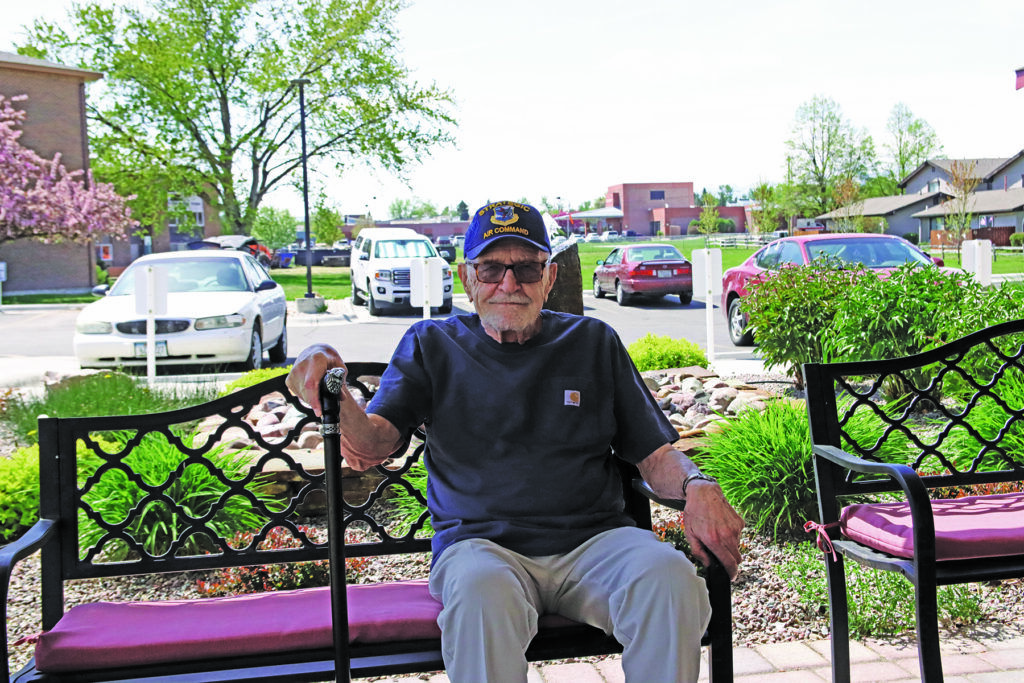
Ken Meppen sits outside Sapphire Lutheran Homes, in Hamilton. Photo by John Dowd.
Often, these included modified B-50 and B-24 bombers and later the KC-97 Stratofreighter. Meppen flew all of these, and finally the Boeing KC-135 Stratotanker, which is still used today.
At 95 years old, Meppen looked back at his service career, from 1953 when he became an officer, to when he retired in 1973. By the end of his career he had over 6,000 hours of flying time, and countless hours of waiting.
Originally from Idaho Falls, he attended the University of Idaho. During the Korean war, the U.S. Air Force was offering aviation cadet school for those with two years of college and these people could become officers, so that’s what Meppen did. Graduating flight school in the class of ‘55, he said that during his time in the U.S. Air Force he was lucky to always have flying jobs.
“I got in because I didn’t want to be sent to Korea,” said Meppen. He wanted a choice, or as much as a person could have in the military. However, not long after the conflict in Korea subsided, he was sent to Vietnam.
He was stationed at U-Tapao Royal Thai Navy Airfield for much of his time in Southeast Asia. While he was there, one of the things he did was fly sorties with the F-105 Thunderchiefs, over Thailand and Laos, to the border with North Vietnam. He would wait in the air as they went in to make their bombing runs.
Those F-105s were bomber-fighters, and had a reputation for confident and seasoned pilots. According to Meppen, the pilots were also a partying bunch, but he always revered those guys. He said he felt bad for them, because they had one of the most dangerous jobs in the air over Vietnam. According to Valiant Air Command, a museum that chiefly features war planes, out of 833 Thunderchiefs that were produced, 382 were lost in Vietnam. Meppen’s job was to refuel these fighters right before they would fly in to do their strikes, and he would rendezvous with them as they headed back out of Vietnam to refuel again and head home.
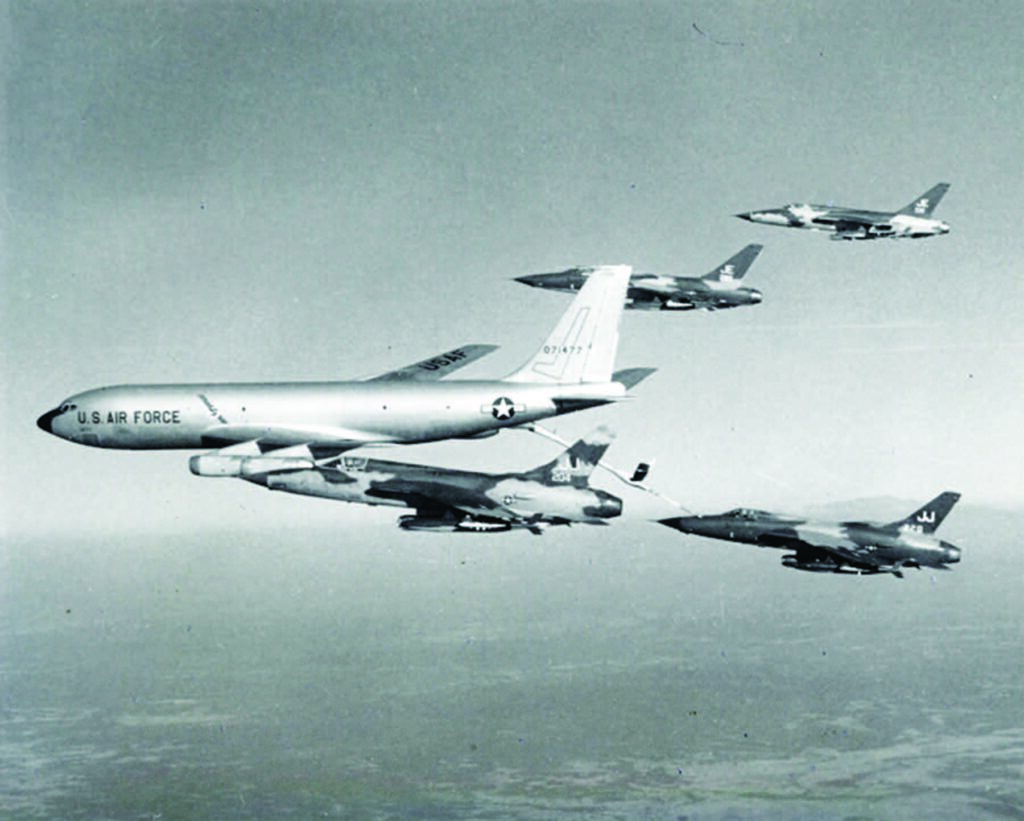
A KC-135 refuling F-105 Thunderchiefs during the Vietnam war. U.S. Air Force photo, courtesy National Museum of the United States Air Force.
Meppen spoke of the typhoons that would come through during the monsoon season, where it could become so dark a person couldn’t see out the windows. During one of these, two B-52 bombers, fully loaded with ordnance, collided mid-air off his right wing. He saw the blast and felt the concussion wave, but never was able to see them impact due to the poor visibility.
Later in his career, he spent a lot of his time in air bases during the Cuban Missile Crisis and the Cold War. Working for SAC, he was part of the response, in case the Soviet Union decided to retaliate. He remembers, during the crisis, an alarm blaze, sending them to load into their planes, ready to take off, waiting for an order that thankfully never came. If it had, he would have flown out to refuel planes as they started flying over to fight World War III, and potentially the nuclear destruction of Earth.
For the length of the Cold War, Meppen said there always had to be B-52s in the air, and those crews would often fly for 24 hours straight, and they needed to refuel in-air. On missions, he could often find himself in the air for around 16 hours at a time. “We like to say we won the Cold War,” said Meppen facetiously. Looking back, he said so much time was spent on alert, and playing cards, waiting for the call to come in to fly on a moment’s notice.
Eventually, the Cold War dropped further in temperature, and later, SAC was disestablished in 1992. Meppen retired before that. He sold real estate in Priest Lake, Idaho, for around 17 years, and after that, spent four years with his wife in Guam. She taught school while they were there, and he said he was a “house husband,” playing bridge and golf. In fact, now at Sapphire Lutheran Homes, in Hamilton, Meppen says the golf is what he misses most.
He and his wife liked Charleston, South Carolina, and they ended up moving there for 25 years. For him, it was about the year-round golf. While in South Carolina, he spent 13 years with National Car Rentals driving rental cars around, part time. He delivered cars to places like the Masters Tournament in Augusta, Georgia, and he got to drive some pretty nice cars.
He retired from everything at 80 years old. Speaking of his service, he said it was not a burden he carried alone. His family was stationed in northern Maine while he was in Spain for a time. While he was there enjoying the good weather, he said he felt bad that his wife was at home, shoveling snow. “Enough isn’t said for the wives and families,” Meppen said. Armed Forces families often need to be just as emotionally tough as their service members, often not knowing where they will be sent and unsure if their person will make it home every time they leave. “I don’t think they get the credit they deserve,” said Meppen.
Tracy says
Dad was Radio Operator in KC 97s during and after the Korean Affair. He loved that duty and had endless stories about the crew. Kept touch with many for the rest of their lives.