by John Dowd
For a lot of people today, electricity seems to be an assumption; something taken for granted. We have it whenever we walk into a building, in every store and every home. It is only when the power goes out, and a simple switch is not enough, that people often realize how integral it is to everyday life. For someone like Dan Kratofil, a lineman with Ravalli Electric Co-op (REC), in his more than four decades of experience, power has literally been a way of life. Keeping it on, that is.
Kratofil, who retired last week, has been working since the early 80s, doing his best to keep the electricity flowing. He has an intimate knowledge of the Bitterroot Valley system of power, having spent 34 years with REC. He also grew up in Hamilton, and will retire in the area. Looking forward to retiring, putting more time into the family farm and potentially traveling more, Kratofil said, “I’m never gonna have to worry about things to do.” However, leaving with him will be a wealth of experience that just cannot be replaced.

Long-time lineman, Dan Kratofil, who recently retired. Photo courtesy REC.
According to Melissa Greenwood, manager of communications with REC, “Throughout his career, he has played a crucial role in keeping the lights on for families and businesses across the Bitterroot Valley, often working long hours in challenging conditions to restore power during storms and outages. His dedication, skill, and commitment to our community have made a lasting impact.”
Kratofil worked on the 500 Line, back in the day, a major power line that runs through much of Montana, Idaho and Washington. He personally worked on the St. Regis to Taft section. He also worked six years in California and did a lot of climbing there, like what most people traditionally think of when they hear, “lineman.” Throughout his years, he has seen everything from planes and sailboats hit the power lines, to severe inclement weather and more.
With the REC, he was on-call for outages and often had to go out in that weather. He helped build new lines and maintained existing ones and for the last six years he was the “service man,” handling the service calls for REC. With an area that covers from the top of Lost Trail Pass to the edge of Florence, it could be quite a responsibility and it could take him quite a while to show up for calls, which he could receive at all hours of the day.
One of the most important elements of experience leaving with Kratofil, which will be hard for new linemen to recreate, is the sheer depth of understanding he had of the system. He explained that, in the old days especially, linemen had to understand every aspect of the system. According to Kratofil, now they use smart phones and tablets.
Years ago, calls would come over a landline and would be connected directly to a two-way radio, carried by the lineman. These radios were essentially powerful walkie-talkies. This caused confusion because often the caller did not realize it was a two-way radio they were communicating with and that the on-call lineman could not hear at the same time he was speaking, because he was depressing the push-to-talk button.
Unlike other places, the REC in Ravalli County did not have a dispatch, so Kratofil would try to get a person’s number and call them back on a landline, if he could get to one. However, during big outages, he would be out somewhere, nowhere near any landline phone. During these times, he was also probably getting several calls at the same time for the same outage.
In those days they also had paper binders with “map books” that were re-printed every year. These map books would show the system and linemen had to manually look up addresses and connect them to a location on their system maps. Now, the system is displayed live, and with smart systems, the digital map displays outages as they happen, and almost exactly where to go. “Now,” said Kratofil, “we live off our tablets and our phones.” They get alerts, sometimes before the customer even knows they have an outage. The linemen can also see all the meter locations and can very quickly determine if the problem is on their side, and by process of elimination, relatively quickly figure out where the problem is.
However, for Kratofil, the old ways meant a lineman knew exactly how the system worked and understood its layout by heart. He will be retiring with that intimate knowledge that just cannot be recreated without years of experience in that kind of environment. He is worried about new linemen getting into the field, saying, “When their tablet goes down… what are they going to do?” His fall back was that he still would have an idea of where to go without the aid of the technology.
He spoke about his job, saying that a lineman often looks like an investigator, using a process of elimination and observation to find the problem. That critical thinking is important, and experience plays a crucial role. He has often had to use his skills of deduction to find the cause. “People always wanna know what happened,” said Kratofil, and having done it for so long, he said, “you see things other people don’t see.”
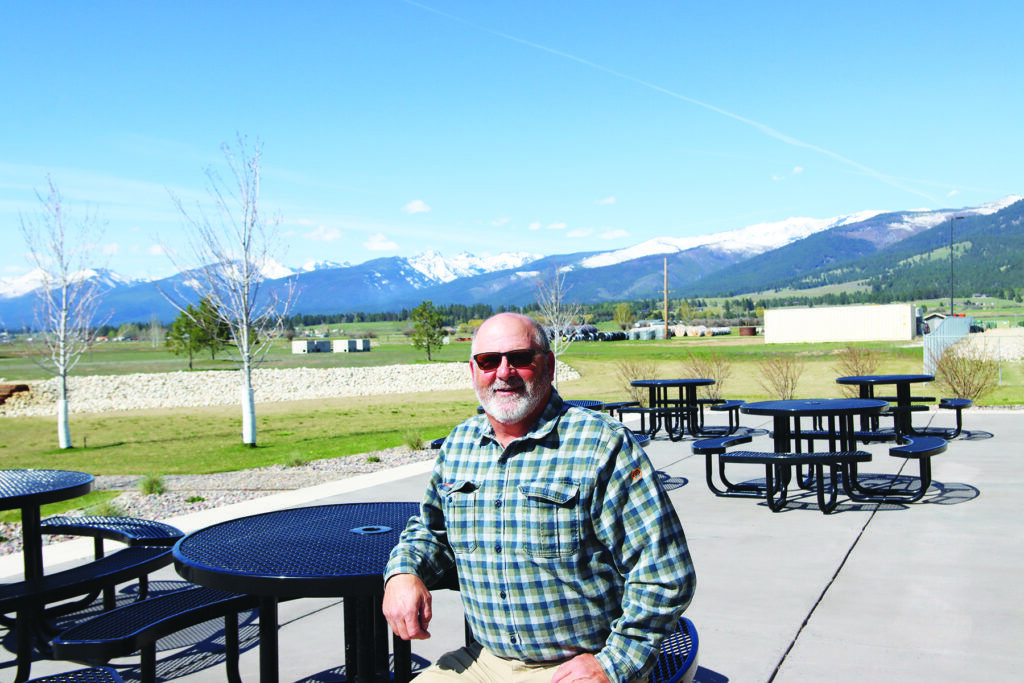
Dan Kratofil sits outside REC on his last day. Photo by John Dowd.
These days they also have much stricter fire mitigation protocols, and linemen are often having to check the lines all the way around the outage before they can turn power back on, to prevent further damage and fire hazards. For him, these things seem important, but for a customer, it can be frustrating.
He said the procedures are critical, as the job can be extremely dangerous. He mentioned some people may see what they are doing and think it is a lot of redundant steps. Kratofil said, “That redundancy saves you from making a mistake. Electricity is not very forgiving.” He also said, “Always assume the line is hot,” even if a person thinks they know what kind of line it is. He explained that things have changed so much and so often that it can be hard to tell anymore what kind of line a person is dealing with. He said a person is better off staying away, and keeping others away, if the line is in a place where others could come in contact with it.
During outages, Kratofil has spent a lot of time out in inclement weather. During those times, a lot of people will call and can chat for a long time. According to him, he is out there to do a job, and it can be dangerous; he can’t spend a lot of time on the phone chatting. “I’m not calling you because I need ketchup,” said Kratofil. Additionally, he has noticed that these days people are more concerned with getting their power on immediately.
With some people moving here from out of state, sometimes there are people who may not be used to living in the country. Looking back, there were a lot of remote cabins that had some power. Those people, according to Kratofil, might have called and been nonchalant about having their power turned back on. These days, with a new and different generation living in and purchasing those homes, he has noticed a lot more concern about timeliness. But he wanted to remind people, it takes as long as it takes to do things right.
However, all in all, he enjoyed his career. Throughout his time, he met a lot of people, and for someone who enjoys the outdoors it allowed him to work all seasons and be outside. Though things are drastically changing in the field, both for better and worse, Kratofil said. But he said it is a great career. He hopes more people get into it, and that they can benefit from all of the experience and valuable knowledge of older linemen like himself.