by Michael Howell
Two weeks ago, the Bitterroot Star published a story containing a number of questions that were going unanswered by anyone locally on the Bitterroot National Forest including local and regional Public Affairs Officers and a local District Ranger. All parties said they were hesitant to provide any immediate answers until the questions and answers had been “vetted” in order to ensure that the answers were accurate. The list included questions concerning the status of the Gold Butterfly Project, the Eastside Forest Habitat Project, any information about the Forest Service’s multi-year monitoring for wolverines or about recent sightings of wolverines, and information about the firing and re-hiring of Forest Service personnel. All parties contacted said that they would “get back” with some answers. But to date no one has replied except a “USDA Spokesperson from the National Press Team, Office of Communication, National Press Desk.”
In its response the USDA justified the firing by blaming the Biden administration for having hired thousands of people with no plan in place to pay them and assures us that “Secretary Rollins is committed to preserving essential safety positions and will ensure that critical services remain uninterrupted,” emphasizing that “To be clear, none of these individuals were operational firefighters.”
But as Sam Forstag, Vice President of the Forest Service Council of the National Federation of Federal Employees Local 60, has pointed out, “While the employees targeted in the illegal firings that began on Valentine’s Day were not ‘primary fire,’ many of those employees contribute to firefighting directly and indirectly.”
“On large fire Incident Management Teams, a majority of the organizational chart are often non-operational positions – Logistics, Planning (ordering/managing resources), Finance, etc. Many of those positions are filled by Forest Service employees who are not in primary fire positions but fill crucial roles throughout the fire season. Incident Management Teams were already short-staffed in recent years because of issues around recruitment and pay, and the illegal terminations only exacerbate those issues.”
Forstag goes on to state that, “many non-primary fire positions are the people who serve on militia crews for local fires to help suppress them before they get too big and keep the overall size and cost of incidents down. These people, too, are the ones being swept up in the chaos of firings, rehiring, paid leave, and contradictory communications over the past two months.”
While the USDA has not been forthcoming about the number of non-bargaining unit employees (BUEs) affected by the attempted probationary firings, Forstag offers us the numbers for the BUEs who were affected in Region 1 in Montana: 284. Of those people, 85% were GS6 or below, typically making less than $20/hour. 75% were GS5 and below. One person illegally fired under the guise of efficiency was a GS2, making less than $12/hour.
“These haphazard firings are affecting the lowest paid people. These are often the people in the field, swinging tools, trying to get by, and serving as public land stewards,” states Forstag.
While the Trump administration, following two adverse rulings from two different federal judges, began the process of “reinstating” the illegally fired employees, at the same time it ramped up its efforts to implement a “Reduction in Force” (RIF) to eliminate the jobs instead, not only in the USDA but in pretty much every federal agency across the board.
Aside from the RIFs the administration has also enacted federal funding freezes that are affecting not only federal agencies, but non-profit organizations, private contractors, and businesses of every sort.
To get a picture of the broader potential impacts to Montana, the Montana Nonprofit Association, in partnership with Montana funders and Headwaters Economics, recently published a white paper entitled “Potential Impacts of Federal Cuts to Montanans & Montana’s Economy,” detailing all federal funding that moves into Montana and where it goes.
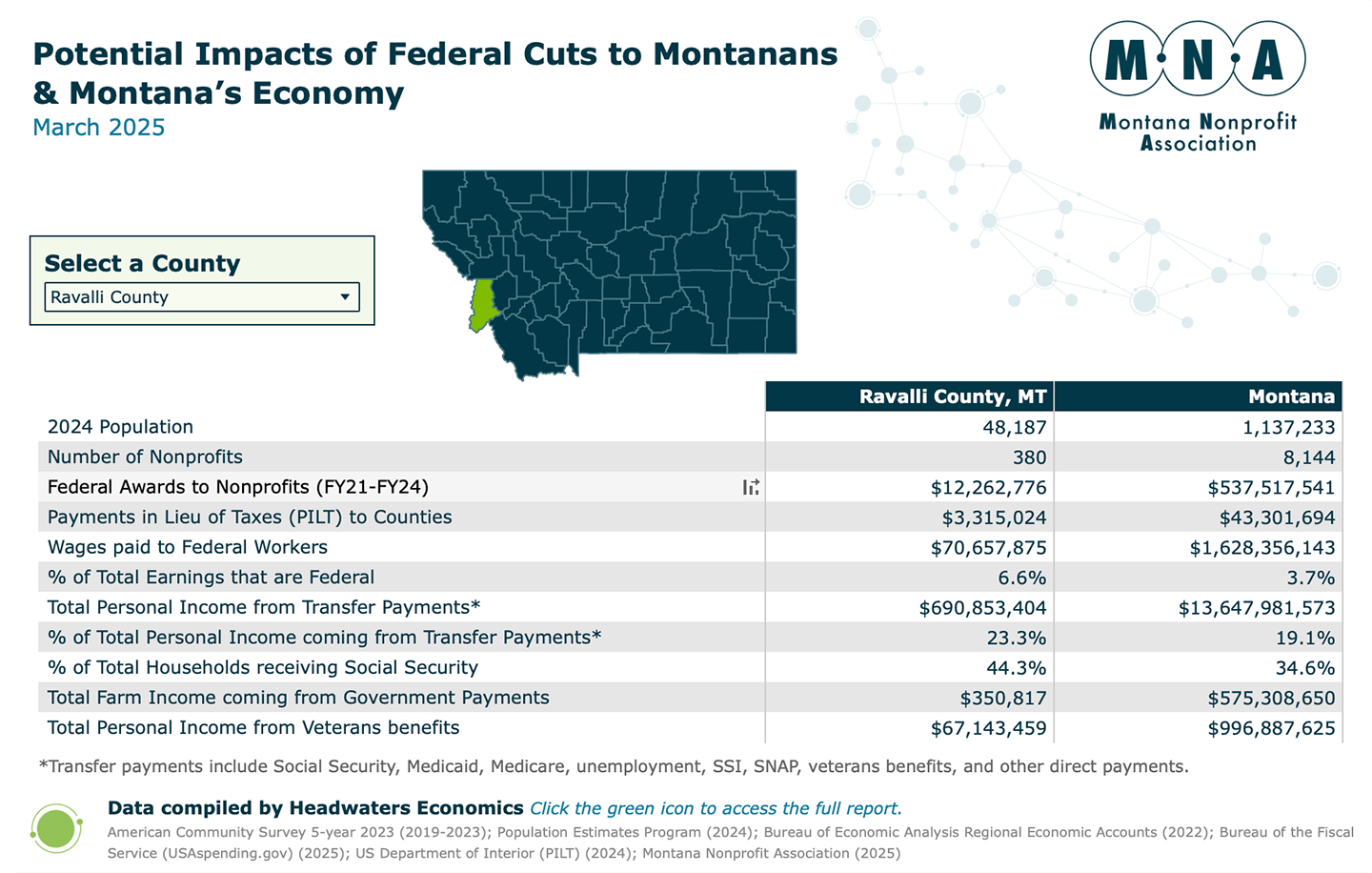
The report underscores the potential consequences of federal cuts, not just to nonprofit organizations, but across all sectors that receive federal funding. Federal funding is a cornerstone of Montana’s economy, contributing over $14.1 billion in obligated funds in FY 2024 to state and local governments, utilities, businesses, schools, and individuals. This includes more than $440 million per month in Social Security benefits to individuals, $4.32 billion to state government (43% of total state revenue), $1.6 billion in wages paid to federal workers in Montana, more than $360 million paid to local governments, and more than $500 million in agriculture subsidies.
“Even micro-reductions to these funds would have devastating impacts across Montana, especially to the state’s most rural areas,” states the report.
According to the report, Montana’s nonprofit sector is the state’s third largest employer, accounting for 11.8% of jobs (60,181) and over $3.6 billion in annual wages. Montana nonprofits have received an average of $134.4 million/year in new obligated federal contracts, grants, awards, and loans over the last four fiscal years. More than half of this funding comes from six federal subagencies: the Forest Service, Environmental Protection Agency, Agricultural Marketing Service, Small Business Administration, Substance Abuse and Mental Health Services Administration, and Administration for Children and Families.
The nonprofit sector makes up an even greater share of the economy in many rural counties. In Deer Lodge County, one in five jobs is in the nonprofit sector, while in Valley County, nonprofits account for 23% of total annual wages.
According to a recent survey done by the Bitterroot Chamber of Commerce of businesses, nonprofits and organizations, 42% of the survey respondents reported being impacted by the federal funding freeze, 20% were uncertain and 36% hadn’t yet been affected. Over half of those who reported being affected said they experienced a reduction in federal grants and contracts. About 40% said they had lost revenue.
According to the MNA report, federal employment is a critical part of Montana’s workforce, employing 13,279 Montanans and contributing over $1.6 billion in earnings. The majority (62%) of Montana’s federal employees work in rural areas where job losses would have deep and lasting consequences.
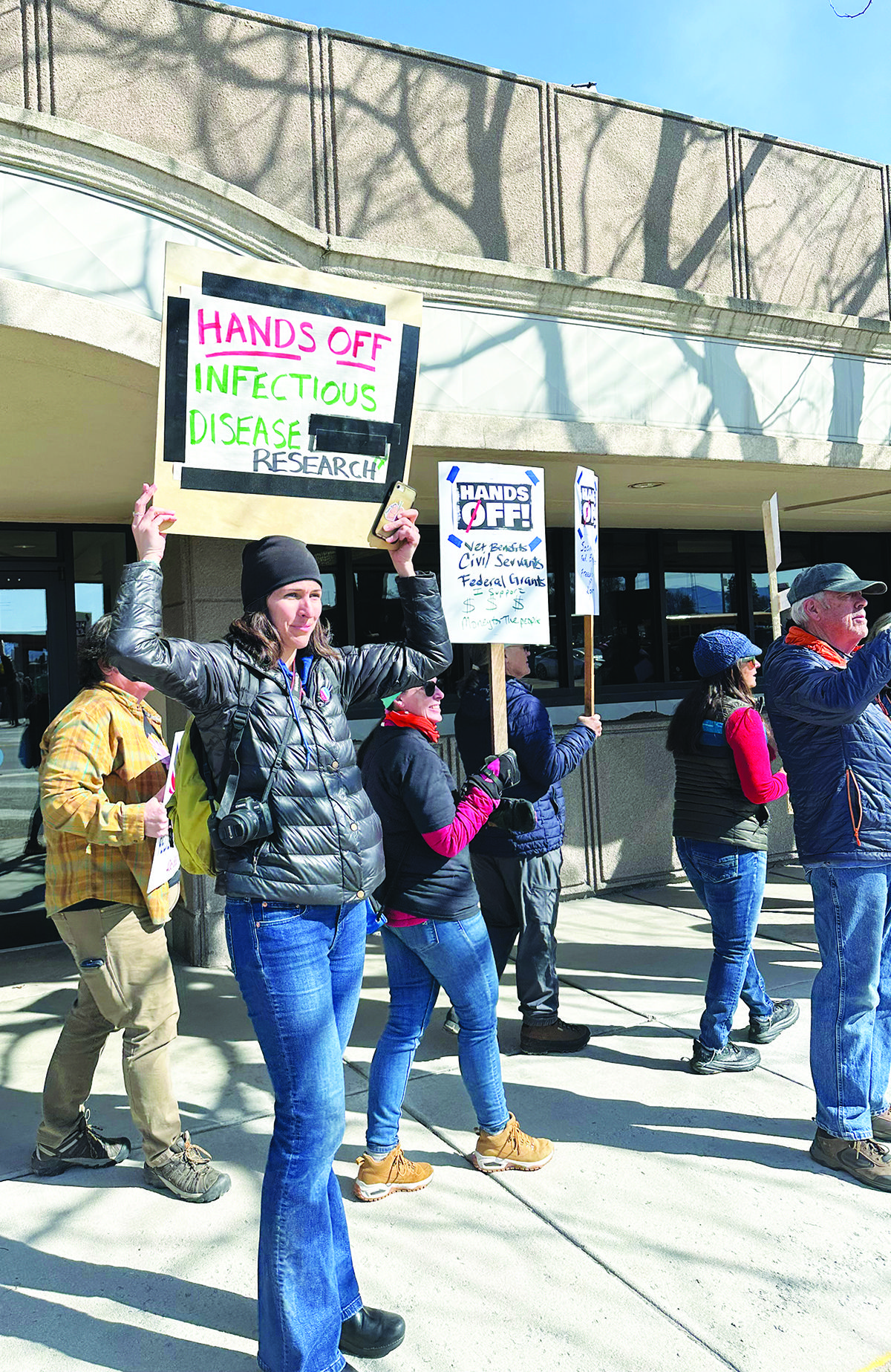
“Job cuts to federal employment create cascading economic impacts. A reduced federal workforce leads to lower household spending, impacting local businesses such as restaurants, grocery stores, childcare providers, and service industries,” states the report.
Recent cuts in the workforce at Rocky Mountain Laboratories will certainly have a major impact on Ravalli County’s economy. A report published by the Montana Bureau of Business and Economic Research found that RML was responsible for creating 1,498 permanent, year-round jobs across a majority of important industries around the state; has drawn in 1,938 additional residents to the state; and generated $105.1 million in income of which $89.2 million is after-tax income; as well as $231.8 million in additional economic output received by Montana business and non-business organizations each year.
About a dozen employees at the lab lost their jobs in February and last week another two dozen layoffs were announced.
TRACY says
HANDS OFF OUR TAX DOLLARS
Tracy says
The US taxpayer should not be responsible for keeping NPOs operating. Why are WE funding any of them.