The type of tick most commonly known to carry the bacterium that causes Lyme disease has been identified in eastern Montana, according to new National Institutes of Health (NIH) research. The tick—Ixodes scapularis, also known as the deer tick or blacklegged tick—is typically found on the East Coast and Midwest but over many decades has gradually migrated farther west.
With help from pheasant hunters and Montana State University, researchers at NIH’s Rocky Mountain Laboratories (RML) in Hamilton confirmed the tick species by analyzing and mapping its DNA. Their work is published in Emerging Infectious Diseases. RML is part of the NIH’s National Institute of Allergy and Infectious Diseases.
Bird hunters from Gallatin County found the tick in October 2023 on a dog used to flush pheasants during a hunt in Dawson County. The hunters gave the tick to the Schutter Diagnostic Laboratory at MSU for identification, and the MSU staff provided the tick to RML for genomic sequencing.
Blacklegged ticks can carry several different pathogens that infect people but are best known as the primary vector of Borrelia burgdorferi bacteria, which causes Lyme disease. B burgdorferi was first identified at RML in 1982 and is named after medical entomologist Willy Burgdorfer, one of the scientists credited with its discovery.
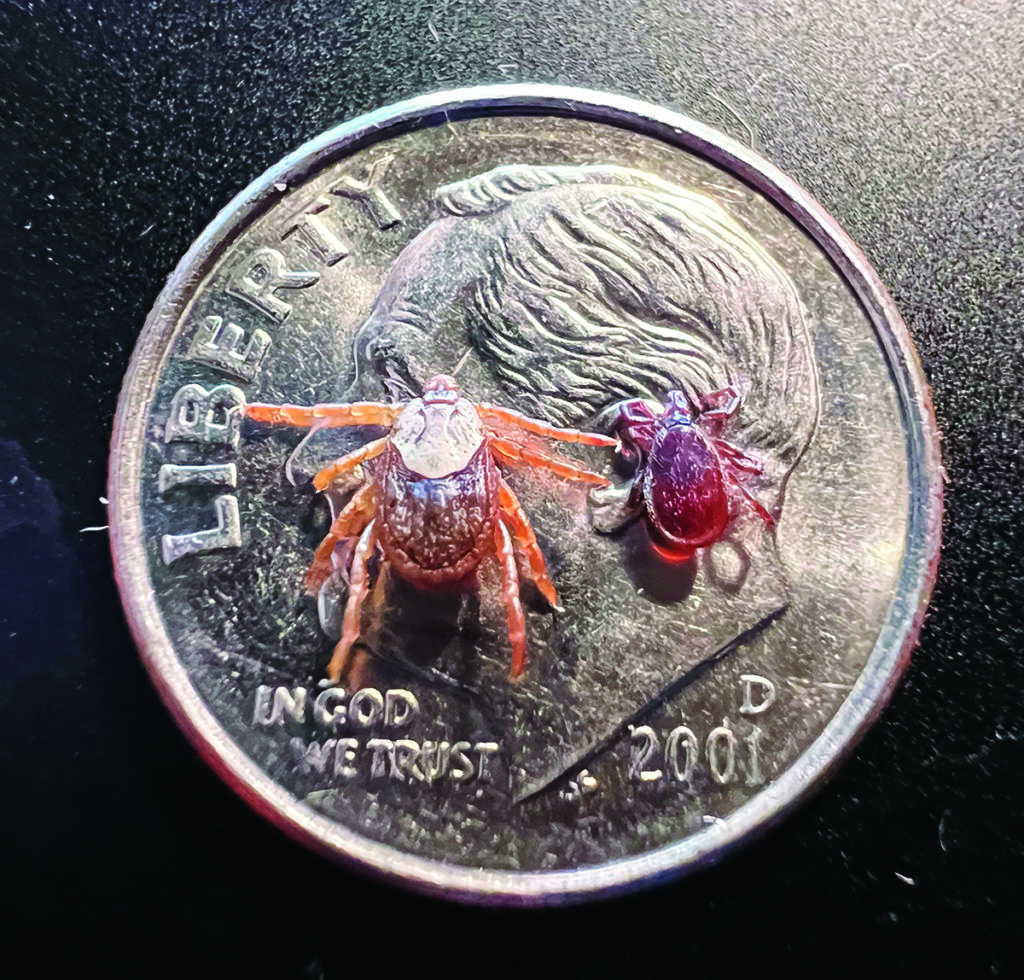
On the left is the common wood tick (Dermacentor andersoni) found throughout Montana that can transmit organisms causing Rocky Mountain spotted fever and Colorado tick fever. On the right is the tick that can transmit the organism that causes Lyme disease (Ixodes scapularis). Both ticks are adult females. Credit: Tom Schwan.
Lyme disease was first recognized in the mid-1970s near Lyme, Connecticut. It is now the most common vector-borne infectious disease in the United States with 63,000 cases confirmed in the U.S. in 2022, but with several hundred thousand more suspected cases.
Typical symptoms include fever, headache, fatigue, and a characteristic skin rash called erythema migrans. If left untreated, infection can spread to joints, the heart, and the nervous system.
Montana physicians have diagnosed resident patients with Lyme disease, but in nearly every case they had been bitten outside the state, and until now, the I. scapularis species hadn’t been confirmed in the state. The confirmation does not mean that Montanans are at increased risk of the various tickborne diseases that I. scapularis spread. Rather, the finding indicates the need for additional tick surveillance and public awareness to fully assess the risk.