by Michael Howell
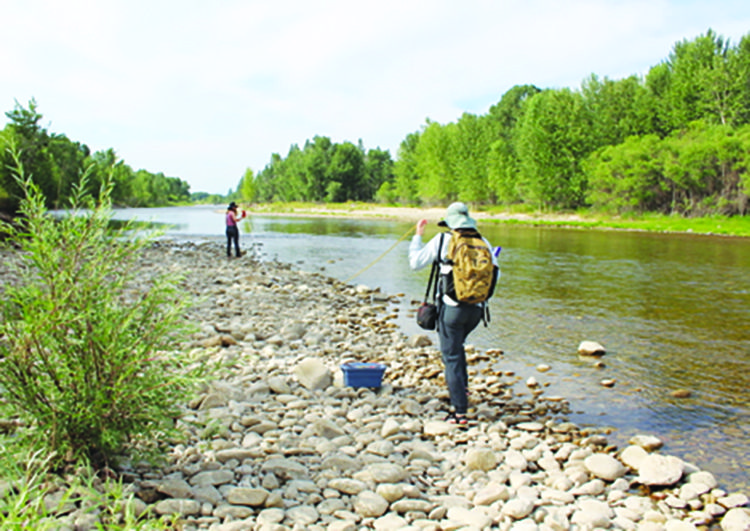
Montana Department of Environmental Quality personnel were in Ravalli County last week sampling algae in the Bitterroot River. The algae sampling is part of the ongoing long-term trend monitoring for nutrients in the river that was begun in 2019.
Nutrient monitoring began in earnest in the Clark Fork River basin – which includes both the Bitterroot and the Blackfoot rivers – in the 1990s when Congress established the Tri-State Water Quality Council to get a handle on the severe pollution problems accumulating in Lake Pend Oreille. As part of that effort, a long-term nutrient monitoring program was instituted in Montana that covered the Clark Fork Basin. Nutrient levels were monitored on the mainstem of the Bitterroot River from 1990 to 2000 as part of that program. When Congressional control was relinquished to the individual states involved, the monitoring program in the Clark Fork Basin was reduced and the contributions of the Bitterroot River were reduced to measuring the nutrient levels in the Bitterroot River to a single point where it flows into the into the Clark Fork River at Maclay Bridge in Missoula.
This scenario remained the status quo until 2017 when the Bitterroot River Protection Association expressed an interest in resuming long term nutrient monitoring in the Bitteroot. BRPA worked with DEQ in 2017 in a pilot program funded for only one year monitoring three sites at the top, middle and bottom of the mainstem. The following year BRPA continued the monitoring on its own while DEQ hatched a plan. That plan, the Bitterroot River Mainstem Long Term Water Quality Monitoring Plan 2019-2039, was adopted and funded for the first 10 years, with a renewable option. BRPA turned to the community for support and organized a collective of organizations, individuals and agencies, called the Bitterroot River Health Check program to continue the monitoring, which was expanded to include six sites along the mainstem from the confluence of the East and West Forks to its junction with the Clark Fork River.
Besides collecting data on general parameters such as temperature, pH, dissolved oxygen and turbidity, and taking water samples for laboratory analysis to determine the nutrient content, the plan also includes sampling for algae.
Excess nutrients in the water can lead to algae growth which can have negative impacts on aquatic life as it gobbles up the oxygen in the water, starving fish and other aquatic creatures of the oxygen they need for survival. While nutrients in the water are essential for aquatic life they become detrimental when there is too much in the system and it becomes overloaded with algae. Thick algae blooms reduce the recreational values of the water for swimming and floating as well. In worse case scenarios they can turn toxic.
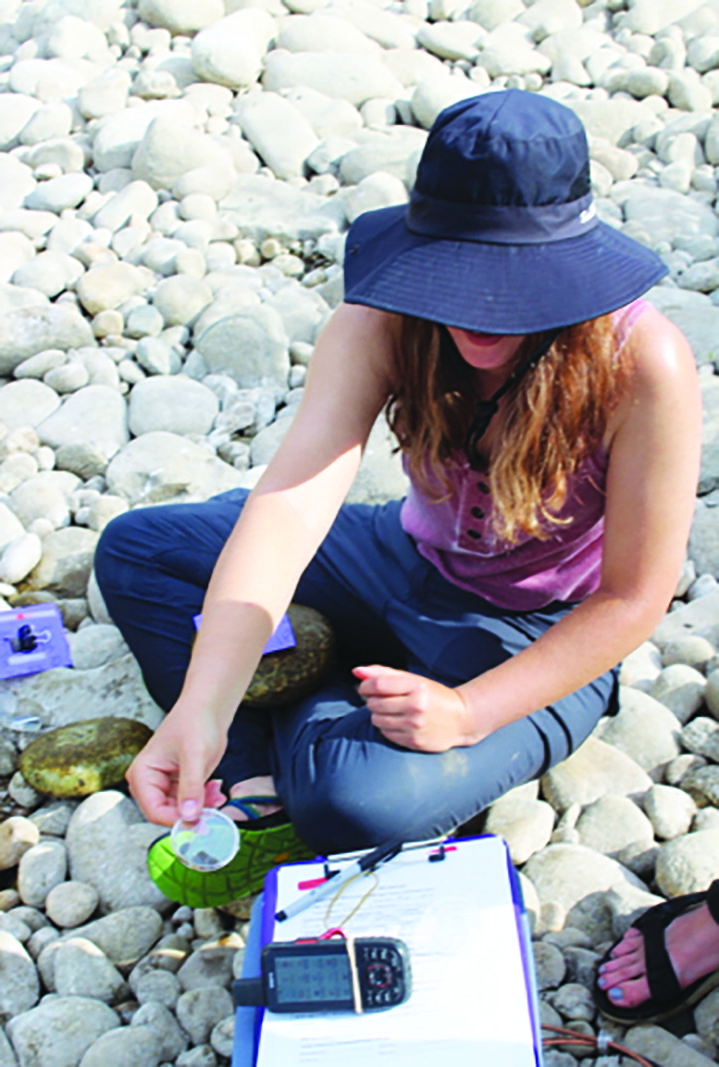
To track algae growth in the river, DEQ has adopted the methods developed by Dr. Vicki Watson at the University of Montana Watershed Health Clinic and works with local volunteers. Three sections of the river at each site are selected for sampling and measured off. The percentage of the area covered by algae is estimated and brick-sized stones are collected from the river bottom at a depth of about mid-calf. A template with a square hole cut out of it is placed over the stone and the algae is scraped off and placed in a petri dish. The dry-ash weight is then determined on laboratory scales.
According to DEQ water quality specialist Darrin Kron, there are some other significant factors at play in algae growth besides excess nutrients. One of those is the depth of the water. If the river bottom is too deep, not enough sunlight can reach the rocks and algae growth is inhibited. Warmer water temperatures can also spur algae growth.
“It is not simply a function of nutrient quantities in the water,” said Kron. “There are these other factors at play that may be contributing to the situation or ameliorating it. But high nutrient content is certainly a key variable.”
It takes five years of data to establish a trend, either increasing or decreasing, in the amount of nutrients in a stream. With the monitoring plan in its fourth year, a trend analysis may be available by the end of 2023.
According to DEQ water quality specialist Gabrielle Metzner, the good news about the Bitterroot River is that the nutrient levels in the river measured over the last few years indicate that it is on the whole below the nutrient levels associated with critical quality impairments. She said DEQ’s Bitterroot River Protection Plan is designed to keep it that way.
“Once the amount of nutrients in the water reaches harmful levels it is a difficult thing to reverse,” said Metzner. “So, our aim is to keep the Bitterroot River as clean as it is today or even better.”