By Michael Howell
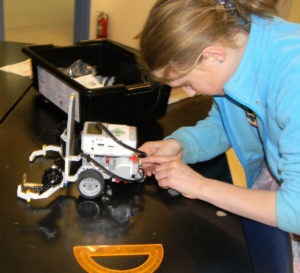
Lone Rock School science teacher Rich Montoya is excited about the new robotics class that has been initiated at the Middle School. The class is designed not only to impart knowledge in the fields of science, technology, engineering and math, but also to engage the students in hands on development, creative problem solving and innovative thinking.
The U.S. Department of Education believes that the United States has developed as a global leader, in large part, through the genius and hard work of its scientists, engineers, and innovators. In a world that’s becoming increasingly complex, where success is driven not only by what you know, but by what you can do with what you know, it’s more important than ever for our youth to be equipped with the knowledge and skills to solve tough problems, gather and evaluate evidence, and make sense of information. These are the types of skills that students learn by studying science, technology, engineering, and math—subjects collectively known as STEM.
President Obama has articulated a clear priority for STEM education: within a decade, American students must “move from the middle to the top of the pack in science and math.” The Obama administration also is working toward the goal of fairness between places, where an equitable distribution of quality STEM learning opportunities and talented teachers can ensure that all students have the chance to study and be inspired by science, technology, engineering, and math—and have the chance to reach their full potential. A priority has been set of increasing the number of students and teachers who are proficient in these vital fields.
The Committee on STEM Education, comprised of 13 agencies, is facilitating a cohesive national strategy, with new and repurposed funds, to increase the impact of federal investments in STEM education. Improving STEM instruction in preschool through 12th grade is one of the five areas in which this funding is available.
Working with parent Maureen McGraw, Montoya has been able to pull together enough funding to get the class up and running. But the federal grant programs are not providing the funding that would allow the kind of program development that Montoya visualizes. He believes that private funding is going to be required.
While Montoya characterizes the difficulty of integrating private funding into a public school program as a “logistical nightmare for the administration,” he sees it as a necessity for the full development of a STEM program at Lone Rock.
Some success along those lines was achieved when Shawn Shea of Morrison-Maierle, a regional multi-disciplinary firm specializing in engineering, surveying, planning, and science, donated five laptop computers to the program.” Great Western Engineering, of Helena, has also donated to the program.
A GoFundMe site on the internet is also being set up to accept donations to the program.
“We are looking for community support,” said Montoya, “and no donation is too small.”
Montoya’s robotics class is for 6th to 8th grade students but he hopes to expand the program into a high school level engineering class.
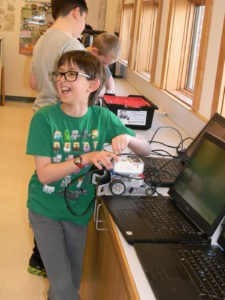
Right now the students sweep up and test out their experimental robotic creations on the classroom floor. Montoya is hoping to draw in enough funds to change that to a tabletop testing area. He also looks forward to getting some computer stations set up in the classroom so that students don’t have to stand at a counter to work on their computers.
Besides picking up a lot of scientific, technological, engineering and mathematical knowledge and skills, the program helps students develop computer skills, analytical thinking and creative problem solving.
The class allows students to develop and work on their own individual projects, encouraging individual approaches. But it also fosters cooperation between the students at the same time by focusing on the advantages of collaboration, communication and “graceful competition” amongst the students in the process.
Montoya is trying to get information about the program out to the community. He said a blog site was being set up and information was going out in a local newsletter.
“We are trying to grow community understanding and support for the program,” said Montoya. “Without money we have nothing.”
Rachel says
It’s great to see small rural towns on the move upward. In STEM education. Kids are so fortunate to have brilliant and motivated teachers like Mr. Montoya and Team.